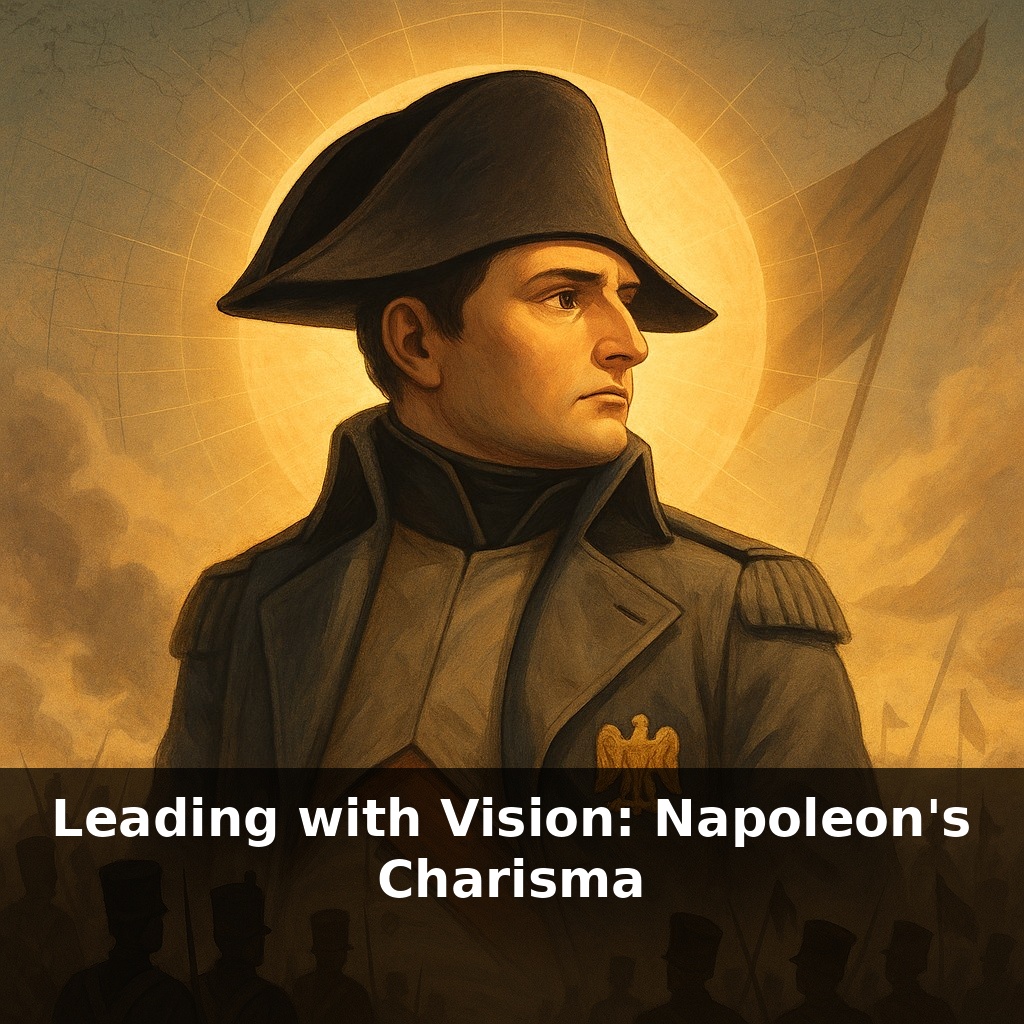
In a crowded battlefield, a single figure commands attention—not with his stature, but with the sheer force of presence. Napoleon Bonaparte, a man who reshaped empires and expectations alike, wielded charisma as his truest weapon. Why did tens of thousands follow him into brutal winters and near-certain defeat, convinced they were part of something greater?
Napoleon’s real advantage wasn’t artillery or tactics; it was the story he convinced people they were living inside. While other rulers clung to old bloodlines, he pointed to a different horizon: a world where talent, not birth, decided how high you could rise. To a farmer’s son suddenly wearing an officer’s sash, that wasn’t theory—that was proof.
His genius was to turn cold strategy into human drama. Campaign orders arrived wrapped in language that made each regiment feel like the crucial note in a larger symphony, not just bodies on a map. Defeats became “necessary storms” on the way to clear skies, not final judgments. In this episode, we’ll break down how he used vision as a daily management tool—not just a speech—so you can translate distant goals into something your team can feel in the room, today.
Napoleon didn’t just rely on stirring words; he wired his vision into the system. Conscription turned abstract ideals into enlistment papers and marching orders. Promotion lists became quiet revolutions, as men from modest backgrounds found themselves vaulted upward. Even legal reforms like the Civil Code encoded his worldview into contracts, courts, and classrooms. Think of it like planting a forest: you don’t just describe the future shade—you choose which seeds to plant, where, and how densely. The result is that long after the speeches fade, the landscape itself keeps pulling people in the same direction.
Napoleon’s real leverage came from how obsessively he synchronized words, symbols, and rewards so they all pulled in the same direction.
Start with how he showed up. On campaign, he walked the lines, called veterans by name, asked about families, and inspected equipment himself. That wasn’t sentimentality; it was calibration. Each interaction gave him data: morale, rumors, frustrations. Then his Bulletins of the Grand Army echoed back what he’d heard—praising specific units, correcting distorted stories, and knitting scattered experiences into one shared narrative.
He also understood the power of concrete milestones. Before major operations, he didn’t just say, “We will win.” He outlined steps: cities to take, rivers to cross, dates to beat the odds. Afterward, he tied promotions, medals, and public ceremonies to those steps, so people could literally see the vision turning into reality. When a sergeant received a medal in front of his regiment, it broadcast a simple message: “This is what our future looks like—and this is who belongs in it.”
Crucially, he made the vision personally legible. Officers weren’t only told about “France” or “Europe”; they were handed maps, briefings, and clear intent. Subordinates were empowered to act without waiting for new directives, as long as they served that intent. That blend of clarity and autonomy let his armies move faster and improvise more effectively than slower, more hierarchical rivals.
He was also a master of selective storytelling. Victories were amplified with almost theatrical flair; failures were edited, contextualized, and quickly attached to lessons learned. Over time, this built a bias toward action: setbacks were expected, but paralysis was not. His people internalized that being part of his orbit meant momentum, even through uncertainty.
The leadership pattern underneath is subtle: he didn’t rely on a single speech or strategy document. He created a feedback loop where frontline reality, narrative framing, and concrete rewards continually reinforced each other—like a river carving a channel deeper with every flood, until it becomes the obvious path for everything that follows.
Think of how Napoleon’s approach might look in a modern product org. Instead of one glossy “vision deck” at the annual kickoff, the CEO would push out short, regular updates that spotlight specific squads: “This week, search latency dropped 18%—that’s what ‘frictionless discovery’ looks like in practice.” Those notes wouldn’t just praise; they’d quietly correct myths, highlight trade-offs, and connect small wins to a long-term direction.
Notice how that differs from a generic all-hands pep talk. The message keeps evolving with reality, but the underlying direction stays steady. Over time, people start anticipating the patterns: which projects get airtime, which behaviors earn promotions, which risks are forgiven. That expectation-setting gradually does more work than any slide.
The parallel in your world might be surprisingly simple: the stories you choose to retell in team meetings, the metrics you celebrate in Slack, even the internal heroes you keep referencing. Those choices become the informal “bulletins” that signal what future everyone is actually building.
Napoleon’s playbook hints at a coming tension: as AI learns to read mood and craft hyper-targeted messages, “bulletins” could update in real time, shifting like a weather front across an organisation. Leaders might see dashboards of emotional forecasts—who’s inspired, who’s drifting—and tweak stories accordingly. That power can nourish trust, like steady rain on dry soil, or erode it, like a slow flood, if people sense they’re being invisibly steered instead of invited.
So the real experiment isn’t copying his era; it’s testing how clearly your own horizon comes through in small moments: a status email, a roadmap tweak, a hiring choice. Like tuning an instrument, tiny adjustments change the whole sound. Keep asking: if someone only watched my actions this week, what future would they think we’re rehearsing for?
Try this experiment: For the next 48 hours, whenever you present an idea to your team (even a small one), frame it like Napoleon rallying troops before a campaign: clearly name the “campaign” (what you’re trying to achieve this week), the “enemy” (the main obstacle), and the “victory condition” (what success specifically looks like). Before you speak, spend 3 minutes choosing one vivid image or metaphor (like Napoleon’s use of “glory” and “history watching you”) to anchor your message, and use it out loud. Then, immediately after the meeting, privately rate your own clarity and emotional impact from 1–10 and ask at least one teammate, “What part of that stuck with you most?” Compare their answers to your intention to see how much your “Napoleonic framing” actually landed.