In the shadowy depth of London, a confined space thrived under pressure, transforming chaos into strategic brilliance. Inside Churchill's War Rooms, plans were forged that changed the course of history within moments, testing the limits of courage and precision. How did this happen in such a cramped space?
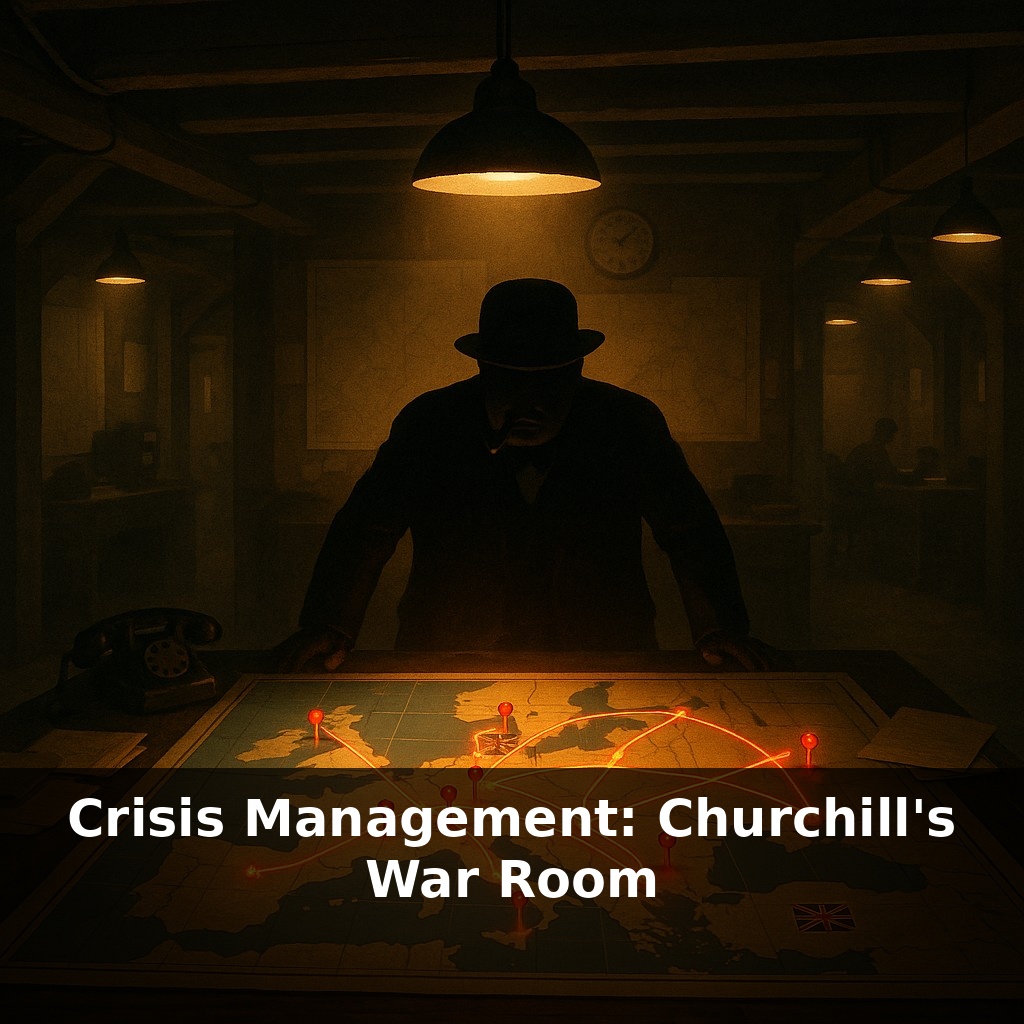
Down in Churchill’s War Rooms, crisis management was not improvised chaos; it was rigorously designed. The space itself was a system: cramped corridors, low ceilings, and a warren of rooms wired with phones, charts, and signals that turned raw data into decisions at speed. Around 100–200 people operated in shifts to keep this underground hub running 24/7, ensuring that no single failure—human or technical—could freeze the system. Critical information moved along defined paths: ultra-brief updates from the front, coded messages routed through specialists, and distilled intel reaching only the key decision-makers. This wasn’t just wartime necessity—it was an early prototype of how to architect a resilient operating environment when pressure, uncertainty, and time constraints collide.
Churchill added an equally deliberate human layer to this machinery. The War Rooms ran on strict rhythms: 9 a.m. Chiefs of Staff huddles capped at about 15 minutes, situation summaries every few hours, and night reports that could wake him at any time. Around 50 officers and specialists cycled through the Map Room alone, updating global positions at six‑hour intervals. Churchill intervened selectively—dropping into rooms unannounced, demanding “the essence” in under 2 minutes, then pushing for alternative options. Under fire, this discipline turned scattered data into shared situational awareness and focused action.
Churchill’s real advantage underground wasn’t just speed; it was disciplined selectivity. With thousands of signals and reports flowing through Whitehall every day, he focused ruthlessly on what only he could decide. That meant three things: strict filters, clear thresholds, and visible ownership.
First, filters. Not every air raid, convoy delay, or diplomatic cable reached him. Issues were graded by impact and reversibility. A minor setback in North Africa? Handled at theater level. A convoy route threatened that could starve Britain of grain or oil within 30 days? That rose fast. In practice, it meant perhaps a few dozen items per day hit the very top, from a backdrop of hundreds of incoming fragments.
Second, thresholds. Churchill set explicit tripwires for escalation. If shipping losses exceeded certain tonnage for a set number of days, or if German forces crossed specific lines on a map, it triggered an automatic review at the highest level. Those lines weren’t vague. They were drawn in inches on the 50,000‑pinholed map: cross this point, and we re‑examine the whole plan. In your world, that’s the difference between “keep me posted on churn” and “if churn exceeds 2% monthly for 3 months, we convene a cross‑functional review within 48 hours.”
Third, ownership. Every critical topic had a named lead, not a vague committee. One person owned aircraft production numbers; another owned convoy protection; another, allied diplomacy. Churchill knew who would walk into the room if that domain turned red. That clarity cut argument time and boosted accountability. On a modern leadership team of, say, 7–9 people, that might mean mapping the top 10 risks and assigning exactly one executive as “single throat to choke” for each.
He also paired brutal realism with structured optimism. Threats were not downplayed: casualty forecasts, fuel shortages, and invasion scenarios were worked through with hard numbers—probabilities, timelines, resource counts. But every gloomy assessment had to be matched with options: at least two credible courses of action, with pros, cons, and resource needs. No “we’re doomed” memos; only “we’re exposed here, and here are three ways to respond.”
Your challenge this week: pick one recurring pressure area—customer outages, regulatory risk, cash runway, key talent loss—and design a “War Room” protocol for just that domain. Define:
1) Exactly 3–5 metrics that would signal rising danger. 2) The concrete thresholds that would trigger your involvement. 3) The single person who owns first response. 4) The forum (15–20 minutes max) where decisions would be made if those thresholds are crossed.
Then, pressure‑test it once—run a 20‑minute simulation using last year’s worst month of data.
In a modern tech company facing a major outage, a Churchill‑style setup might mean a live board showing just five signals: % of users affected, error rate, time to recovery, support backlog, and SLA breach risk. Updates every 10 minutes, but only three scenarios trigger the CEO’s direct entry: more than 30% user impact, downtime over 45 minutes, or a critical customer invoking penalty clauses. Below that, a named incident commander—not a committee—runs the response.
Finance leaders can mirror this with liquidity risk. Instead of drowning in spreadsheets, they monitor three forward‑looking markers: daily cash burn, weeks of runway at current spend, and % of revenue from the top 5 customers. If runway dips below 26 weeks or dependency on any single customer exceeds 35%, it forces a 30‑minute cross‑functional review within 72 hours.
Your own version might cover supply chain fragility, data breaches, or key‑role succession. The key is to pick one domain and design escalation rules that are precise enough to be used in a live drill tomorrow morning.
By 2035, expect your “war room” to be part physical, part virtual: a secure hub where AI agents pre-filter millions of data points into 5–7 live risk tiles—cyber, supply chain, brand, legal, and talent. Leaders won’t watch dashboards; they’ll interrogate them: “Simulate 3 cyberattacks hitting in 24 hours.” Systems will return ranked playbooks in under 30 seconds, plus predicted impact on revenue, trust, and regulation across the next 90 days. The skill to build now: asking sharper, more constrained questions.
For the next 30 days, track how often your “urgent” alerts actually change a decision. If fewer than 30% drive action, cut your signals in half. Then, commit to one 15‑minute risk review per week, capped at 5 items. After a month, compare: did response times drop by at least 20% and error rates by 10%? If not, tighten thresholds again.
To go deeper, here are 3 next steps: First, pull up the digitized “Cabinet War Rooms” maps from the Imperial War Museums site and practice a 20-minute “war room drill” on a current project: list your 3 biggest risks, 3 key assets, and who’s “in the room” with you (actual names), just like Churchill’s daily briefings. Next, grab *Churchill’s Ministry of Ungentlemanly Warfare* by Giles Milton or *Winston Churchill: Walking with Destiny* by Andrew Roberts and skim one chapter tonight, underlining how he structured information flow under pressure, then adapt one tactic (e.g., single-page daily brief) for your own team. Finally, test a modern “war room” tool by setting up a dedicated crisis channel in Slack or Microsoft Teams, pinning a simple crisis protocol template from the UK government’s Civil Contingencies Secretariat or FEMA, and do a 15-minute mock scenario with your team this week to see where your decision-making bogs down.