Troops once marched dozens of miles on orders crafted by a commander who never told them exactly what to do. Instead, he shared why it mattered—and then stepped back. In today’s episode, we’ll step onto that wartime tightrope between control and chaos, and see what it teaches us.
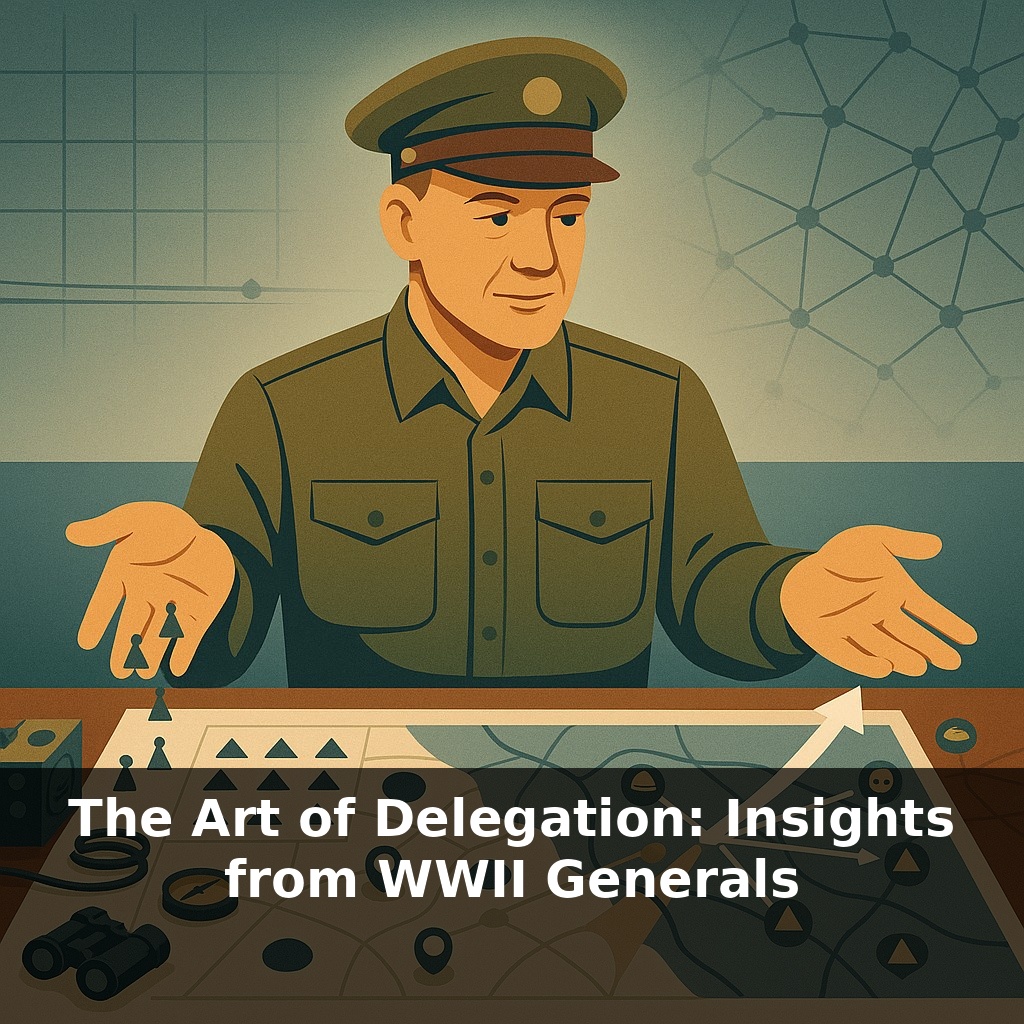
In World War II, some generals quietly broke the old rulebook: they stopped trying to move every unit like chess pieces and instead turned their armies into networks of problem‑solvers.
Eisenhower set broad direction, then let 36 senior leaders from five nations decide how to win their part of the fight. Slim held a 700‑mile front together by trusting platoon leaders to act without waiting for orders. Rommel pushed fast not just because he was daring, but because his subordinates knew his intent so well they could act before he spoke.
This wasn’t abdication—it was disciplined delegation. They paired clear intent with real authority, and then backed their people repeatedly, even when things got messy. The result was faster decisions, higher morale, and a force that could adapt mid‑battle.
In modern teams, the terrain is different, but the leadership problem is the same: how do you let go without losing the plot?
On paper, these generals looked like they were giving away power; in practice, they were tightening focus. Their secret wasn’t just “delegate more,” but *what* they delegated and *what they refused to let go of*. They clung fiercely to purpose, priorities, and principles—and pushed everything else down the chain. That’s why a young officer on a jungle patrol or a staff colonel in London could improvise without derailing the campaign. In a modern team, this is closer to a well‑run product roadmap than a task list: leadership owns the destination and constraints; the team owns the route.
Rommel once told a subordinate: “The commander must be where the decisive attack is launched,” yet his units often moved faster than he could travel. The trick wasn’t omnipresence—it was teaching people to think like him when he wasn’t there.
Three habits show up repeatedly.
First, they translated big ideas into simple, portable intent. Eisenhower didn’t brief his 36 Overlord commanders with a thick deck of slides; he hammered home a few non‑negotiables—land, build up faster than the enemy, break out, link up. That clarity let British, American, Canadian, Free French, and Polish units each solve wildly different problems without tripping over one another. In modern terms, everyone shared the same “definition of success,” even when their tasks barely overlapped.
Second, they aligned “who gets blamed” with “who gets to decide.” Slim was ruthless about this. If a brigade commander was accountable for holding a river line, Slim made sure that commander could shift units, supplies, even air support without begging three echelons up. By contrast, units that failed often lived in a world where responsibility flowed down but permission never did. When you ask someone to own an outcome while forcing them to ask for approval on every step, you’re not delegating—you’re setting up a scapegoat.
Third, they treated trust as a muscle, not a mood. George C. Marshall’s “90‑day wonders” were controversial precisely because they pushed trust downward at speed: 200,000 junior officers trained not just in tactics, but in making calls with incomplete information. Their superiors then had to *live with* those calls often enough that initiative felt normal, not exceptional. That repetition turned a poster slogan—“use your initiative”—into a daily habit.
The paradox: this approach can look slower at first. It takes time to teach intent, redraw authority lines, and stomach early mistakes. But once it’s running, the system behaves less like a single brain issuing orders and more like weather fronts interacting—local patterns shifting quickly while still obeying larger forces. That’s how German divisions in 1940 sometimes covered roughly twice the distance of more centralized forces: not magic, but hundreds of small, fast decisions that didn’t need to wait their turn in line.
In a modern product team, this shows up in small but telling ways. A VP might state one sharp outcome—“Cut customer onboarding time by 30% this quarter”—then let engineering, design, and sales each solve their slice without dictating methods. The product manager negotiates trade‑offs with peers, not just waits for top‑down rulings. When an unexpected blocker appears—say, a third‑party API change—the people closest to the work decide whether to re‑architect, add a workaround, or change the milestone, then *inform* up rather than *ask* up.
Amazon’s famous “two‑pizza teams” rely on something similar: a clear owner for each service, full control over their deployment pipeline, and alignment around a small set of metrics instead of step‑by‑step instructions. Over time, the org chart starts to look less like a pyramid and more like a river system: many tributaries making local adjustments while still flowing in the same direction. In healthy companies, you can see this on the ground: meetings shift from status updates to “Here’s what we changed—here’s what we’re trying next.”
Soon, your “second-in-command” might be a model, not a major. As AI agents plan routes, adjust prices, or allocate cloud capacity in milliseconds, the hard part won’t be speed—it’ll be teaching them what outcomes actually matter. Think of setting guardrails for a self-driving convoy: you choose the destination, risk limits, and no‑go zones, then let software weave through traffic. The frontier skill is designing goals and feedback so humans and algorithms can improvise toward the same end state.
Your challenge this week: run a live experiment in letting go. Pick one decision you’d normally keep—like approving a budget tweak or feature change—and hand it to someone closer to the work. Give them your “left and right limits” only. When the outcome lands, resist rewriting it. Debrief together: what did they see that you didn’t?
If you do this often enough, your role shifts from traffic cop to air‑traffic controller—less about waving every car through, more about watching patterns form and adjusting the overall flow. Over time, the real signal that you’ve grown isn’t how many calls you make, but how many *good* calls get made without you in the room.