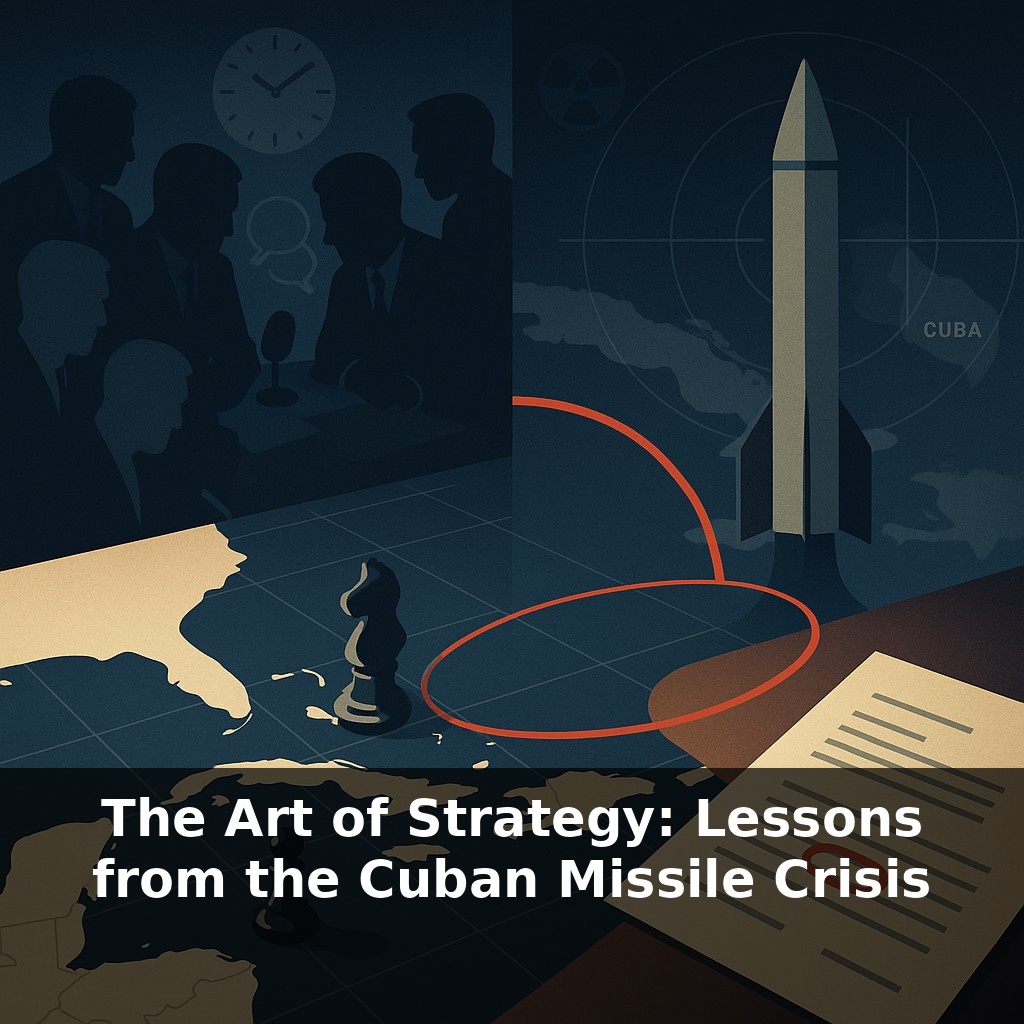
For nearly two weeks in 1962, a handful of men held the power to end human civilization—yet they spent much of that time arguing over single words in memos. In this episode, we’ll step inside those rooms and ask: how do you think clearly when the stakes are unthinkable?
Those arguments over single words weren’t a sideshow; they *were* the strategy. “Quarantine” instead of “blockade.” A public demand instead of a secret ultimatum. A speech tone that signaled firmness without cornering the other side. Under nuclear pressure, language, process, and timing became as concrete as missiles and ships.
In this episode, we’ll zoom in on three quiet levers that shaped the crisis: how Kennedy’s team slowed decision speed on purpose, how they built multiple fallback options instead of one “master plan,” and how they used back-channel messages to say things they couldn’t afford to say in public. Think of it less as playing chess and more as constantly re-writing the rulebook while the clock is ticking. Our goal isn’t to admire historical drama—it’s to extract a toolkit for your own high-stakes decisions, where you can’t afford a single catastrophic move.
Kennedy’s team also refused to see the crisis through just one lens. Some hours they acted like cold calculators, tallying missile ranges and likely Soviet responses. Other moments, they were prisoners of routines: naval officers pushing standard blockade procedures, intelligence teams defending their usual playbook. And always, individual fears and egos leaked into the room. The art was not in eliminating these competing logics, but in recognizing when each one was quietly steering the conversation—like subtle currents nudging a boat off its plotted course. To learn from 1962, we have to learn to spot those currents in our own decisions.
Kennedy’s team didn’t just argue about options; they quietly redesigned *how* options got onto the table in the first place. One crucial move was to separate “talking space” from “acting space.” ExComm became a kind of intellectual lab where ideas could be voiced, attacked, and revived without each comment locking the U.S. into a public stance. Only after hours of messy, seemingly circular debate did a smaller group translate that chaos into a crisp external message.
That separation mattered. It meant hawks could argue for air strikes at 10 a.m. and still support a maritime approach at 6 p.m. without looking weak. In many organizations, leaders accidentally fuse the lab and the stage: the first opinion voiced in the big meeting sounds like a commitment, so everyone hardens around it. In 1962, Kennedy protected a zone where people could be brutally candid about worst cases—like Soviet retaliation against Berlin—while still preserving flexibility in what the world actually saw.
They also learned to treat “silence” and “delay” as signals, not voids. When Moscow didn’t respond immediately to U.S. demands, ExComm didn’t simply panic; they asked, “What does this *kind* of delay usually mean in Soviet practice?” Was the bureaucracy jamming? Was Khrushchev consolidating support? They drew on years of intelligence about standard patterns inside the Soviet system. In modern terms, they weren’t just analyzing the email they got; they were analyzing the email they *didn’t* get, and how fast, and through which channel.
Inside the U.S. system, organizational habits kept trying to drag the crisis back to business-as-usual. The Navy, for instance, was built to execute clear rules of engagement. A ship approaches, you hail it, you board it, you enforce. Simple. But nuclear stakes made simple dangerous. So civilian leaders had to deliberately *override* some routines: changing interception distances, tightening authorization rules, forcing commanders to ask for permission in situations where they’d normally act on autopilot.
That tension—between efficient routine and tailored judgment—is where many high-stakes mistakes are born. In calm times, you want as much on autopilot as possible. In volatile times, you need to know exactly which habits to suspend, and for how long.
In finance, good traders build “mental ExComms” around a big position. Before moving millions, they’ll sketch a range of price paths, regulatory surprises, and liquidity shocks—then ask: which of these relies too heavily on standard models, and which depends on one person’s gut? They aren’t chasing certainty; they’re mapping where each type of thinking is quietly in charge. A similar move shows up in product strategy. A team debating a risky launch might list three columns beside each proposal: numbers that support it, processes it leans on (sales playbooks, support capacity), and personal stakes (whose pet feature it is, who’s on the line for revenue). You’re not judging yet; you’re revealing hidden engines. Even solo, you can do this. When facing a major career move, write two versions of your reasoning: one as a spreadsheet, one as a process map, one as a private diary entry. Then notice how different the decision feels in each frame.
Future leaders may lean on tools that behave less like crystal balls and more like flight simulators—letting them rehearse moves before stakes turn real. An AI “ExComm assistant” could surface hidden organizational ruts or group pressures the way a metal detector reveals buried nails in a plank. Your role shifts too: from lone decision-maker to architect of how your team thinks under pressure, upgrading not just choices, but the systems that shape them daily.
Your challenge this week: when a tough choice appears, resist the first “obvious” move. Draft three paths that all *avoid* your preferred instinct—like alternate routes on a map when your usual road is closed. Ask: which path keeps options open longest? Over time, you’ll train yourself to notice exits others don’t see until it’s too late.