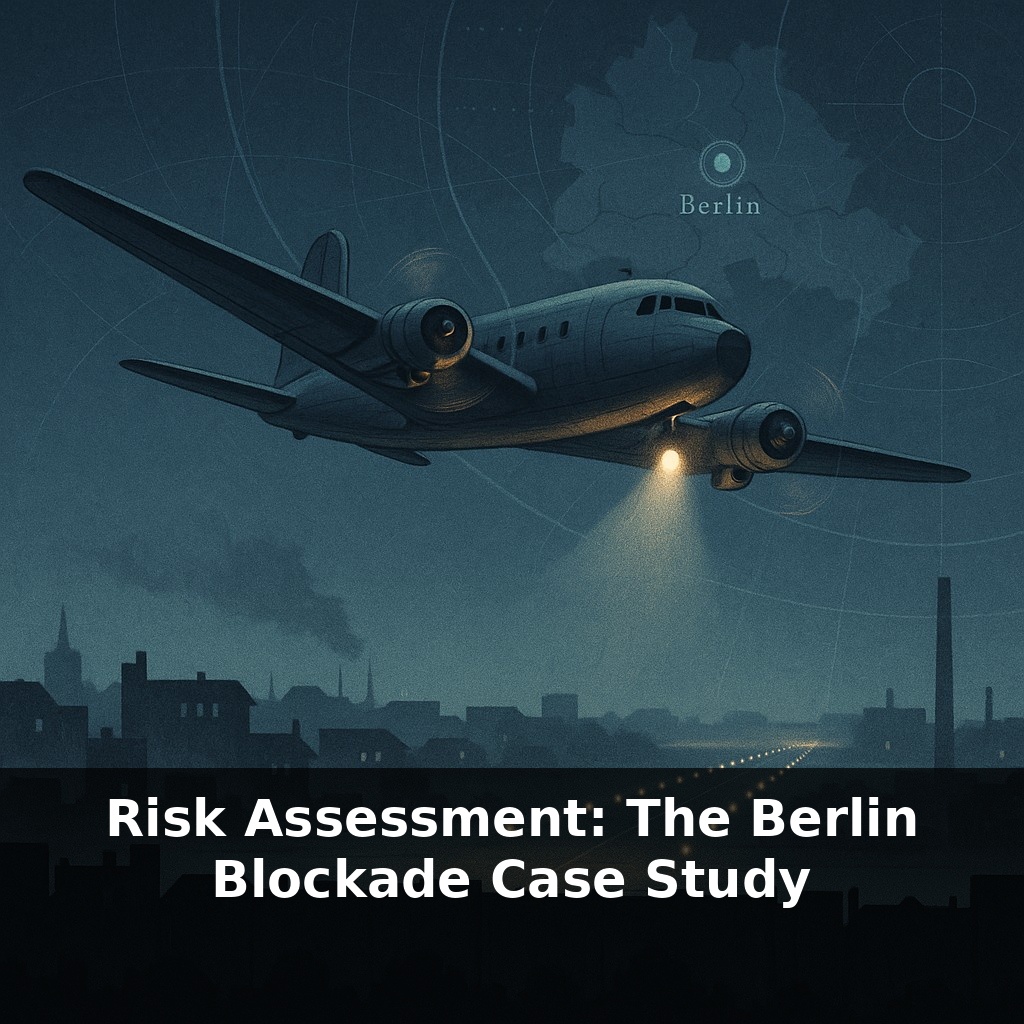
A city the size of a modern tech hub was once kept alive almost entirely by airplanes. Day and night, cargo planes rose and landed in tight choreography, while leaders weighed every flight against the risk of starting World War Three. How do you choose action under that kind of pressure?
The Berlin Blockade forced Allied planners into a kind of live‑fire strategy lab. Overnight, they had to transform a political crisis into a logistics problem they could actually control. Instead of debating abstractly, they began asking concrete questions: How many people must be fed per day? How many calories? How much coal to keep factories and apartments from going dark? Then they worked backward from those numbers to design an operation that could run continuously without collapsing. It wasn’t about finding a perfect plan; it was about finding a plan that could survive contact with reality, and then improving it under stress. Each runway, crew, and flight schedule became a lever they could pull to shift risk from “war” toward “manageable hardship.” In this episode, we’ll use their approach as a blueprint for how to think when the stakes are high and options all look bad.
Instead of asking “How do we beat the Soviets?”, Allied planners reframed the problem as “What exact risks are we willing to take—and where?” They separated emotional fear from measurable exposure: mid‑air collisions, winter shortages, political humiliation, miscalculation at the checkpoints. Then they ranked these like a portfolio of threats, trading one kind of danger for another. You can treat your own decisions the same way: not as single yes/no bets, but as bundles of risks you can redistribute across time, resources, and relationships, so no single failure can sink you.
The first move the Allies made was deceptively simple: they wrote down the worst‑case failures in plain language. Not “logistics risk,” but “families freezing in unheated apartments” or “fighters scrambling after a mid‑air collision.” Then they asked, for each: How likely? How bad? How visible? This turned a swirling crisis into a grid of concrete trade‑offs.
Next, they separated *non‑negotiables* from *variables*. Non‑negotiables: West Berlin must not fall; direct armed clash must be avoided. Almost everything else—comfort levels, political prestige, even economic efficiency—was negotiable. That hierarchy quietly ruled out dramatic but fragile options (like a one‑time armored convoy) in favor of something slower but more controllable.
Crucially, they distinguished *systemic* from *local* risks. Losing a single plane was tragic but contained; firing the first shot on the ground could ignite Europe. So they were willing to accept higher operational danger in the air to reduce strategic danger on the ground. In modern terms, they pushed risk “down” into smaller, more survivable units instead of letting it accumulate at the top.
Then came capacity math. Planners broke the problem into load‑bearing components: runway slots per hour, turnaround times, maintenance cycles, weather delays. They continually asked: Where is the bottleneck *today*? A new runway, better radar, or larger aircraft could all raise the ceiling. Like a careful investor, they reinvested every gain—in efficiency, experience, political capital—back into expanding that ceiling.
Feedback loops were built in from the start. Daily tonnage, accident reports, morale indicators, Soviet reactions—all flowed into decisions about routes, schedules, and public messaging. Nothing was treated as “set and forget”; every rule was provisional unless it protected a non‑negotiable.
You can use the same structure: define failures in ordinary language, rank what truly can’t be sacrificed, push the biggest dangers into smaller compartments, and keep tuning the system as real data replaces your early guesses.
Think of how you’d launch a product under hostile conditions—say a competitor controls key distribution channels and can undercut your pricing overnight. You could “charge the roadblock” with a big, one‑time launch and massive ad spend. Or you could copy the Berlin planners’ logic and design an “airlift strategy”: a sequence of small, fast, low‑visibility moves that collectively keep your market alive without provoking a price war.
You’d start by listing concrete failure modes: “customers churn to cheaper rival,” “cash runway drops below three months,” “brand seen as unreliable.” Then you’d sort your non‑negotiables: maybe *survive 18 months* and *retain 40% of core users*. Comforts like perfect margins or rapid growth become negotiable.
Next, you’d deliberately push risk into smaller compartments: limited pilots in specific cities, capped discounts, segmented offers. If one trial fails, it doesn’t collapse the whole business. And instead of a fixed grand plan, you’d run rolling cycles of data, adjusting channels, bundles, and timing weekly—treating each tweak like adding another safe, efficient corridor through contested airspace.
Blockades today may be invisible: severed fiber‑optic cables, frozen payment systems, jammed GPS. Future planners must ask not just “Can we keep things running?” but “What quiet scaffolding do we need *before* anyone pulls the plug?” That means redundant routes, pre‑agreed access rights, and drills that stress‑test them. Like divers using a safety line, you want backup paths laid down long before the water turns dark and disorienting.
Real risk thinking is less like heroics and more like gardening: pruning fragile branches, testing soil, planting backups before storms hit. As you face your own “blockades”—a key hire leaving, a supplier failing, a law changing—treat them as design prompts. Which small, reversible bets today could keep your options open when the next shock lands?
Before next week, ask yourself: 1) “If I were in Clay’s shoes during the Berlin Blockade, which ‘airlift-style’ workaround could I create in my own project instead of accepting the apparent dead end—what concrete alternative route have I not yet tested?” 2) “Looking at my current risks, which ones am I treating like the Soviets’ blockade—visible but underestimated—and what specific early-warning signals (metrics, deadlines, stakeholder behaviors) can I set up this week to spot escalation sooner?” 3) “Where am I over-relying on a single ‘supply corridor’ (one client, one supplier, one technology), and what is one realistic redundancy I can put in motion now so I’m not scrambling if that route closes suddenly?”