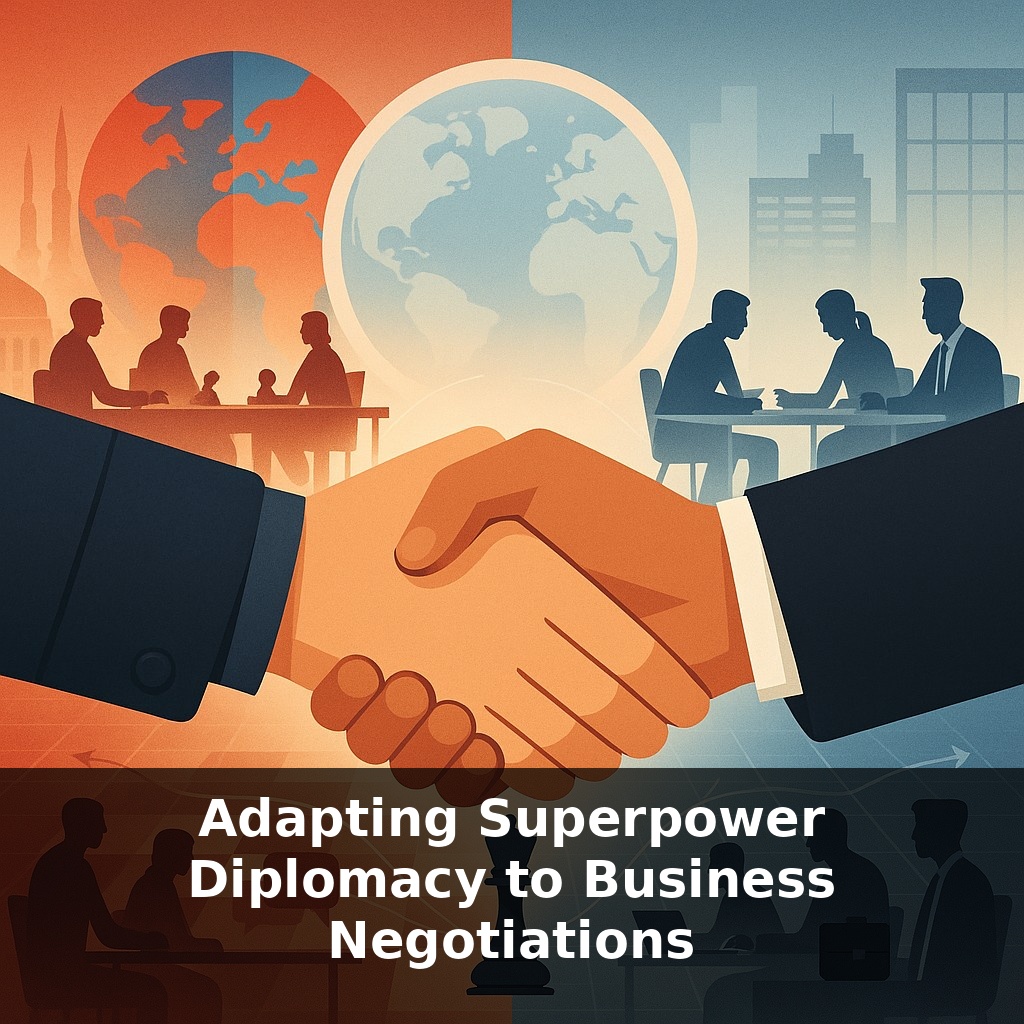
In the Cold War, two rival superpowers spent decades in tense standoffs—yet their diplomats often walked away with deals both sides could accept. Today, many executives still treat big negotiations like battles. Why did the countries do better than the companies?
Thomas Schelling once described bargaining as “a process of mutual adjustment”—and the people who took him most seriously weren’t corporate dealmakers, but nuclear strategists. While boardrooms still default to “win or lose” thinking, Cold-War envoys quietly developed tools for turning volatile standoffs into structured problem‑solving: deterrence to protect what mattered most, linkage to trade across issues, signaling to clarify intentions, and back‑channels to lower the emotional temperature.
In earlier episodes we saw how leaders managed risk and information when the stakes were existential. Here, we’ll translate that same disciplined mindset into everyday dealmaking: M&A talks, vendor contracts, strategic partnerships. Think less about squeezing the other side, and more about designing the game so both sides can afford to keep playing.
In business, high‑stakes deals often stall not because terms are impossible, but because leaders don’t know how to safely shift from posturing to problem‑solving. That’s where our Cold‑War toolkit becomes practical. Instead of obsessing over “the number” in a contract, we can design the whole negotiation environment: who’s in the room, what gets discussed first, how trade‑offs are sequenced, even how messages are framed for internal audiences. Done well, this turns tense bargaining into something closer to co‑authoring a shared business plan than haggling over a single price.
Start with a puzzle: if most Fortune 500 firms already use back‑channel communication in M&A talks, why do so many blockbuster deals still implode at the last minute? The answer is rarely “bad math.” It’s usually that leaders haven’t translated superpower‑style discipline into the messy details of who speaks, about what, and when.
First, deterrence in business is less about threats and more about clarity. Before you walk into a major negotiation, map your true “no‑go” lines and make them quietly credible: alternative suppliers pre‑qualified, financing options prepared, integration plans modular enough to survive a partial deal. You’re not sabre‑rattling; you’re making it obvious—to yourself and eventually to them—what you can and cannot trade without damaging the business.
Next, treat issue‑linkage as a design problem, not a trick. That MIT Sloan finding—that bundling issues raised joint gains in most corporate negotiations—only happens when you choose *compatible* linkages. Disney’s deal with Pixar didn’t hinge on just a price; it tied together governance, creative autonomy, technology sharing, and brand stewardship. The package worked because different terms mattered differently to each side. Your job is to surface those asymmetries: maybe cash today matters more to them, while a multi‑year exclusivity window is gold for you.
Signaling then becomes your way of steering expectations without cornering anyone. You can preview trade‑offs in principle (“We’re open to a higher upfront fee if we see flexibility on term length and data access”) before committing to numbers. That helps expand the ZOPA by hinting at structure before you argue about decimal points.
Finally, use back‑channels to explore, not to undermine. Quiet conversations are ideal for testing creative structures—earn‑outs, joint ventures, phased commitments—without forcing anyone to defend half‑baked ideas in front of their entire team. When those options look promising, bring them back into the formal process fast so the deal retains legitimacy.
Think of your role as architect of the deal’s *architecture*: you’re designing the sequence and shape of moves so each side can protect what it must, reveal what it can, and still discover value that wasn’t visible at the outset.
In practice, this can look surprisingly ordinary. A SaaS vendor, for instance, might quietly prepare three interchangeable deal “routes” before a big renewal: lower price with rigid scope, mid‑price with flexible features, or premium with co‑development rights. On the surface it’s just a menu; underneath, it’s a pre‑built map of where they *won’t* go and where they’re happy to be generous if the client cares more than they do.
A global retailer entering a joint venture in a new market might privately assign “strategic weight” to each term—brand use, data access, supply‑chain control, exit options. During informal talks, they float patterns rather than positions: “We could be lighter on branding if we’re heavier on logistics.” That phrasing invites trading across dimensions without forcing anyone to concede too soon.
The most skilled dealmakers keep a running list of “acceptable surprises”—outcomes they hadn’t planned for but can quickly endorse—so that when the other side proposes something novel, they can say “yes” faster than a rival can say “wait.”
AI and VR will stretch these deal tools in strange directions. AI sentiment scans might flag tension shifts faster than any human—like seeing ripples on a lake before the storm. VR “summits” could restore eye contact and nuance to globally dispersed teams, but also tempt leaders to stage‑manage theatrics. The frontier skill won’t be copying diplomats’ moves; it will be deciding which human judgments to *protect* from automation as the tempo of negotiation accelerates.
As you borrow tools from statecraft, remember the goal isn’t elegance on paper but resilience in practice. Test your agreements like a bridge under shifting loads: new regulations, leadership turnover, market shocks. If the structure flexes instead of cracks, you’ve moved beyond tactics and into strategy—designing deals that stay livable even as the landscape moves.
Before next week, ask yourself: 1) “In my next high-stakes negotiation, what’s the ‘red line’ I absolutely won’t cross—and what flexible ‘trading chips’ (price terms, timelines, service levels, IP rights, access, etc.) am I genuinely willing to move on?” 2) “If I treated this counterpart like a superpower rival instead of an adversary, what long-term strategic interest (future deals, market access, intel, reputation) would I protect, even if it means conceding on a short-term win?” 3) “What hidden pressure might be shaping the other side’s behavior—internal politics, budget cycles, leadership changes—and how can I test that hypothesis with one specific question or proposal in our very next conversation?”