Hannibal Barca: Master of Elephants
📝 Transcript
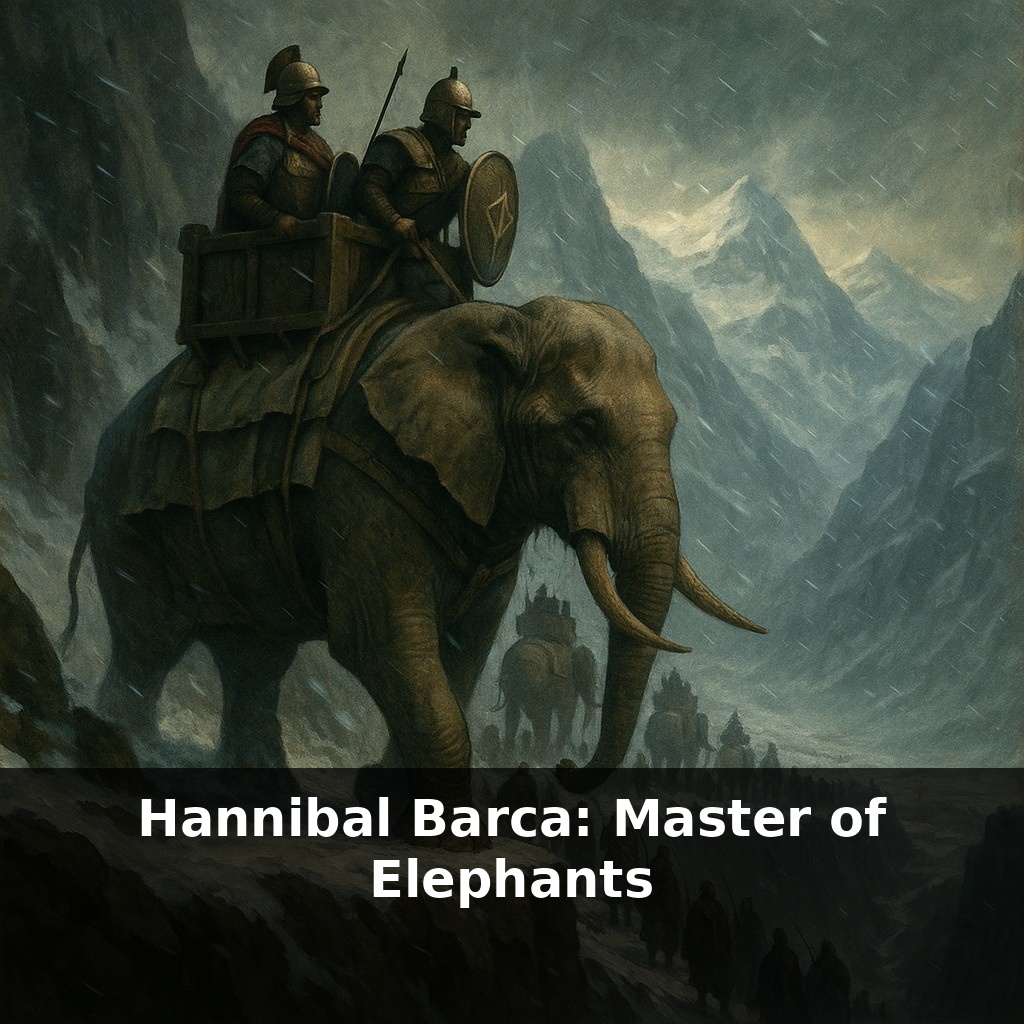
An army from North Africa appears at the edge of the Alps—with war elephants. Not facing south toward the sea, but north, toward walls of ice and hostile tribes. Rome thinks it knows where the danger is. Hannibal’s first move is to prove them absolutely, terrifyingly wrong.
Snowblind, half-starved, and surrounded by men who could no longer feel their own hands, Hannibal still kept a ledger in his head—not of coins, but of risks. Every avalanche, every ambush, every fallen pack animal forced a decision: press on, detour, or turn this disaster into an opportunity. He wasn’t just moving an army; he was debugging a failing project in real time, with human lives as the code.
Ahead lay not just Rome, but years of operating deep in enemy territory—no home port, no steady reinforcements, no guaranteed supplies. To survive, he’d need more than courage. He’d need to turn terrain into a weapon, fear into a signal, and every setback into a prototype for the next maneuver. This is where Hannibal stops being a daring invader and becomes something rarer: a strategist who plans to live on the knife-edge—and stay there.
Hannibal also understood something subtler: people could be moved like units on a map—if you learned what scared them, what angered them, what they hoped for. Italian allies watched him as closely as Roman scouts did, weighing whether he was a passing catastrophe or a viable alternative to Rome. He answered with staged mercy for some cities, brutal speed against others, and careful rumor-craft to magnify both. If his logistics were the skeleton of the campaign, this psychological layer was its nervous system, carrying jolts of signal through a landscape Rome thought it controlled.
Hannibal’s real genius emerged once he was off the mountains and could start *designing* his campaign like a system that had to run continuously in hostile conditions.
He began by reshaping how his army *thought*. Carthaginian citizens, Libyan infantry, Numidian cavalry, Iberian tribesmen—each group brought its own weapons, languages, and grudges. Instead of forcing uniformity, he assigned roles that played to their strengths, then rehearsed coordination until this patchwork force behaved like a single organism. Where Rome drilled identical legions, Hannibal effectively ran a modular architecture: specialized “components” that could be rearranged for each battle.
At Trebia and Trasimene, that flexibility became a kind of applied theater. Hannibal didn’t just look for good ground; he *set scenes*. At Trebia, he baited Roman aggression with cavalry skirmishes, lured them across an icy river at dawn, then triggered an ambush from concealed troops. At Trasimene, he used fog, timing, and local guides to stretch a Roman column along a lake road, then hit its front, flank, and rear in a choreographed collapse. These weren’t flukes; they were controlled experiments in how far Roman commanders could be pushed into overconfidence.
Cannae was the mature version of that method. Hannibal took an apparent weakness—a thinner, more fragile center—and turned it into a trap that *required* Roman success to function. The more eagerly they pushed in, the more they fed the encirclement forming around them. It’s the military version of an opponent “over-optimizing” for the wrong metric: Rome kept winning local, momentary advantages, right up to the point they discovered the exits were gone.
Crucially, Hannibal paired battlefield design with long-term persuasion. He timed victories to coincide with diplomatic outreach, sending captured Roman prisoners home to spread stories of disaster, while treating some Italian allies conspicuously better than others. The message was calibrated: Rome is not invincible; your loyalty is now a negotiable asset.
The tragedy for Hannibal is that his campaign logic assumed two things he never fully got: sustained support from Carthage, and mass defections from Rome’s core Italian allies. His system could *stretch* astonishingly far; it could not, in the end, replace the industrial depth of the power he had shocked but not broken.
In modern terms, Hannibal’s campaign feels less like a single “product launch” and more like running a high-risk beta program in hostile territory. One useful lens is to compare him not to other generals, but to a founder who refuses to pivot on the *core* vision, yet constantly iterates on execution. After Cannae, for instance, he didn’t chase Rome’s walls in a grand, cinematic siege. Instead, he quietly seeded influence in southern Italy, repositioned bases, and groomed younger commanders—like a company building regional beachheads while the main competitor fortifies its headquarters.
You can see echoes of his method in leaders who treat constraints as design parameters, not excuses. Think of early SpaceX: underfunded, politically vulnerable, operating in a market dominated by a state-backed giant, yet obsessively refining each launch to buy just a little more time, credibility, and capability. Hannibal worked the same way with people: rotating units to preserve veteran cores, cultivating local elites, and rationing shock tactics so each use had narrative impact, not just tactical payoff.
Future campaigns will increasingly look like Hannibal’s long game: stretched supply, shifting loyalties, uncertain home support. His story nudges planners to ask not just “Can we win?” but “Can we *sustain* winning?” Think less about perfect battles, more about resilient systems—alliances that can wobble without breaking, plans that absorb political mood swings, forces trained to adapt like a good software patch: quick, quiet, and built to work on imperfect hardware.
Hannibal’s real legacy may be this: he treated constraints as invitations, not walls. His failures didn’t erase the experiment; they fed Rome’s own learning curve and shaped centuries of doctrine. Your challenge this week: when you face a hard limit, treat it like fresh snow on a steep slope—map it, test it, and see where an unexpected path appears.
From this course
Tales of Ingenious Generals
8 episodesUnlock all episodes
Full access to 8 episodes and everything on OwlUp.
Subscribe — $1.99/monthLess than a coffee ☕ · Cancel anytime