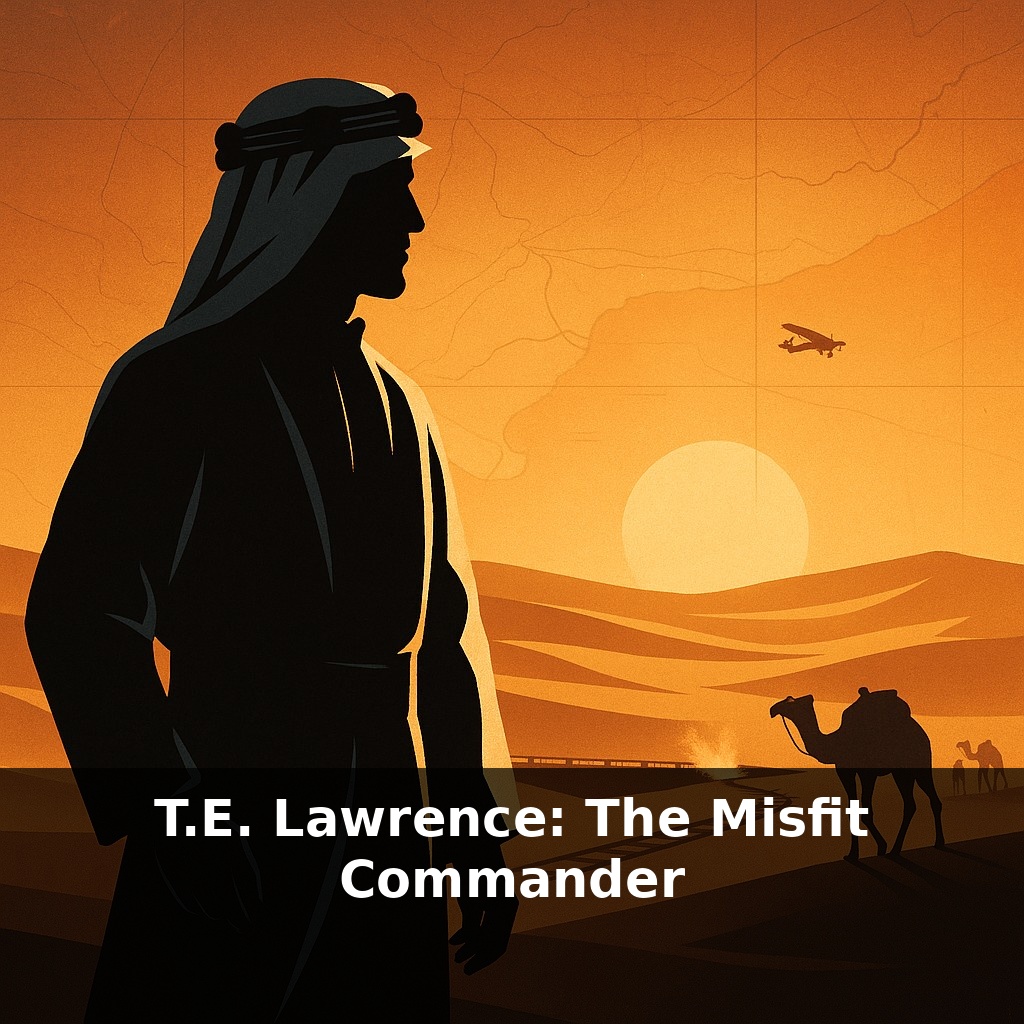
Gunpowder, camels, and a few dozen rebels stall an empire of hundreds of thousands. A book printed in only 200 copies quietly explains how. In this episode, we step into the desert with T.E. Lawrence, where cultural fluency mattered more than uniforms or rank.
Lawrence steps off the standard map of World War I. While other officers chased trenches and headcounts, he chased leverage. He looked at the Ottoman Empire’s long, exposed railway lines and saw not infrastructure, but pressure points—glass ribs on a giant that could be cracked with a well-placed tap. Instead of trying to command divisions he’d never get, he focused on obsessively understanding a handful of tribes, routes, and leaders he actually could influence.
In a world addicted to scale—bigger armies, bigger budgets, bigger plans—Lawrence built impact the way a careful coder builds a script: small, elegant routines that trigger much larger effects in the system. He wasn’t simply “good with the locals”; he rewired the battlefield so that a few dozen riders and some explosives could shape the movements of hundreds of thousands.
Lawrence also broke the usual chain of command. Technically a junior officer, he operated more like a roaming product manager than a line executive—moving between Arab leaders, British headquarters, and the front, translating not just language but intent. He spent nights in tents arguing strategy with tribal chiefs, then rode for days to nudge British plans a few degrees in their favor. His genius was less “heroic raids” and more continuous negotiation: aligning wildly different agendas just enough that, together, they kept Ottoman forces stuck guarding empty stretches of desert steel.
Lawrence’s core move was to invert what “success” looked like. British headquarters measured progress in captured cities and enemy casualties. Lawrence measured it in Ottoman anxiety: how many soldiers were stuck guarding tracks that might be blown up tonight?
He pushed the Arab forces away from set-piece battles and toward what he bluntly called “war on the materials.” The aim wasn’t to annihilate Ottoman units; it was to make the railway so unreliable that Istanbul had to pour in men, money, and time just to stand still. When Turkish archives say roughly 30,000 troops were chained to the Hejaz line, that’s the scoreboard he cared about.
His method was ruthlessly practical. He chose targets like a hacker choosing which server to probe: not the most glamorous, but the ones whose failure would force the enemy to overreact. Bridges, culverts, and remote stretches became favorites. Blow a bridge, and you don’t just stop trains; you force engineers, guards, and repair crews into months of tedious, vulnerable work.
Over more than 60 demolition operations, he refined a rhythm. Small bands of riders moved light and fast, carried minimal explosives, hit at night or in remote zones, and vanished before a proper response formed. Success depended less on bravery than on timing, route selection, and the psychology of uncertainty. A single charge under a rail wasn’t meant to “win the war,” but to whisper to Ottoman command: “You still don’t control this space.”
The Aqaba operation in 1917 showed how far he was willing to push this logic. Instead of attacking the port from the sea, as the Ottomans expected, he guided a tiny force on a punishing inland approach that commanders deemed impossible. By appearing from the “wrong” direction with only a few dozen Bedouin fighters and a handful of British officers, he converted surprise and local alliances into 1,200 prisoners. It was less about numbers than about collapsing the enemy’s mental map of what was safe.
Underneath the legend was a misfit’s discipline: choose asymmetric goals, make the enemy guard everything, and never fight on terms that make your own weakness relevant.
Lawrence kept asking: “Where is the enemy brittle, not big?” In modern terms, think less about rival headcount and more about where their system can’t afford friction. A startup facing a giant platform can’t win by cloning every feature; it can win by quietly targeting the one workflow that, if disrupted or outperformed, forces the giant to divert teams, PR, and legal just to reassure customers.
You see the same pattern in cyber campaigns that don’t chase prestige targets but go after obscure logistics vendors or identity providers. Crippling a minor authentication service can yank dozens of bigger firms into chaos. The direct damage is small; the ripple is everything.
Lawrence also treated alliances as movable architecture, not fixed contracts. He’d “renovate” coalitions piece by piece—bringing one tribe closer for a single raid, then letting that relationship rest while another group took the lead. The structure was always half-finished, but that incompleteness made it flexible: nothing was so permanent it couldn’t be reconfigured for the next opportunity.
Lawrence points toward a future where “front lines” are mostly mental. Cyber teams, drone pilots, and local partners may never meet, yet shape the same fight. The real contest shifts to story: who convinces civilians, allies, and even enemy soldiers that resistance is futile or rebellion is inevitable? Think less trench map, more group chat—threads of rumor, fear, and hope that decide whether a regime feels solid or suddenly hollow underneath.
Lawrence hints at a quieter kind of power: noticing seams others treat as solid walls. In boardrooms or city halls, most still aim to “hold territory” instead of nudging key junctions of trust, supply, or belief. Like a careful architect altering one load‑bearing beam, a single, well‑chosen intervention can make an entrenched structure suddenly feel temporary.
Start with this tiny habit: When you finish brushing your teeth at night, whisper one line of a “desert order” to yourself, like: “Tomorrow I will scout just one unfamiliar idea for 5 minutes.” Then quickly jot a single word on a sticky note that names your “desert” for the next day (e.g., “language,” “writing,” “leadership,” “courage,” inspired by Lawrence’s roles as spy, writer, guerrilla leader). In the morning, put that sticky note in your pocket so you carry your small, rebellious mission—just like Lawrence carried his secret plans—into the day.