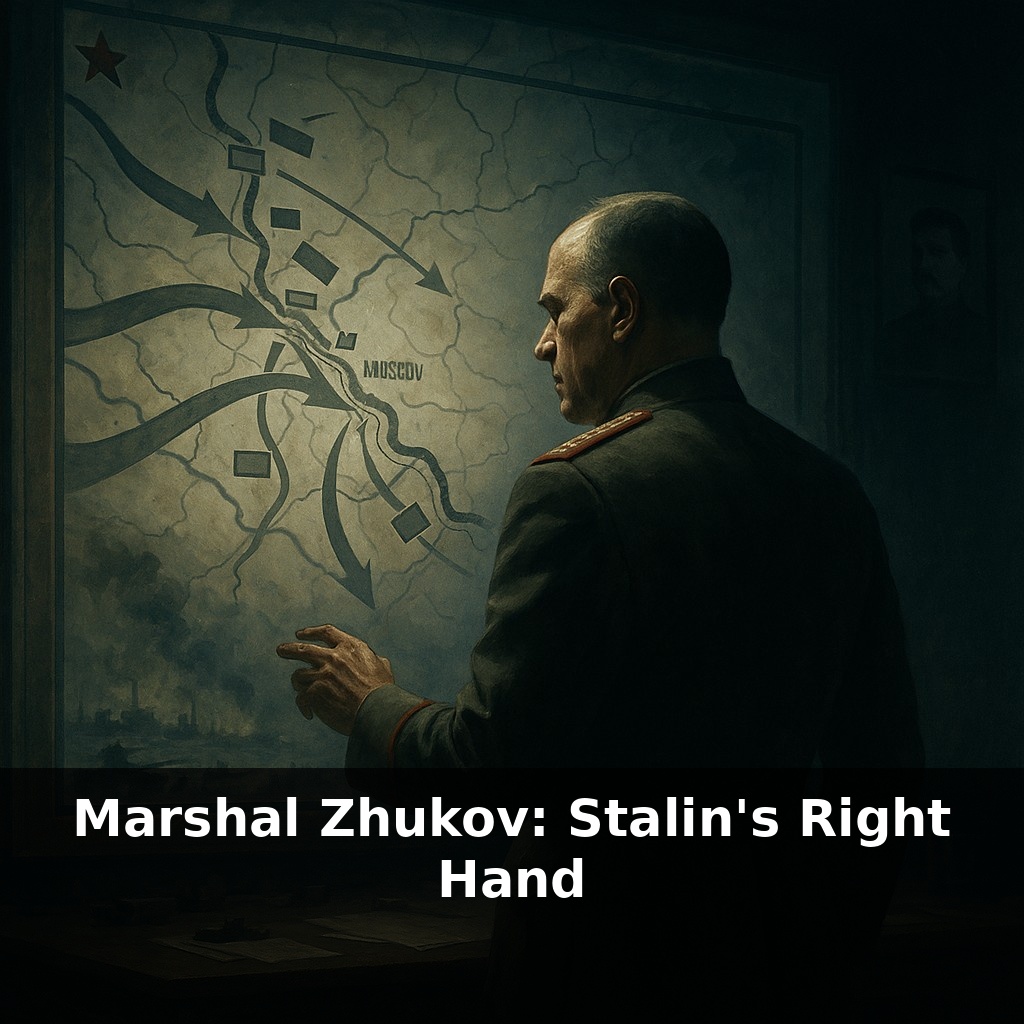
Artillery thunders on the edge of Moscow. A general studies a map so huge it covers an entire wall. His orders will send more people into battle than live in many countries—yet he cannot hesitate. Who is trusted with that decision, under Stalin, and why did Stalin also fear him?
Under that wall-sized map stood Georgy Zhukov, a man whose “to‑do list” might read: move 1.2 million soldiers, 2,000 tanks, 1,000 aircraft—before dawn. He wasn’t just reacting to crises; he was shaping the entire tempo of the war, the way a conductor controls not only the melody but the silence between notes. To his staff, he seemed almost mechanical: sleep a few hours on a camp bed, then back to calculating how many bridges could carry how many tanks in how many hours. Yet those calculations decided whether whole cities lived or died. Strangely, he wasn’t from a grand military dynasty at all, but from a poor furrier’s family, more used to counting kopeks than divisions. So how did a boy from the Russian countryside end up orchestrating the movements of entire fronts—and unsettling the very regime he served?
Zhukov’s path there was anything but smooth. As a teenager, he was thrown from a horse so violently it nearly killed him; he rebuilt his strength in the cavalry, learning—literally—the cost of a misjudged move. In the chaos after the 1917 Revolution, he joined the Red Army and rose not by charm but by ruthless competence. Superiors found him blunt, even abrasive, but his units arrived on time and hit hard. While others polished ideology, he obsessed over training, logistics, and timing, treating every exercise like a dress rehearsal for catastrophe. That focus would matter once Hitler’s armies smashed into the USSR in 1941.
Zhukov’s real test began not with triumph, but with disaster. In summer 1941, Nazi spearheads ripped through Soviet lines so fast that whole formations dissolved. Communications failed, headquarters vanished, maps were suddenly lies. Many officers froze or clung to useless plans. Zhukov did the opposite: he cut, shifted, and rebuilt on the move.
His hallmark was a brutal clarity about what mattered. If a unit was doomed, he wouldn’t waste fresh forces trying to rescue it; he’d form a new defensive line behind it, then use the enemy’s overextension against them. Where others saw a collapsing front, he saw exposed flanks, overstretched supply routes, attacks losing momentum. His staff recalled that in crisis meetings he’d strip problems down to a few key questions: Where is the enemy’s main effort? Where can we make him pay for that decision?
That approach shaped the defense outside Moscow in late 1941. While panic spread in the capital, he focused on three levers: time, terrain, and reserves. Time meant delaying actions—small groups trading space for hours and days. Terrain meant choosing exactly where the enemy would bleed: forest belts, narrow roads, frozen rivers turned into kill zones. Reserves were his hidden card. He hoarded fresh divisions and Siberian units in the rear, ignoring screams from threatened sectors, waiting until the Germans had committed fully. Then, when frost hardened the ground and enemy formations were spent, he counter‑struck along carefully chosen axes.
He applied similar logic later when shifting from defense to offense. At Stalingrad and Kursk, he helped design operations where the apparent Soviet weakness—bending under pressure—masked a prepared trap. He’d allow the enemy to push into what looked like opportunity, then close around them with forces already pre‑positioned. It’s closer to a well‑rehearsed team sport play than a heroic improvisation: the visible struggle at the front depended on weeks of unseen planning, rail movements, ammunition stockpiles, and deception measures.
Yet his methods were costly. He accepted casualty levels that horrified even some colleagues, arguing that delay or hesitation would ultimately kill more. That cold calculus won campaigns and scarred his reputation: a commander both feared and indispensable.
Zhukov’s “mechanical” focus wasn’t just temperament; it shaped how he structured entire campaigns. He preferred simple, repeatable patterns over clever one‑off tricks. Staff officers noted how often his plans used a basic formula: fix the enemy in place, smash a chosen sector with overwhelming force, then push fresh units through the gap before the opponent could react. That simplicity made execution possible even when communications were failing and junior commanders had only fragments of the plan.
One way to picture his approach is through large‑scale construction. Instead of obsessing over a single spectacular building, he thought like a chief engineer redesigning an entire city block: rerouting roads, sequencing when foundations are poured, deciding which structures must rise first so others can connect safely. In 1944–45, as Soviet forces advanced west, this “city planner’s” mindset showed in coordinated blows from multiple directions—Ukraine, Belarus, the Baltics—forcing Germany to defend too many “projects” at once and stretching its resources to the breaking point.
Today, Zhukov is pulled in opposite directions: heroic statue and uncomfortable reminder. Russian films and parades polish him into a faultless icon, while newer archives expose sharp edges—rivalries, purges he survived, operations critics call wasteful. NATO planners quietly study his campaigns as stress‑tests: how do modern forces cope when satellites fail and logistics groan? Like re‑running an old, punishing training drill, revisiting his record reveals both endurance and limits.
Zhukov’s story forces us to weigh outcomes against the human price tag. His campaigns read like a ledger where victory sits beside staggering loss, daring us to ask what we’d sign off on if stakes felt “existential.” Your challenge this week: when you praise any big success—historic or personal—ask, “Who absorbed the hidden cost behind this result?”