 2min preview
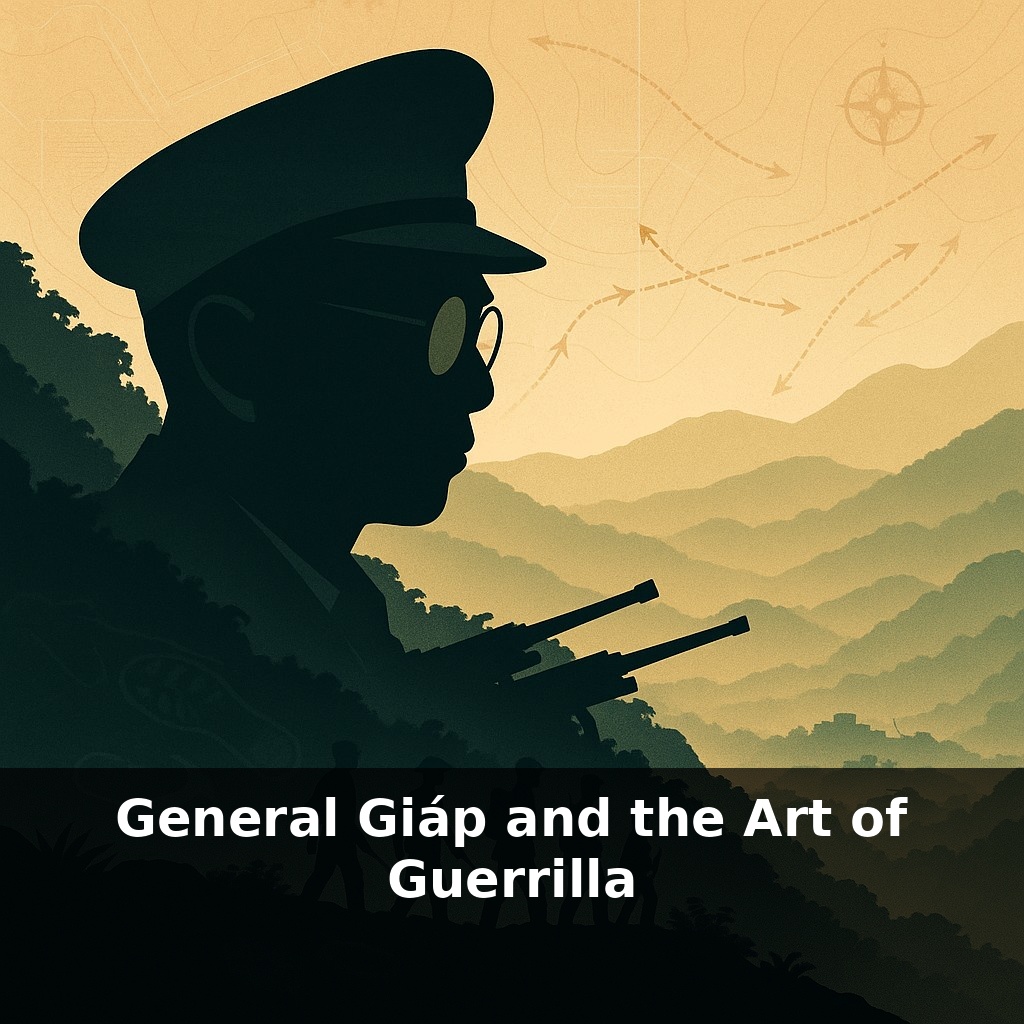
General Giáp and the Art of Guerrilla
📝 Transcript
Artillery shells arc into a remote valley. French officers watch, confident: their enemy has no tanks, no air force, barely uniforms. Yet a former history teacher, not a career soldier, is about to turn that certainty into a trap that will rewrite how the weak can defeat the strong.
Giáp’s genius wasn’t just in where he placed his guns, but in how he redefined what an army could be. He inherited fighters who owned more sandals than rifles and turned them into a force that could outlast industrial powers. His real weapon was organisation: villages became recruitment offices, rice fields doubled as supply depots, and local grievances were carefully woven into a national cause. Instead of waiting to match the enemy tank for tank, he asked: what can we already do better—endure, blend in, move quietly, learn fast—and how do we build a strategy around that? This mindset let him mix political persuasion, clandestine logistics, and selective battles into one system. To outside observers, it looked chaotic—small bands vanishing into jungle and city alike. Underneath, it was closer to a mesh network: resilient, redundant, and designed so that no single failure could break the whole.
Giáp built this system in a country shattered by famine, colonial rule, and war on multiple fronts. French forts dotted the landscape, later replaced by American firebases and airstrips; cities leaned toward foreign influence while villages held their own loyalties and fears. Instead of treating these fractures as weaknesses, he mapped them like a coder mapping legacy systems—identifying which pieces could be repurposed, which had to be bypassed, and where a small input could trigger a chain reaction. Crucially, he saw that rifles mattered less than relationships: control the story, and you slowly control the battlefield.
Subscribe to read the full transcript and listen to this episode
Subscribe to unlockSubscribe for $1.99/month to unlock the full episode.
From this course
Tales of Ingenious Generals
8 episodesUnlock all episodes
Full access to 8 episodes and everything on OwlUp.
Subscribe — $1.99/monthLess than a coffee ☕ · Cancel anytime