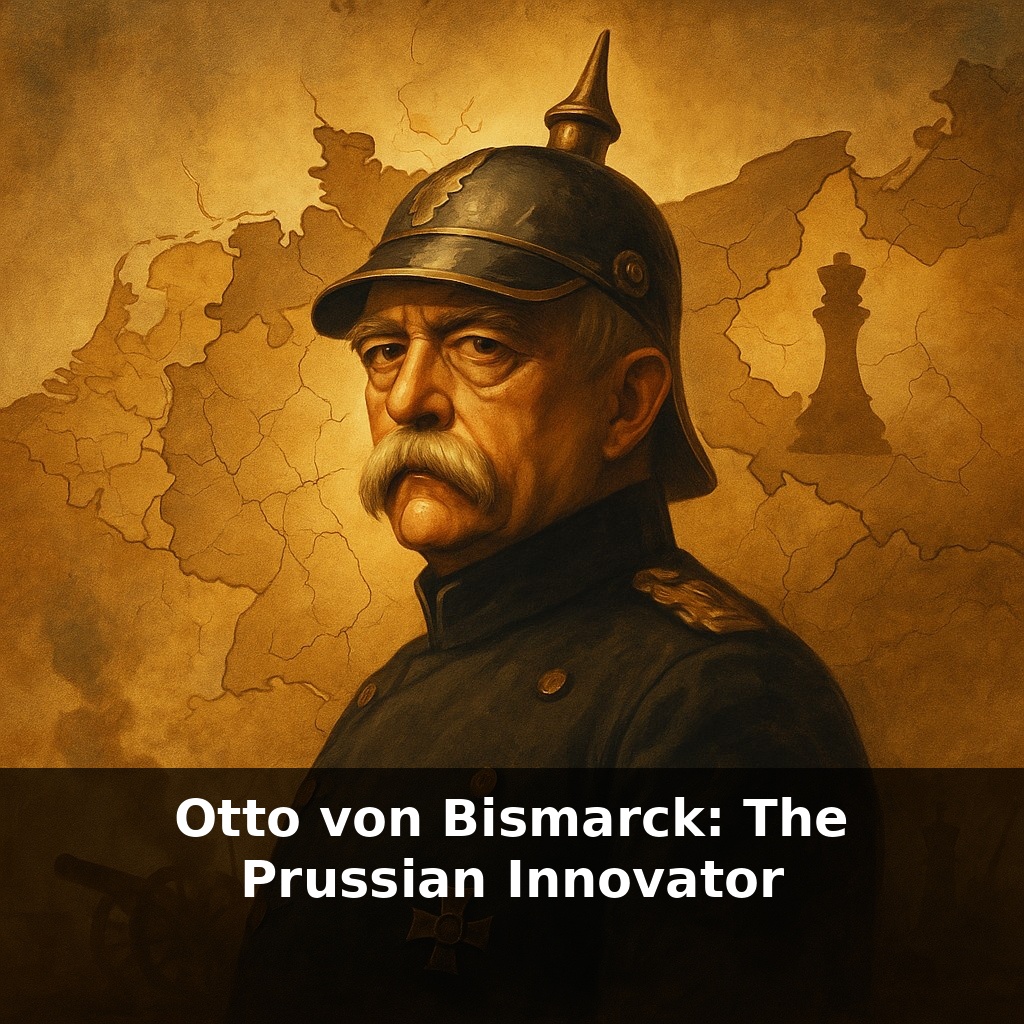
In less than two years of fighting, Otto von Bismarck shattered three powerful enemies and stitched together dozens of German states. A reckless warmonger… who actually hated long wars. How does someone who fears chaos reshape an entire continent through carefully controlled crises?
Bismarck grew up far from the roaring capitals of Europe, on a rural Prussian estate where politics felt as distant as the sea. Yet by the time he entered high office, the continent was a crowded room of suspicious powers, each listening for the faintest shift in the floorboards. Rather than shouting for attention, he learned to move the furniture an inch at a time—never so much that anyone could justify an all-out brawl. He studied not only armies and borders but also newspapers, public moods and royal egos, treating them like the hidden gears of a complex clock. When one gear jammed, he nudged another instead of smashing the whole mechanism. To understand how he did this, we need to follow him not onto the battlefield first, but into the smoky council chambers where a single sentence could redraw a map.
Bismarck’s real breakthrough came when Prussia itself looked stuck. Its parliament blocked military reforms, liberals distrusted the king, and neighboring powers expected gradual decline rather than ascent. In this deadlock, Bismarck treated constraints less as walls than as pressure points. He mapped who feared whom, who needed time, who needed money, who needed prestige—like tracing fault lines under a city before constructing a tower. Instead of chasing grand speeches or moral crusades, he asked narrower questions: Who actually signs this order? Who loses face if that border moves? Who benefits if nothing happens for six months?
Bismarck’s next move was to turn military power into a kind of silent leverage rather than a constantly used weapon. He backed the army’s modernization, but not because he wanted constant campaigns. He wanted other governments to read Prussia’s mobilization tables and railway timetables and quietly adjust their calculations. When he did choose confrontation, it was only after he’d rehearsed not just how to win, but how to stop.
His wars followed a pattern. First, he framed the dispute so that Prussia appeared as the side correcting an injustice or defending a right—crucial for swaying neutral powers. With Denmark, he wrapped Prussia’s push into a joint operation with Austria, making it hard to paint him as the lone aggressor. With Austria itself, he engineered a limited quarrel over the spoils, then signaled early that he would not dismantle the Habsburg Empire if victorious. That reassurance kept Russia and Britain calm. Against France, he trimmed and edited diplomatic messages—the famous Ems dispatch—until Napoleon III looked like the one slamming the door.
In each case, he set a ceiling on his own ambitions. He resisted generals who wanted to march on Vienna, or carve up Austria, or push deeper into France after 1870. Crushing an opponent too thoroughly, he believed, only invited a future crusade for revenge. Instead, he aimed to leave beaten powers wounded but structurally intact, with room to become useful partners later. That restraint puzzled many contemporaries who measured success in square miles seized.
Meanwhile, at home, he strengthened the new state not just with bayonets but with laws. He pushed through pioneering health insurance, accident insurance and old-age pensions—not out of sudden sentimentality, but to tie workers’ loyalty to the empire rather than to revolutionary movements. The social question, he decided, could not be policed away; it had to be partly answered. In doing so, he treated domestic unrest and foreign threats as linked fronts of the same long campaign: prevent coalitions, whether of hostile governments abroad or discontented citizens at home, from aligning against the order he was building.
Instead of drafting thick treatises, Bismarck often embedded his strategy in small, concrete moves that later historians could trace like fingerprints. Before the war with Denmark, he quietly sounded out Italian leaders, hinting that their quarrel with Austria might soon have a better moment; months later, Italy’s alignment helped keep Austria from gathering full support. When he anticipated a hostile newspaper storm in one capital, he arranged a reassuring royal visit or leaked a conciliatory remark in another, so ambassadors would report mixed signals rather than a clear pretext for alarm.
Inside Prussia, he experimented with timing just as much as with content. He might let a bill fail loudly to measure which deputies were bluffing, then reintroduce a trimmed version once tempers cooled, attaching it to a popular budget item that opponents could not afford to sink. One revealing pattern: he preferred reversible steps. A treaty with an escape clause, a law that could be amended later, a vague pledge instead of a binding guarantee. Like a software architect releasing a beta version, he watched how each “update” behaved in the wild before committing the regime to it fully.
Bismarck’s legacy hints at a future where states act less like rigid blocs and more like adaptive networks. As AI, cyber tools and drones compress decision time, leaders may copy his habit of pre‑calculating “off‑ramps” before a crisis begins. Domestic policy will matter, too: social protections could become as strategic as missiles when inequality fuels unrest. The risk is that today’s systems, unlike one statesman, resemble a crowded cockpit—many hands on the controls, but no single pilot.
In the end, Bismarck’s real innovation wasn’t a battlefield trick but a habit of thinking: treat every policy like a prototype, every alliance like code that might need debugging. For modern leaders, executives or community organizers, his story is a reminder to design exits as carefully as entrances—and to see today’s “wins” as version 1.0, not a final release.
Start with this tiny habit: When you finish reading or watching any news about politics or world events, pause and whisper to yourself, “What would Bismarck bargain for here?” and name just one concrete trade-off (like “he’d give up prestige to secure a long-term alliance”). When you close your laptop or put down your phone, take 10 seconds to mentally list one “Realpolitik” move you could use today—such as combining two errands, smoothing over a small conflict, or aligning your goal with someone else’s interest. Each evening while brushing your teeth, recall one moment from your day where you used (or could have used) Bismarck-style pragmatism instead of impulse.