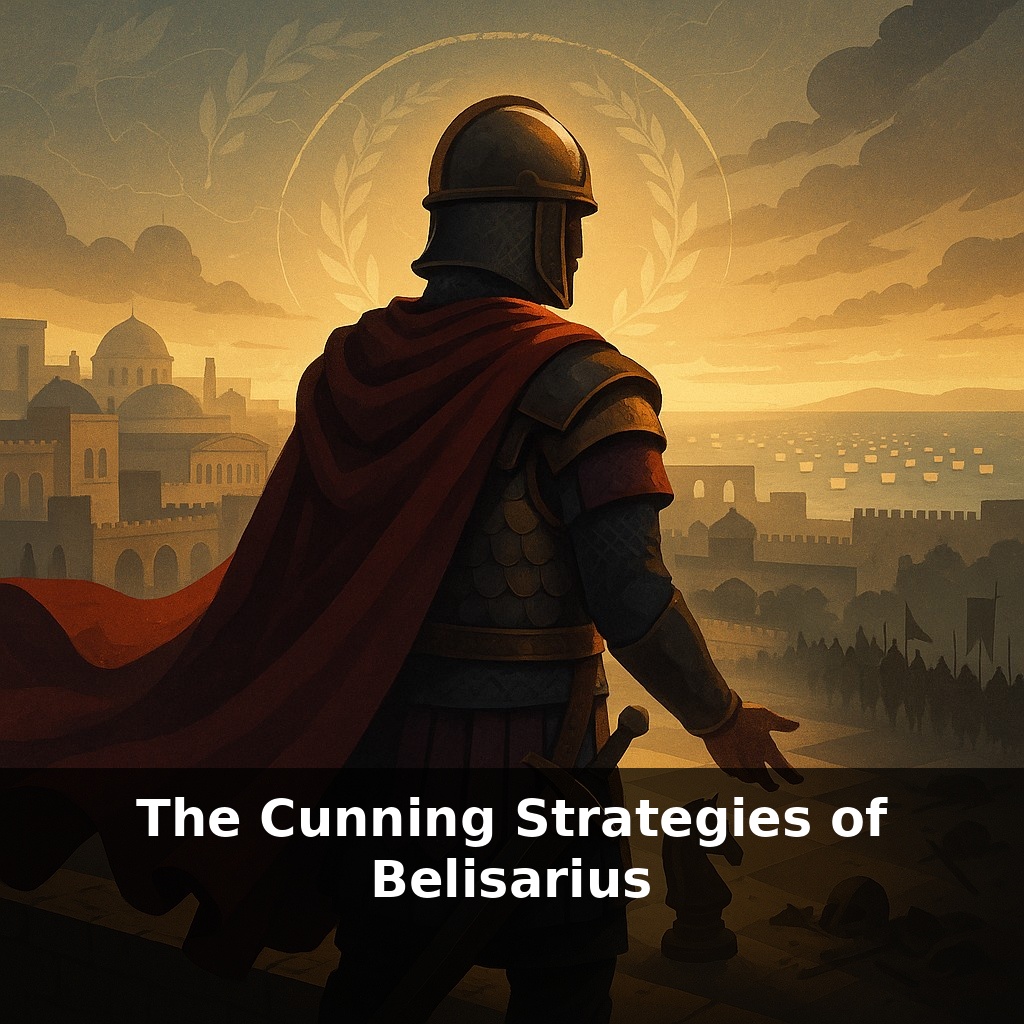
A general walks into Rome with barely a fraction of his enemy’s troops—and still holds the city. In one campaign, his fleet is the largest the Mediterranean has seen in centuries. How does someone win colossal wars with forces that look, on paper, like a rounding error?
Belisarius’s real advantage wasn’t just what he did on battlefields; it was how he rewired the incentives around him. While other generals treated war like a license to plunder, he treated it like a long-term contract with both his emperor and local populations. He banned looting not out of softness, but because every farm spared today was a supply depot and tax source tomorrow. He spoke the language of merchants and bishops as fluently as that of officers, stitching together fragile coalitions from rival tribes, city elites, and even former enemies. In North Africa and Italy, he turned conquered subjects into stakeholders, proving that disciplined behavior could be more terrifying—and persuasive—than terror itself. Where most commanders optimized for the next battle, Belisarius optimized for the next year, the next province, the next negotiation.
Instead of chasing glory on open battlefields, Belisarius often chose to fight for corridors, not castles: passes, harbors, aqueducts, and city gates that quietly determined who would eat, trade, or move. In Persia, he used feints and fast withdrawals to make sturdier armies hesitate, then struck where their lines bent around rivers and forts. In Italy, he treated walls not as barriers but as levers—controlling gates, roads, and grain routes the way a careful engineer manages pressure in a dam. His real battlefield was the network of roads, ports, and loyalties that fed his enemies’ strength.
Belisarius’s real edge was how he stacked **layers of advantage** around a small core of troops—mobility, information, and narrative—until raw headcount stopped mattering.
Start with mobility. He didn’t just move fast; he chose *when* to be seen. Against the Goths in Italy, his cavalry would appear in strength on one front, then vanish before the enemy could pin them, reappearing days later against an unguarded convoy or bridge. He treated distance like a budget: every mile his men rode had to buy confusion, not just progress. When cut off in Rome, he launched sudden night raids on siege works, then slipped back inside before dawn, forcing a much larger army to sleep in armor and react to ghosts.
Information was the second layer. Communications with Constantinople were slow, so he built his own decision network in-theater. He cultivated local informants—merchants, disgruntled nobles, even rival generals’ staff. Before major moves, he often knew who hated whom inside the opposing camp. In North Africa, after defeating the Vandals, he intercepted letters showing that some Byzantine officials planned to replace him. Instead of rebelling or sulking, he quietly secured key ports and garrisons first, then presented Justinian with a fait accompli: the province pacified and revenue flowing. Removing him would now be expensive.
Then came narrative. Belisarius was acutely aware that every action wrote a story in the minds of enemies and allies. When a city surrendered, he made a point of publicly confirming its privileges and protecting religious sites. This wasn’t sentiment; it was a signal: *Cooperate, and you’ll be better off than under your old rulers.* When some Gothic commanders switched sides, he paraded their loyalty, not their humiliation, encouraging others to imagine a future with him rather than against him.
Occasionally he used restraint as a weapon. At the siege of Naples, his engineers quietly dug a tunnel through an old aqueduct. When his men broke in, the city could have been sacked. Instead, he punished only a narrow group of resisters and restored order quickly. Word spread across Italy that resistance might fail, but surrender wouldn’t mean annihilation. That combination—credible threat plus credible mercy—created a psychological pincer movement as powerful as any on the battlefield.
Belisarius treated constraints as design specs, not excuses. When he landed in North Africa, he didn’t try to mirror Vandal strength; he reconfigured the field. He split his force into compact, semi-autonomous groups that could act on partial information without waiting for orders to crawl back from Constantinople. These weren’t just detachments; they were prototypes of a modular command system. One squadron harassed along the coast, another locked down key crossings, others secured grain and horses. Each piece was small enough to move fast but large enough to matter if contact turned into combat.
He also understood that people, not maps, were the real terrain. In Italy, he quietly elevated capable Gothic leaders who were willing to cooperate, giving them limited but real authority under imperial oversight. Instead of purging the previous regime wholesale, he repurposed its mid-level talent. That meant fewer desperate last stands and more negotiated handovers of cities, fortresses, and fleets that might otherwise have taken months—or thousands of lives—to seize by force.
Belisarius hints at how to win when you can’t outspend or out-staff rivals. In today’s cyber conflicts or tight-budget organizations, his approach suggests a shift: treat data, trust, and timing as your main “armies.” A small security team that spots patterns early, or a startup that earns user goodwill before scaling, can box in larger, slower players. Your challenge this week: map one area where you’re outmatched, and redesign it around speed, insight, and credibility instead of volume.
Belisarius shows that leverage often hides in places we overlook: customs, rumors, even travel speed. He treated each like a line of code in a larger system, debugging failures instead of blaming “bad luck.” Try tracing one ongoing struggle in your life as if it were his campaign log—what small, repeatable edges could quietly flip the whole script?
Before next week, ask yourself: 1) “Where in my life am I outnumbered—at work, in a project, or in a negotiation—and how could I ‘Belisarius’ it by exploiting terrain, timing, or information (for example, changing the setting of a meeting, who’s in the room, or what data is on the table) instead of trying to win by brute force?” 2) “If I treated my ‘enemy’ the way Belisarius often did—showing restraint, offering fair terms, or turning them into allies—how might that change a current conflict I’m in, and what exact conversation or email could I send today to test that approach?” 3) “Like Belisarius using scouts and intelligence before committing troops, what is one concrete piece of information I need to gather today (from a colleague, a customer, or a rival team) before I ‘charge in’ on a big decision this week?”