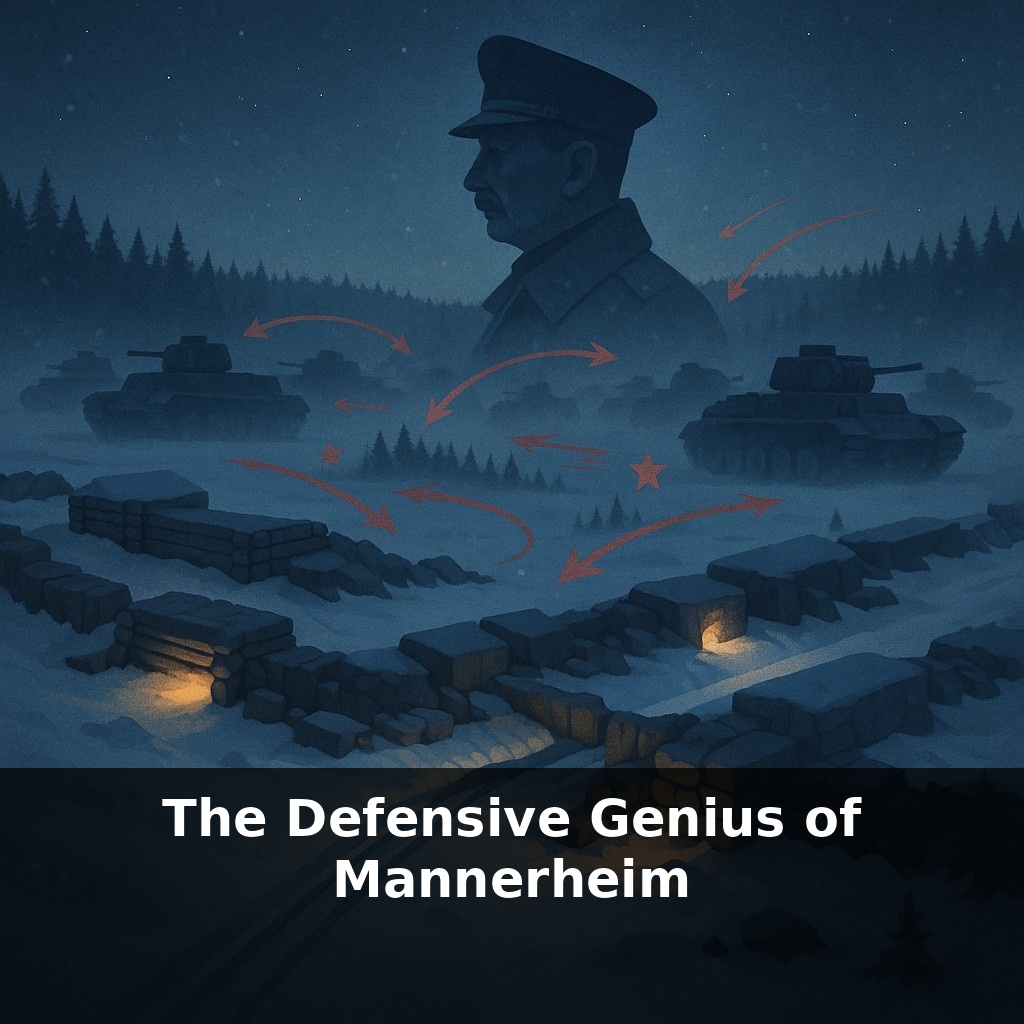
A tiny country, outnumbered about three-to-one, halts a giant army in subarctic darkness. Soviet tanks grind to a halt in frozen forests; ski patrols vanish into silent snow. How does a defensive line that’s mostly wood and stone hold long enough to force a dictator to bargain?
Soviet intelligence had promised Stalin a quick march to Helsinki. Their maps marked Finnish positions almost like minor speed bumps on a highway. Then reality hit: assaults stalled, casualties soared, and the “backward” Finns fought with a coordination that didn’t match their meager hardware. Somewhere behind those patchwork fortifications was a mind treating the whole front like a living system, not a static wall.
Mannerheim wasn’t just placing bunkers; he was scripting how they would fail, where units would bend, and when they would vanish and reappear. Think of a chess player who assumes every piece will be sacrificed eventually, and plans combinations that begin after the losses, not before. That mindset turned shortages into traps, cold into a weapon, and scattered units into a single, stubborn will that Moscow had to reckon with.
Mannerheim’s real leverage was paradoxical: the more Finland lacked, the more precisely he had to think. He dissected the map like a contractor forced to renovate a house with almost no budget, asking: where do I absolutely need concrete, and where will clever carpentry do? Road networks, frozen lakes, and ridgelines became switches he could flip—open to lure, closed to choke. He pushed initiative downward, trusting junior officers to improvise in blizzards and darkness. That trust was radical in an age of rigid commands—and it let local insight continually refine his larger design.
Mannerheim’s first move was brutal triage: he quietly accepted that he could not protect all of Finland and chose to protect what mattered. That meant concentrating scarce troops where Soviet armor and supply columns had to pass, and leaving vast stretches of wilderness almost empty. But “empty” didn’t mean undefended; it meant defended differently.
He treated the map as zones of friction. Where terrain already punished movement, he added just enough man-made obstacles—wire here, a roadblock there, a few dugouts covering a narrow isthmus. In places where nature was less helpful, he compensated with deeper layers of fallback positions and pre-sighted fields of fire. The goal wasn’t to make every position strong; it was to make every approach exhausting.
He also refused to let any sector become a single point of failure. Artillery, for example, was painfully scarce. Instead of tying guns permanently to one stretch of front, he created “fire brigades” that could be shifted by rail or road to wherever Soviet pressure peaked. Crews rehearsed rapid dismounting, firing, and disappearing before counterbattery fire could arrive. The same logic applied to infantry reserves: they were held just far enough back to be flexible, but close enough to intervene before a breach became a collapse.
The most distinctive layer was mobility on snow. Ski units weren’t elite decorations; they were the nervous system of the defense. Small detachments moved along forest paths, frozen bogs, and lakes at speeds motor columns could not match. They mapped Soviet habits: where supply sleds paused, where sentries got lax, which curves in a forest road forced convoys to bunch up. Then they cut those lifelines—burning fuel dumps, ambushing field kitchens, dragging logs across roads to trap trucks in kill zones.
Leadership style reinforced all of this. Mannerheim issued intent, not scripts. Regulations were bent to fit conditions on each ridge and village. Reports from platoon leaders—complaints about boots, notes on snow conditions, patterns of Soviet artillery fire—were treated as operational data, not noise. Over time, that feedback loop sharpened the whole system, turning scattered observations into adjustments in where to reinforce, when to rotate units, and how to time counterattacks so they hit exhausted attackers at their lowest ebb.
Mannerheim’s real edge shows up in the small, concrete choices he made. For instance, when Soviet units finally blew gaps in parts of his line, he didn’t rush everyone to plug the hole in a panic. Instead, he let attackers pour in just far enough that their own logistics stretched thin—then hit the flanks with fresh local reserves who knew every fold of ground. A regiment that had spent weeks on quiet duty in one sector might suddenly be railed overnight to strike in another, arriving with accurate map sketches passed along from ski patrols.
He also treated “minor” details like shelter and rest as operational tools. Units rotated out before they were broken, not after, preserving a core of veterans who could stiffen new formations. Field kitchens and hot drinks weren’t comfort perks; they were planned as morale spikes before expected assaults. And when reports showed Soviet units adapting to one Finnish trick, he didn’t forbid initiative—he tasked frontline officers to invent the next one, then spread working ideas sideways across the army like patches to a shared software system.
Mannerheim’s lesson quietly echoes forward. Small states study his playbook the way startups dissect how a tiny rival fends off a tech giant: by raising the “price” of every advance. Today, Baltic planners sketch layered defense zones that turn highways into selective valves, not open doors. As Arctic ice thins, logisticians revisit how fuel, sensors, and drones survive brutal cold. And AI labs feed Winter War data into simulators, training algorithms to spot when agility beats mass.
Mannerheim’s deeper legacy isn’t just military; it’s cognitive. He treated constraints like a sculptor treats stone, carving possibility from limitation. Modern crisis teams echo this when they pre-plan “graceful failures” instead of chasing perfection, turning outages, budget cuts, or staff losses into chances to redirect pressure and re-balance the whole system.
Try this experiment: Pick a current project where you feel “outgunned” (too few resources, tight deadline) and deliberately design a “Mannerheim Line” for it. List the 3–5 most critical choke points where things usually bog down (e.g., approvals, data, key decisions), and for each, set up one deliberate obstacle that slows chaos but channels progress—like requiring a 10‑minute pre-meeting brief or a one-page decision memo before any big change. For the next week, defend those choke points ruthlessly the way Mannerheim defended the narrow passages through the forests, and track what happens to interruptions, rework, and mistakes. At the end of the week, compare: did your “defensive line” make the work feel slower but safer, or did it actually speed things up by preventing costly retreats?