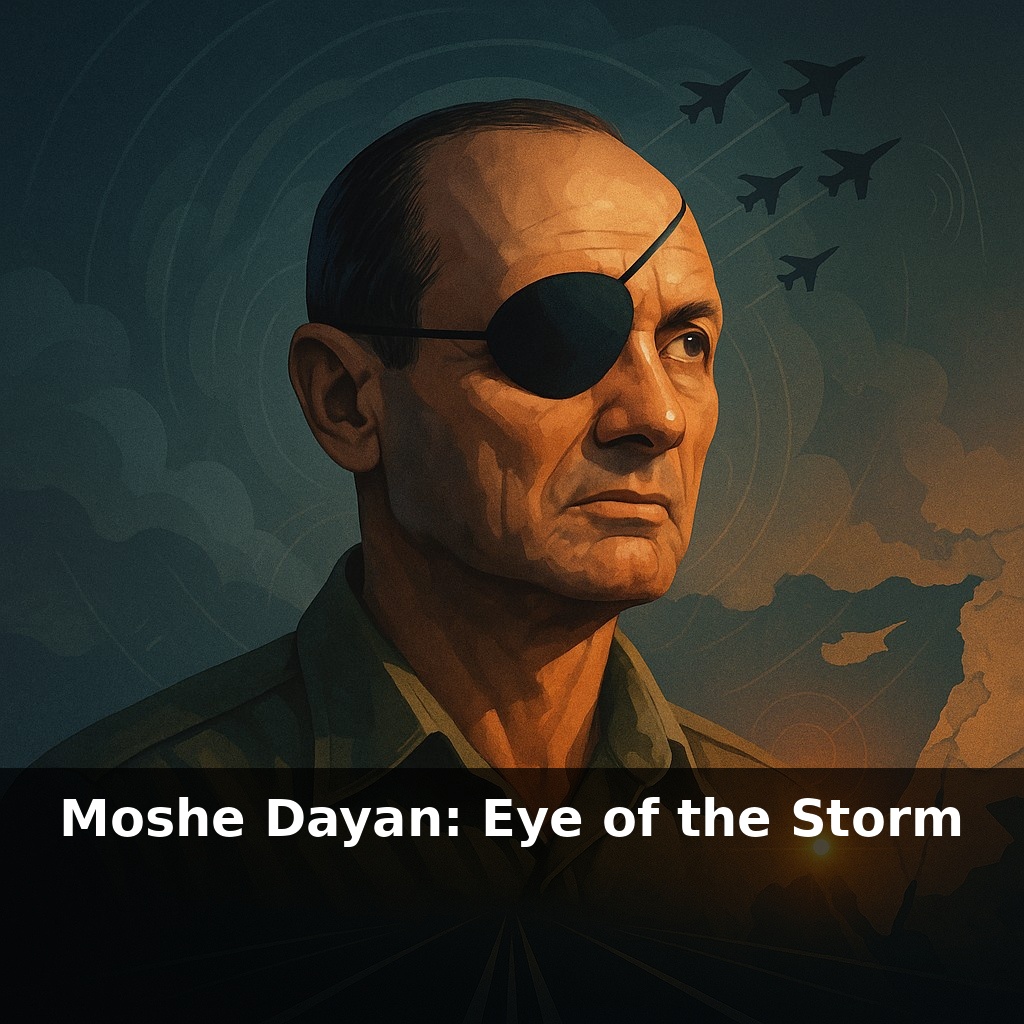
A general loses an eye as a teenager—and later convinces a tiny country it can fight and win in less than a week. In one dawn, his air force shatters almost an entire enemy fleet on the ground. How do speed, nerve, and one risky bet reshape a nation’s fate?
Dayan’s missing eye became a myth; his real power was how he saw with the one that remained. Where others counted divisions and tanks, he counted minutes, runways, and radio frequencies. He inherited an army that was tough but improvised, more neighborhood watch than modern force. He set out to turn it into something else: a machine that could wake up in the dark, assemble from civilian life, and strike before breakfast.
To do that, Dayan obsessed over details that seemed mundane: how fast a reservist could get from tractor to tank, how many aircraft could take off from a short strip without colliding, how commanders in jeeps could talk to pilots overhead without delay. Think of it as rewiring a busy train station so every track, signal, and timetable lined up perfectly for one rush hour that really mattered—opening the door to campaigns measured in hours instead of months.
Dayan’s upbringing made that obsession almost inevitable. He grew up on a kibbutz that mixed frontier danger with strict routines: milking at dawn, patrols at night, meetings that lasted longer than the meals. As a teenager he joined irregular defense units, learning how scattered farmhands could, on short notice, act like a coordinated patrol. Later, in British-uniform campaigns across the Middle East, he watched empires move divisions with ponderous paperwork and distant orders. Those two worlds—improvised village defense and slow imperial logistics—taught him exactly what he did and didn’t want for Israel’s future army.
Dayan’s first real laboratory wasn’t the Sinai or the Golan; it was the early 1950s IDF, a force full of veterans who knew how to fight but not how to move as one. As Chief of Staff, he didn’t start by buying shiny new weapons. He started by asking a blunt question: “Who will actually show up, and how fast, if war starts tonight?”
The answer pushed him toward a system built around reservists rather than a huge standing army Israel couldn’t afford. But reservists live scattered lives—teachers, mechanics, farmers—so he treated the country itself as a kind of hidden barracks. Road networks, bus depots, even telephone exchanges became silent parts of a mobilization plan. When the sirens went, the whole civilian grid was supposed to flex.
Inside the army, he pushed for a specific style of campaign: short, decisive, and layered. Not just tanks racing ahead, but tanks whose movements were timed with artillery and aircraft, all sharing information fast enough to keep the front from turning into a traffic jam. He backed officers who could improvise on the move, but he insisted they be plugged into a shared picture rather than acting as lone heroes.
This is where his trust in intelligence came in. Dayan encouraged deep surveillance of neighboring armies: runway counts, radar habits, refueling cycles, command routines. Over time, that built a mental map of how opponents woke up, armed up, and moved. When war came, he wanted to be steps inside their decision loop, striking not just where they were, but where they were about to be.
Yet he also understood limits. Israel couldn’t win a slogging match in sheer numbers, so he kept returning to a hard constraint: how many days of intense operations the economy and reserves could sustain before the edge dulled. That calculation shaped everything—from how far units were expected to advance, to how long aircrews could be pushed before exhaustion warped judgment.
In practice, his reforms turned campaigns into tightly choreographed storms: brief, violent, and reliant on everything working in sequence. It was brilliant when it worked—and dangerously brittle when assumptions proved wrong.
Dayan’s approach showed up most clearly in how he treated each new crisis as a design problem. In 1956, during the Suez campaign, he didn’t just send paratroopers into Sinai; he reshaped how they linked with armor racing over sand tracks, testing how far units could stretch before losing coherence. After 1967, he pushed for quick deployment plans on the new frontiers: who guarded narrow passes, who could rush to the canal, who watched the skies over the Golan. These weren’t abstract questions—they produced binders of orders, road priorities, fuel dumps, even preplanned landing zones.
In today’s terms, he behaved less like a traditional field marshal and more like a lead systems engineer on a complex software rollout: synchronize updates, stress-test for peak load, remove lag between modules. He kept asking, “Where is the single point of failure?” The irony was that he rarely treated his own judgment as one of those potential failure points, even as his confidence hardened into doctrine.
Dayan’s legacy quietly haunts today’s planners: when algorithms can cue strikes in seconds, “acting first” stops being exceptional and becomes default. That raises a deeper question: who, or what, decides when tension becomes intolerable? The lesson isn’t to shun initiative, but to design brakes as carefully as accelerators—red teams that poke holes in assumptions, diplomatic “escape hatches,” and leaders willing to pause a seemingly perfect plan long enough to ask, “What if we’re the ones who are wrong?”
Dayan’s story hints at a quieter skill: knowing when yesterday’s brilliance has gone stale. In business or tech, it’s like retiring a star product before bugs turn fatal. His arc nudges us to ask: which of our own “proven” instincts now blind us? The next leap may come less from sharper vision than from choosing, occasionally, to blink.
Try this experiment: For the next 24 hours, whenever you have to make a decision under pressure (even small ones at work or home), give yourself exactly 60 seconds to decide, then commit fully—no revisiting, no second-guessing, in the spirit of Dayan’s rapid battlefield calls. Keep a simple tally of how many of those “Dayan decisions” you make and how often they actually lead to worse outcomes than if you’d hesitated. If you hit a situation where your instinct clashes with conventional wisdom (like Dayan backing a risky maneuver others doubted), choose your instinct once and see what happens. At the end of the day, ask yourself whether fast, decisive action caused more problems—or actually moved things forward more than your usual style.