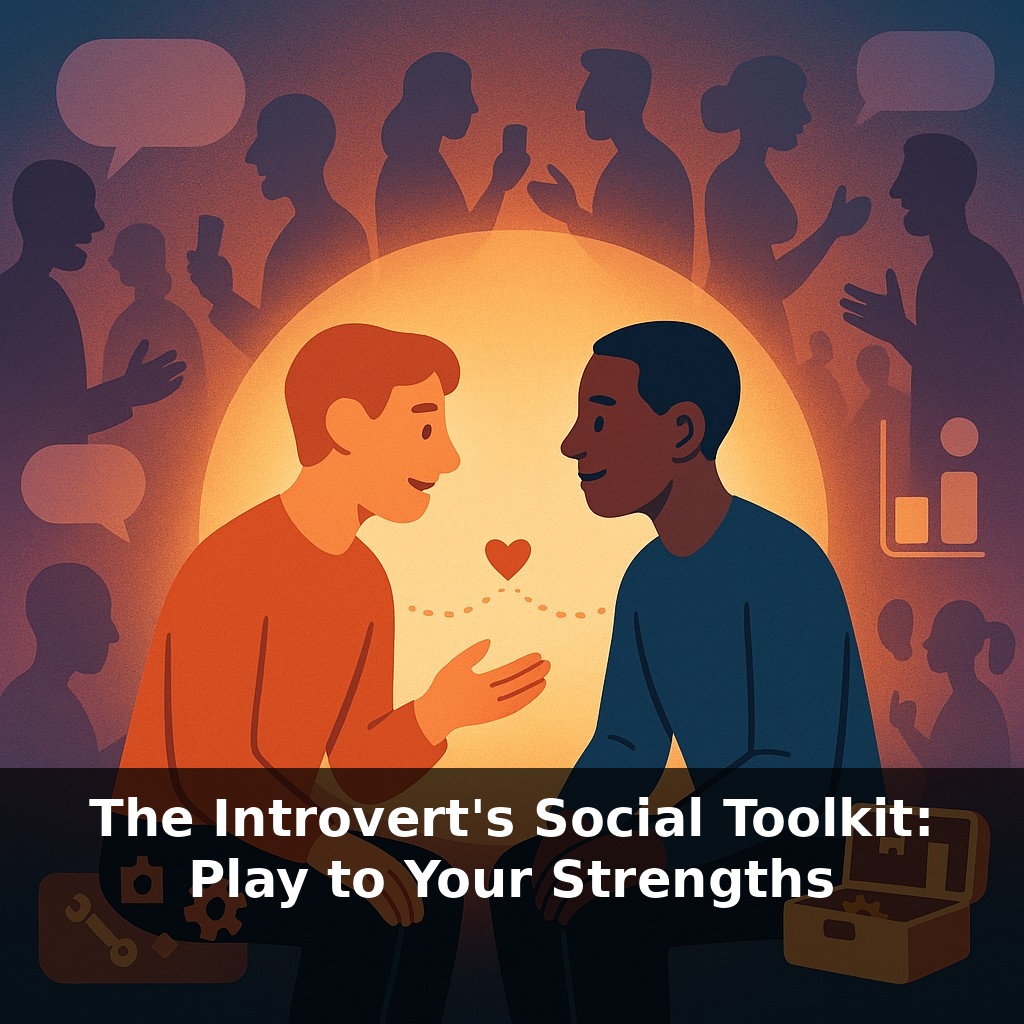
The Introvert's Social Toolkit: Play to Your Strengths
📝 Transcript
About half the people you meet feel drained after small talk—yet many think they’re “bad” at being social. Consider two coworkers at the same party: one works the room with ease; the other, interestingly, dives deep into just three conversations. Here’s the twist: the quieter one may be using the stronger social skill.
Here’s the real turning point: once you stop judging yourself by “how outgoing you look” and start measuring by “what value you quietly create,” your entire social strategy changes. Instead of forcing constant interaction, you begin designing situations where your natural strengths do the heavy lifting. That might mean asking one thoughtful question and then really listening, rather than volleying comments just to keep things lively. Or choosing a focused chat with one colleague after a meeting, where your careful observations can surface, like a photographer waiting for the exact right light before pressing the shutter. The goal isn’t to act more extroverted—it’s to engineer contexts where preparation, reflection, and genuine attention become obvious advantages, not hidden, “polite” background behavior.
So the next step is to stop treating your introversion like a flaw to fix and start treating it like a design constraint. Architects don’t complain that gravity exists; they build structures that work *with* it. You can do the same with your social life. That means noticing when your energy is highest, which formats feel least costly (one‑to‑ones, written messages, structured meetings), and which roles let you contribute without performing. You’re not trying to “keep up” with louder people—you’re customizing the room, the pace, and even the channel so interaction feels sustainable instead of draining.
Here’s where science quietly backs you up. When researchers compare introverts and extroverts, the differences aren’t “good at people” vs. “bad at people.” They’re about preferred *conditions*: intensity, pacing, and depth. Introverts tend to process more internally before responding, notice subtler signals, and sustain focus longer on one thread. None of that shows up well in fast, noisy, unstructured interactions—but it shines in the right format.
So your real leverage point isn’t “being more social”; it’s *choosing arenas where your brain’s default settings are an asset*. Three levers matter most: time, size, and channel.
Time is about when and how quickly things move. Many introverts do better when they know what’s coming—a meeting agenda sent ahead, a topic for a call, even deciding in advance which two people they’ll talk to at an event. That lowers the mental “background load” so you can use your focus where it counts: tracking nuance, following threads others drop, catching inconsistencies or unspoken concerns.
Size is about how many people share your attention. In a big, free‑for‑all discussion, the loudest voice often wins. But in pairs or small groups, the person who notices patterns and connects dots can quietly steer the whole direction. You don’t need to dominate; you need enough space for your slower, more accurate thinking to land. This is why mixed teams generate more original ideas when they add silent brainstorming: your mind is built for that mode.
Channel is about *how* you exchange information. Conversation in real time rewards speed; written or asynchronous channels reward clarity and thoughtfulness. Email, chat, shared docs, even a short follow‑up message after a meeting let you contribute the thing you do best: considered input that reduces errors and refines ideas. In many workplaces, the person who sends the sharp, well‑timed follow‑up quietly becomes the unofficial navigator of decisions.
Think of this as social “portfolio allocation”: you’re not opting out of interaction; you’re investing more of it where your returns—connection, influence, satisfaction—compound fastest.
You might test this “design, don’t perform” approach in low‑stakes places first. At work, volunteer to be the person who reads background documents before a meeting and comes with 2–3 risks or questions no one else has flagged. You’re using the same focus that helps you spot errors, but now it’s a visible contribution. In a group hangout, notice who’s hanging back like you. Ask one specific question about something they clearly care about—a shirt from a band, a book under their arm, a logo on their laptop—and let the topic do the heavy lifting.
In mixed‑personality teams, try proposing five minutes of silent note‑taking before open discussion. Frame it as a way to “get more ideas on the table,” not as an introvert accommodation. When people see the quality jump—sharper questions, more original angles—you’ve quietly proved the value of your pacing.
Over time, you can start treating your calendar like an artist’s palette: fewer, richer colors instead of constant noise, placing high‑energy interactions where they’ll matter most.
Remote‑first workplaces and AI tools will quietly tilt things in your favor. Auto‑summaries can spotlight the sharp question you typed, not the loudest voice in the room. VR and hybrid setups make it normal to “step out” without drama, so recovery breaks look like professionalism, not withdrawal. Leadership paths may split: some roles rewarded for broadcasting, others for refining. That second lane fits you: less stage, more control room, where careful choices ripple through whole systems.
You don’t need to overhaul your personality; you need to fine‑tune your settings. Treat each interaction like adjusting light in a room: dimmer for big groups, spotlight for one‑to‑ones, soft lamp for async messages. Over the next month, notice where you leave feeling clearer, not smaller—and quietly schedule more life in those conditions.
Before next week, ask yourself: 1) “In my next social situation (like my team meeting, family dinner, or meetup), where could I intentionally lean on an introvert strength—like thoughtful listening, asking deeper follow-up questions, or preparing 2–3 conversation starters in advance—and what would that actually look like?” 2) “Which specific ‘energy leaks’ in my social life (certain people, times of day, or types of gatherings) leave me most drained, and how could I experiment with one boundary or exit strategy—like setting a time limit, taking a solo break, or leaving early—just once this week?” 3) “If I treated my need for recharge as non-negotiable, what is one concrete ritual I could schedule after my next social event (a solo walk, quiet reading, or music with no talking) so I end the day feeling like myself again?”
From this course

Talk to Anyone: Social Skills for Real Life
7 episodesUnlock all episodes
Full access to 7 episodes and everything on OwlUp.
Subscribe — $1.99/monthLess than a coffee ☕ · Cancel anytime