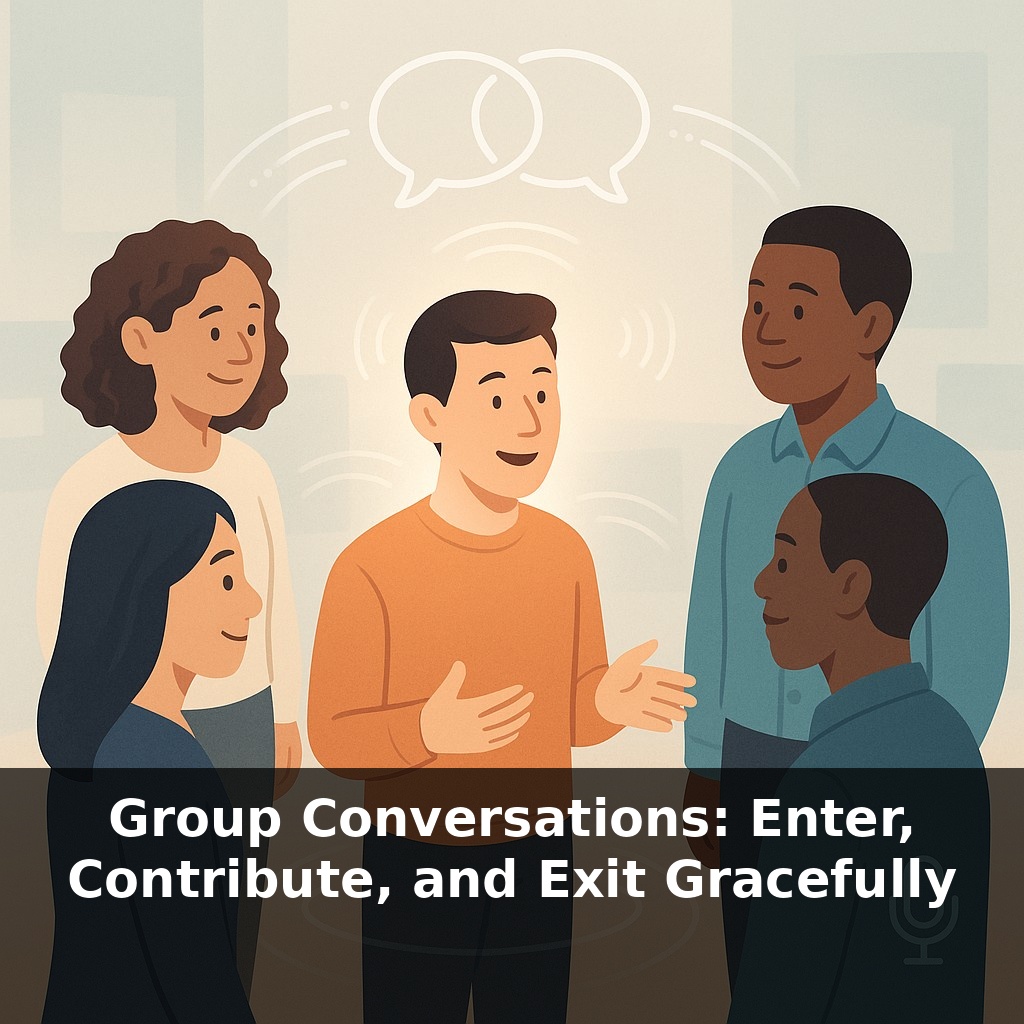
About half the people in any room feel awkward speaking in groups—yet the people who talk *less* often end up liked *more* when they choose their moments well. You’re standing with three coworkers, the story is rolling, and there’s that tiny pause. What you do next quietly changes everything.
MIT researchers found that teams who simply shared the floor more evenly beat others by a huge margin on tough problems. Not because anyone gave TED-level speeches—but because the rhythm of entry, talking, and exit flowed better. That rhythm is where most of us quietly struggle.
You might know how to talk one-on-one, yet feel strangely “jammed” in groups: you see a topic you care about, your brain lights up, but your timing feels off. Someone else jumps in first. Or you finally speak and worry you’ve gone on too long, like a song that missed its ending.
This is where micro-skills matter: catching the subtle signs that it *is* your moment, landing a short, clear contribution, and stepping out without that “now what do I do with my hands” feeling. Instead of forcing yourself to “be more social,” you’ll learn to tweak *when* and *how* you join so your voice fits—and lifts—the group.
Some people seem to “just know” when to glide into a group chat, add one clean point, and bow out without leaving awkward air behind. That’s not magic or personality—it’s pattern recognition. They’re quietly tracking small cues: who hasn’t spoken yet, which way bodies are angled, how fast voices overlap, whether the topic is heating up or winding down. Think of it less like performing and more like reading a weather radar: you’re learning to spot shifts before they hit. Once you can notice those patterns, you can enter earlier, speak shorter, and exit smoother—without pretending to be louder or more “extroverted” than you are.
Think of group conversations as having three “doors” you can walk through: the way in, the way you stand in the room, and the way out. Once you can see those doors, you stop feeling trapped and start feeling like you have options.
First, the entry door. People rarely *announce* entry points; they leak them. Look for tiny pauses after punchlines, a head turning slightly toward you, a question tossed “to the group” instead of to one person. Physical space matters: if someone shifts their stance to open the circle, or sets their phone down and scans faces, they’re making room. Your goal isn’t to pounce, it’s to *pair* your move with theirs: a half-step in, brief eye contact, then a short preface like, “Quick thought on that…” or “Can I add a twist?” These small signals let others adjust instead of feeling interrupted.
Once you’re in, the “standing in the room” part is contribution. Here, the skill isn’t being dazzling—it’s being *trackable*. People follow you more easily when you speak in visible chunks: one clear point, maybe one short example, then a handoff. You can literally mark the edges of what you’re saying: “Two things…” (share them) “That’s it.” This makes you sound more confident and makes it easier for others to respond without stepping on you. Notice who looks like they want in next—a quick “What do you think, Sam?” turns your turn into a bridge, not a block.
The exit door is where most awkwardness piles up, but it doesn’t have to. Exits feel smooth when three elements line up: appreciation, a tiny reason, and a pointer back to the group. For example: “This was fun—I’ve got to jump to a call, but I want to hear how that project turns out,” plus a small backward step or glance toward the next speaker. In ongoing meetings, you can exit *topics* even if you’re not leaving the room: “That’s my take—I’m curious how others see it,” then physically lean back or turn your shoulders slightly away from the center. Your body is saying, “My part’s done; floor’s open,” which helps the discussion move instead of stall.
At a friend’s birthday, four people are debating travel hacks. You’re nearby, half-listening. Someone says, “I always overpack shoes,” and two others laugh. Nobody replies right away; one person glances around while sipping their drink. That micro-pause is your clean opening—step slightly closer, let your eyes pass over the group, and say, “I have a ruthless packing rule for this.” You’re not hijacking; you’re offering a clear, contained piece.
Contributing, you might frame it like this: “I only pack shoes that match three outfits. Last time it cut my bag in half.” Then you pass the conversational ball: “Anyone else have a weird rule like that?” Now you’re not just talking—you’re curating.
To exit, you could say, “That’s my only superpower here; I’m stealing everyone else’s ideas,” with a small laugh and a shift of your body so others naturally fill the center. The topic continues, and you’ve left a pleasant “aftertaste”: you were brief, specific, and made others’ voices more central.
As meetings get recorded, captioned, and analyzed by default, your future “conversation footprint” may matter as much as your email record. Software could flag when you consistently talk over quieter colleagues or vanish from discussions, much like a bank app highlighting odd spending. That visibility can push teams toward fairer turn-taking, but also tempt managers to rank people by “airtime scores.” The opportunity: treat these tools as mirrors for growth, not surveillance to game.
Your challenge this week: treat each group chat like a low-stakes experiment. In one, only practice noticing entry cues. In another, focus on one crisp point, then hand off. In a third, practice exits. Jot one sentence after each: “What surprised me?” Over time you’re less “on stage” and more like a sound engineer, tuning levels so everyone’s voice—including yours—comes through.