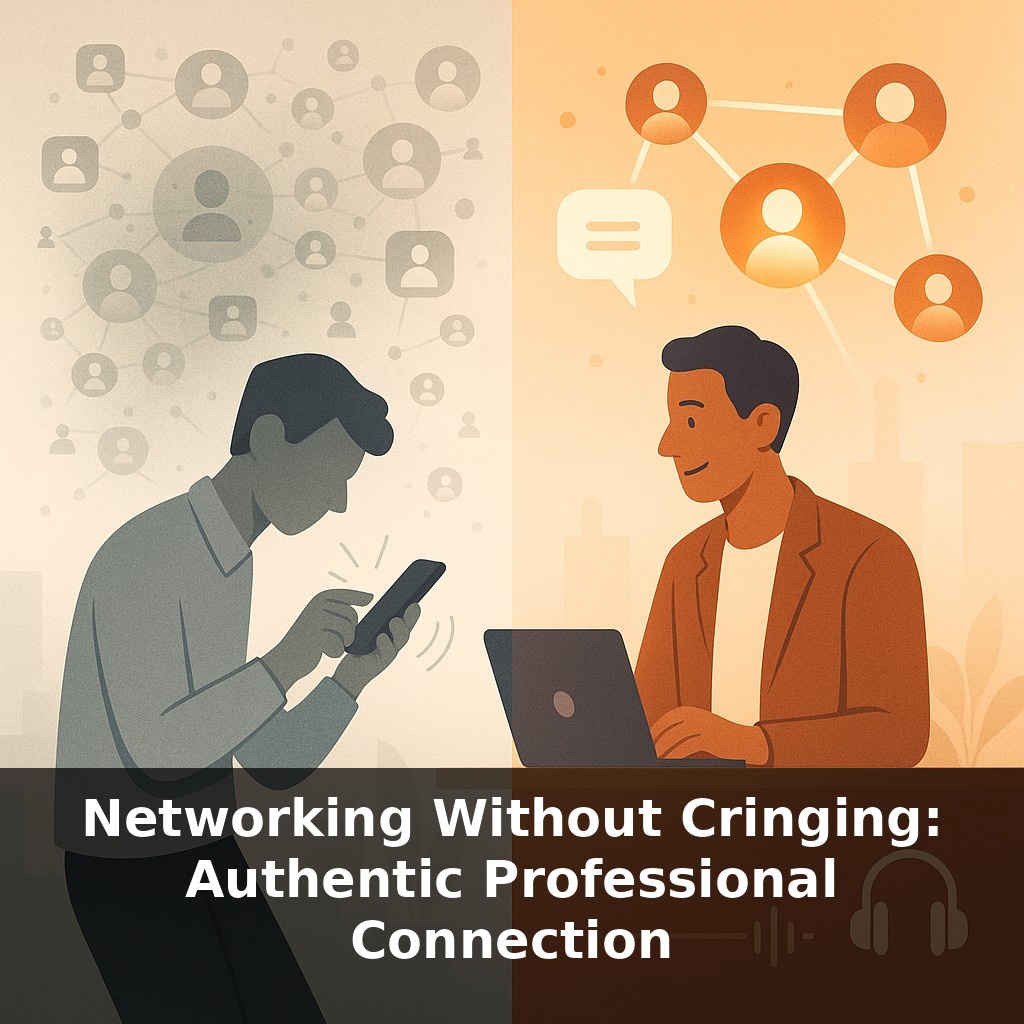
About half of all jobs never hit a job board—they quietly pass through conversations. Now, one person scrolls LinkedIn adding strangers at high speed. Another sends a single thoughtful message to someone they admire. Same platform, two strategies. Which one actually builds a real career safety net?
Those quiet conversations that move opportunities around? They’re not accidents. They usually grow from tiny, authentic moments: a sincere question after a talk, a helpful comment in a niche forum, a brief “this made me think of your work” email. The people who seem “naturally” well-connected aren’t necessarily loud or extroverted—they’ve just learned to be consistently useful, curious, and visible in small ways over time.
This is especially good news if big, buzzy events drain you. Research shows that trust and reciprocity—not popularity—predict which connections actually open doors. That means your strengths as an observer, a careful thinker, or a one‑on‑one conversationalist are not disadvantages; they’re precisely the ingredients that make relationships feel safe and memorable in a noisy, crowded professional world.
Here’s the twist: most people still treat “networking” like a numbers game, even though the research doesn’t back that up. Studies on social capital show that a few strong connections—people who’d actually vouch for you, share information, or think of you for a project—often have more impact than dozens of casual contacts. For introverts, this flips the script. You don’t need to be “on” all the time; you need to be intentional. Think less about collecting business cards, more about slowly becoming the kind of person others are glad to introduce, recommend, or collaborate with.
Look at your own experience: the people you’d actually go out of your way to help aren’t the ones who shouted their achievements at you. They’re the ones who made you feel seen, respected, and safe. That’s the quiet core of connection science keeps circling back to.
One big shift: stop asking, “How do I talk about myself?” and start asking, “How can I make this easy and interesting for the other person?” For many introverts, that’s a relief. You’re not performing; you’re running a thoughtful conversation.
Psychologically, a few levers matter a lot more than charm:
- **Specific curiosity.** Vague interest feels polite. Specific interest feels real. “I liked your talk” is fine; “Your point about measuring failure rates changed how I think about X” invites a real reply. - **Small, reliable follow‑through.** Sending the article you mentioned. Making the introduction you offered. People unconsciously track consistency; it’s how trust accumulates. - **Shared context.** We relax when someone “gets” our world—our constraints, jargon, or goals. Joining niche communities (a subfield Slack, a small mastermind, a local meet‑up around one topic) lets you skip generic chit‑chat and jump into real problems.
Biologically, connection is also about *how* interactions feel in your body. When you’re rushed, over‑stimulated, or pretending to be “on,” your nervous system broadcasts tension. Others pick it up. When you move at a pace that suits you—shorter calls, quieter spaces, one‑to‑one chats—your calm presence becomes an asset. That’s also when those oxytocin‑driven feelings of ease and trust are most likely to arise on both sides.
Think of it less as “meeting important people” and more as slowly building a small circle of folks with whom you share useful information, encouragement, and honest perspective. Over months and years, that circle compounds: someone thinks of you for a role; someone else offers feedback on a risky idea; another forwards your name when a project needs exactly what you do well.
You can’t force who will become central in your work life, but you *can* design the conditions: ask better questions, show up where your kind of people gather, and leave every interaction just a bit better than you found it.
A useful test: if you removed your job title from the conversation, would this person still remember you a week from now? Often, what sticks isn’t *what* you do, but the small, concrete way you showed up.
Think of the researcher who, after a webinar, emails: “Slide 14 made me rethink how I track experiments—here’s a quick script I hacked together in case it’s useful.” Or the junior designer who quietly live‑notes a chaotic meeting, then sends a clean summary to everyone. No big speech, no self‑promotion—yet people start to associate them with clarity and initiative.
You can also create “micro‑projects” that give others an easy reason to interact: a short industry roundup you send to three peers, a tiny dataset you clean and share, a 20‑minute office hour you offer to students entering your field.
In medicine, tiny daily doses often outperform one dramatic intervention. Treat your efforts the same way: small, regular contributions that help specific people solve specific problems. Over time, those people become your proof of work.
As AI screens out formulaic messages, quiet consistency will stand out more than clever pitches. Think about how you “tune your signal”: the tone of a short note, the care in a quick introduction, the way you close a meeting. Those tiny moments will be harder for algorithms to fake and easier for humans to remember. Your challenge this week: pick one recurring interaction—status update, email, or check‑in—and adjust it so it feels 10% more human, specific, and calm.
Genuine connection scales slowly, but it *does* scale. As you stack these small, honest interactions, you’re not just collecting names—you’re quietly shifting who thinks of you when it counts. Like a long-term investor choosing a few solid companies, you’re placing careful bets on people and letting compound interest handle the rest.
Before next week, ask yourself: 1) “Looking at my current work and interests, whose brain am I genuinely curious to pick (e.g., that product manager I admire on LinkedIn, the guest from this episode, or someone I already know but haven’t reached out to) and what’s one *specific* question I’d love to ask them?” 2) “If I rewrote my default ‘networking’ message so it felt like a real human invitation—mentioning something concrete I appreciate about their work and what I’m hoping to learn—what exact words would I use?” 3) “At my next meeting, event, or online interaction, how can I swap one ‘so what do you do?’ question for something more real (like ‘What are you excited about working on lately?’), and who will I try it with first?”