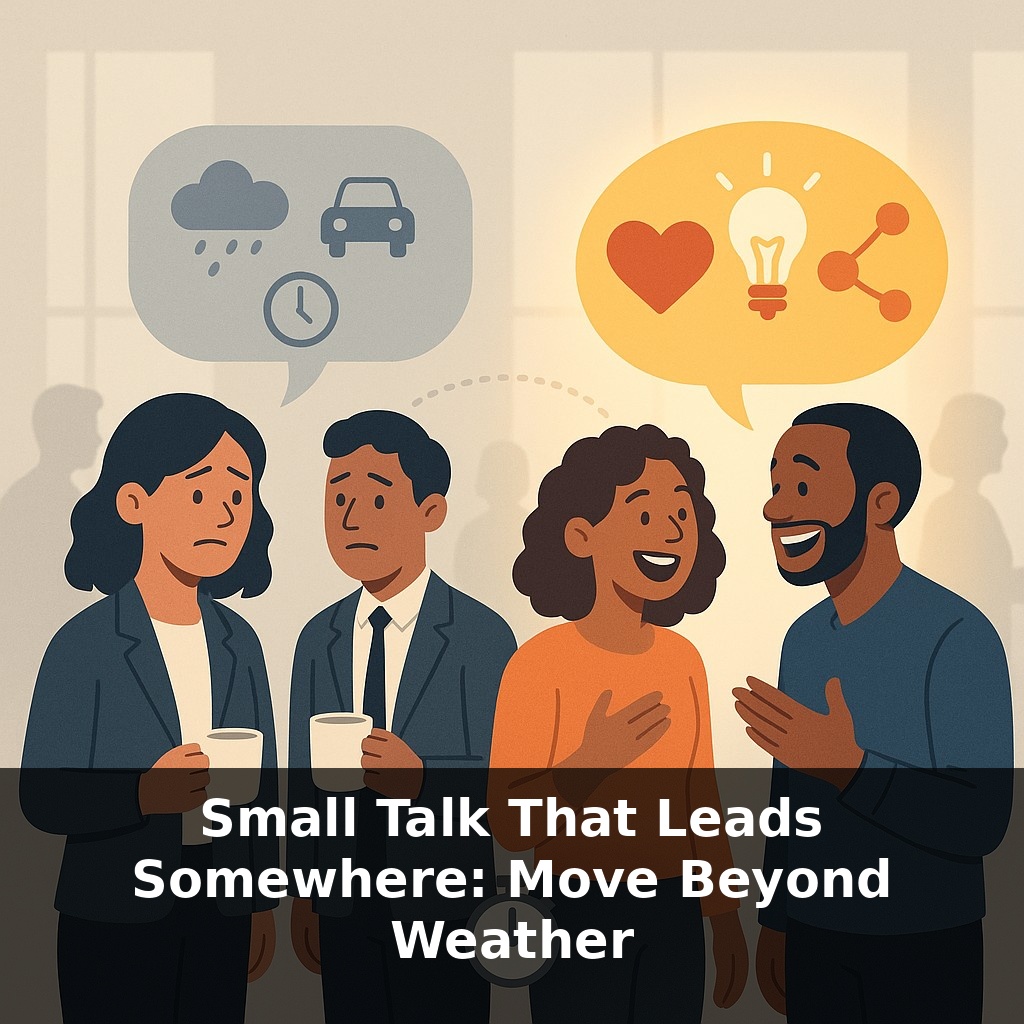
A Princeton study found we decide whether to keep talking to someone in under fifteen seconds. Now, drop into this: you’re at a work event, coffee in hand, stuck on weather talk. Across the room, two people are laughing like old friends—who met five minutes ago. What’s the difference?
That gap between awkward small talk and instant connection isn’t personality magic—it’s technique. Most people default to “safe” topics like weather, traffic, or how busy everything is, then quietly blame themselves when the conversation dies. But what actually kills it is predictability. When your questions sound like a form you fill out at the dentist’s office, people give you form-style answers: short, polite, and forgettable.
The good news: you don’t need to be witty or extroverted; you need a better toolkit. Instead of searching for the “perfect” thing to say, focus on asking questions that invite stories, not status updates. Think in categories: recent highlights, tiny struggles, ongoing projects, or curiosities. These gently pull people into sharing a slice of their real life. Combined with simple follow-ups—“How did that happen?” “What made you choose that?”—small talk starts steering itself.
Think of most everyday chats as sketches, not finished paintings: you’re just laying down a few lines to see what picture might emerge between you. To make those lines useful, you don’t need deeper topics—you need better angles. People light up when you touch three zones: what they’re currently working toward, what they’ve recently overcome, and what they’re quietly geeking out about. Questions that nudge these areas sound casual but reveal values, skills, and stories. When you respond with real curiosity—brief reflections, “me too” moments, or a simple “tell me more”—the other person feels seen, not scanned.
Let’s turn this into something you can actually *do* mid-conversation, not just understand in theory.
Start by upgrading your opener from “information request” to “moment invitation.” Instead of “So, what do you do?” try: - “What’s something you’re working on lately that you’re excited about?” - “What’s been taking most of your brain space this week?”
Notice these don’t hunt for job titles; they surface whatever currently matters to the person—work, a side project, a kid’s science fair, marathon training.
Next, treat their first answer as a *rough draft*, not the final version. Most people will give you a cautious, compressed reply to test how safe it is to share more. Your job is to gently stretch it. Use small, targeted nudges that show you’re actually tracking:
- Zoom in on a detail: “You mentioned ‘a messy project’—messy how?” - Highlight emotion: “You sounded pretty proud when you said that—what made it such a win?” - Contrast past vs. present: “Have you always been into that, or is it a recent thing?”
These don’t push for secrets; they just open a door for a fuller story.
Now layer in *reciprocal snippets*—short, relevant shares that signal, “I’ll go first too,” without hijacking the conversation: - Them: “I’ve been learning guitar.” - You: “Nice. I’m at the painfully-bad stage with piano. What got you into guitar specifically?”
You’ve briefly revealed yourself, then handed the ball back. That back-and-forth rhythm is where trust builds.
Watch for “green lights”—micro-signs that it’s okay to go a step deeper: longer answers, more expressive tone, added personal detail, or them asking *you* a question. Each green light earns you one notch of depth:
- From activity → motivation: “What made you pick *that* race / role / class?” - From motivation → meaning: “What do you like about that kind of challenge?”
If you hit a “yellow light” (one-word replies, glances at the door, phone-checking), gently widen the scope instead of digging: - “Totally fair. Outside of that, what’s been fun for you lately?”
Over time, you’ll notice patterns in what people return to: certain values (freedom, creativity, stability), recurring themes (teaching, fixing, exploring). That’s your bridge to more substantive topics—without ever announcing, “Let’s get deep now.”
Think of each new topic like a doorway in a hallway: most people peek in, then keep walking. Your goal is to *step inside* one or two rooms together, without forcing it. Use questions that let people choose the room.
Concrete example at a networking event: Instead of: “How’s the conference so far?” Try: “Caught anything today that you might actually use next week?”
If they mention a tool or idea, you can follow with: - “Where would that make the biggest difference for you?” - “What were you doing before you found that?”
With friends, nudge beyond “How are you?”: - “What’s something tiny that made this week 2% better?” - “Is there anything you’re low‑key proud of right now that no one knows about?”
When someone shares a hobby, skip the résumé questions and go sideways: - “What’s the most unexpectedly hard part of that?” - “If you could cheat and instantly be amazing at one aspect of it, which would you pick—and why?”
Your aim isn’t depth for its own sake; it’s to find one thread worth tugging, then stay with it a little longer than most people do.
Building on this notion of conversational evolution, in a few years, drifting through a lobby in silence may feel as dated as dialing a rotary phone. As tools start suggesting questions in real time, the skill shifts from “thinking of something to say” to choosing which thread actually fits this moment and this person. Think of it less like rehearsing lines and more like jazz: you’re improvising around prompts, playing off the other person’s cues, and gradually developing your own conversational style and “sound.”
When you treat those first few lines like a doorway instead of a dead end, conversations start to feel less like quizzes and more like co‑creating a playlist—swapping tracks, skipping what doesn’t fit, turning up what resonates. Over time, you’ll notice which questions reliably light people up, and that becomes your personal setlist for connecting on purpose.
Try this experiment: In your next three small-talk moments today (coffee line, elevator, Slack chat), intentionally skip the weather and use a “micro-shift” question instead, like: “What’s been the best part of your week so far?” or “Working on anything you’re oddly excited about right now?” Notice which question gets the other person to tell a story (not just a fact), and mentally tag that as a “keeper.” Then, before the day ends, replay those three interactions in your head and decide which exact wording felt most natural to you and got the warmest response—use that one as your new default opener for the rest of the week.