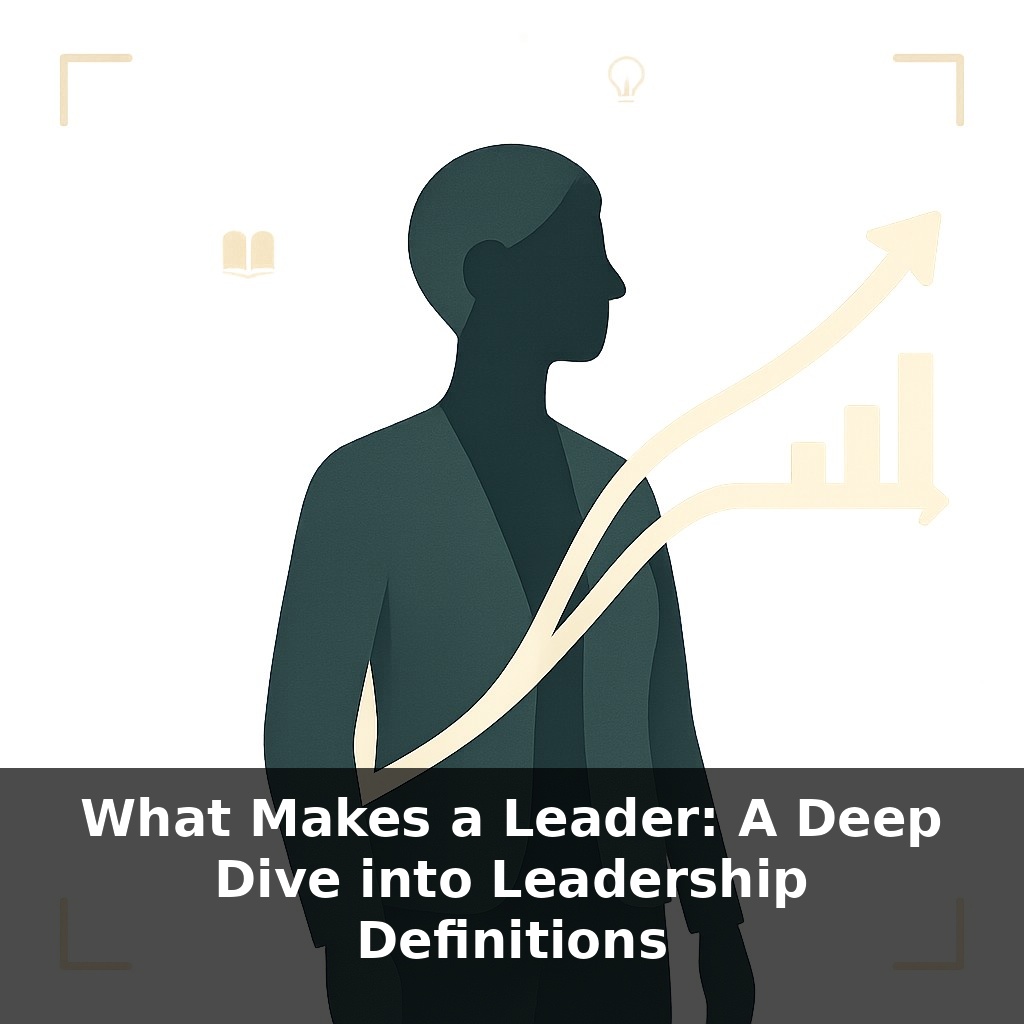
What Makes a Leader: A Deep Dive into Leadership Definitions
📝 Transcript
A Fortune 500 company replaces its CEO. Within a few years, shareholder returns jump by almost ten percent. Same industry, same market shocks—completely different outcomes. So here’s the puzzle: if leadership isn’t just personality or power, what *exactly* is it?
Part of the confusion comes from where we *look* for leadership. We fixate on the person at the top, like a camera that never leaves the head chef while ignoring the kitchen. But research across psychology, management, and sociology keeps pointing to something quieter and more systemic: leadership shows up in how direction, alignment, and commitment are created and sustained over time, not just in who has the title.
This is why two managers with similar résumés can produce wildly different results in the same company. One turns strategy into clear priorities, coordinates teams that used to work at cross-purposes, and builds trust that survives bad quarters. The other talks a good game but leaves people guessing, competing for resources, and hiding problems.
In this episode, we’ll unpack *what* leaders actually do when they’re effective—and why definitions that focus only on traits or authority keep failing us.
Think of this episode as zooming out from the individual leader and looking at the *system* they’re operating in. Context changes everything. A founder guiding a five‑person startup through chaos faces different demands than a hospital administrator coordinating across unions, regulations, and life‑or‑death stakes. The same person might look visionary in one setting and ineffective in another. Research backs this up: leadership quality depends not only on who you are, but also on how well your skills, values, and style fit the situation you’re trying to change.
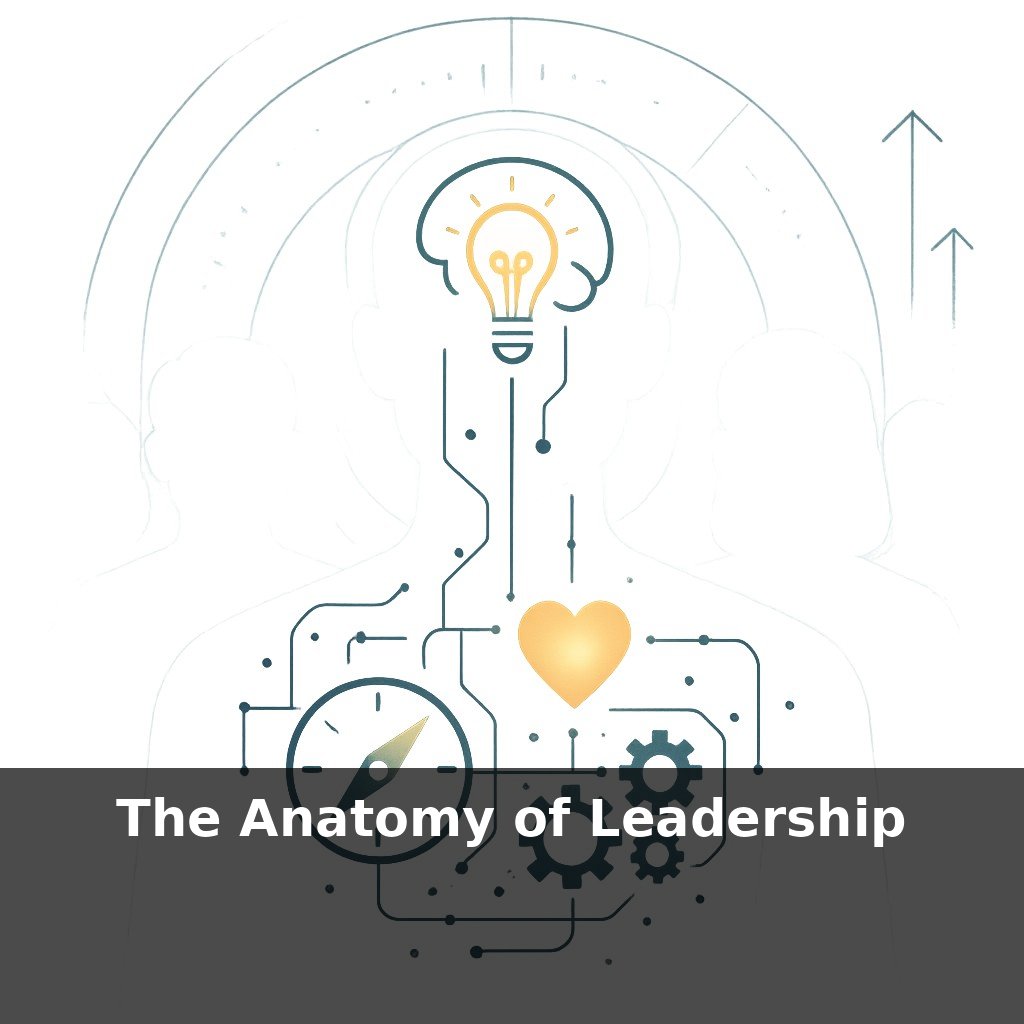
Try listening to how leaders talk when things get messy. In earnings calls after a bad quarter, in all‑hands meetings during layoffs, in clinical briefings after a medical error—you’ll hear three kinds of work happening in real time: making sense of what’s going on, deciding what to do about it, and shaping how people experience the path forward. That’s where research pinpoints the engine room of leadership: integrated capabilities rather than heroic personalities.
Start with the cognitive side. In complex situations, there usually isn’t a “right” answer waiting to be discovered, only competing interpretations. Strong leaders don’t just analyze data; they *curate* which signals matter, test their own assumptions, and update their views when reality contradicts their plans. In the Judge et al. meta‑analysis, traits like conscientiousness and emotional stability correlate with this kind of disciplined, less reactive thinking. It shows up in practices like pre‑mortems, red‑team reviews, and structured decision debriefs—tools that improve decision quality over time rather than chasing perfection in a single choice.
Then there’s the social–emotional layer. Influence research keeps finding that people are more persuaded by those who understand their constraints and emotions than by those with the flashiest slide deck. That’s one reason leaders high in emotional intelligence tend to unlock better performance: they notice when a team is withdrawing, when conflict is festering, or when a stretch goal is quietly tipping into burnout. Google’s Project Oxygen highlighted this: the most effective managers were those who coached, listened, and created psychological safety so bad news travelled *fast* instead of being buried.
Overlaying both is moral character. Integrity and fairness aren’t just “nice to have” virtues; they are practical assets that stabilize trust under pressure. When decisions about promotions, credit, or cuts are made transparently and with clear principles, people are more willing to stay engaged even when outcomes hurt. The S&P Global finding on women‑led firms hints at this broader pattern: diverse perspectives at the top often coincide with more robust governance and risk awareness, which compound into better long‑term results.
Crucially, none of these capacities live in isolation. In real leaders, they braid together: clear thinking shapes the options on the table, social–emotional skill shapes how those options land with others, and character constrains *which* options feel acceptable. The visible behavior—calm in a crisis, thoughtful course corrections, teams that stay candid and motivated—emerges from that integration.
This is why the “born leader” story falls apart under scrutiny. Heritable traits matter, but they operate more like starting conditions in a game than a fixed destiny. Over a career, feedback, role models, deliberate practice, and even failures sculpt how someone uses what they were given. Introverts can learn to speak with conviction; charismatic extroverts can learn to shut up and listen; technically brilliant skeptics can learn to trust and delegate.
The developmental question, then, isn’t “Do I have it?” but “Which muscles am I under‑using, and how can I train them in the context I’m actually in?”
Watch how this plays out in everyday situations. A product manager realizes two teams are quietly undermining each other’s timelines. Instead of escalating blame, she pulls engineers, designers, and sales into one short working session and asks a single question: “What would have to be true for this launch to feel like a win for each of you?” As people speak, she maps constraints on a whiteboard, surfaces hidden dependencies, and negotiates trade‑offs in real time. No one changes jobs, but the social “map” of the work changes; conflict is converted into shared problem‑solving.
Or take a mid‑level leader in a government agency facing budget cuts. He can’t change the funding, but he can change how uncertainty is handled. He publishes a simple, public decision rule for protecting critical services, invites staff to stress‑test it, and sticks to it even when it hurts in the short term. Over months, people start volunteering better ideas for savings because they trust the process more than any single outcome.
Boardrooms are quietly rewriting job descriptions: leaders are less “boss” and more “chief pattern detector.” As AI takes over routine analysis, your edge becomes how you frame problems, choose what *not* to automate, and hold the moral line when fast options look attractive. Networked work also means your influence travels like Wi‑Fi signals—strong in some rooms, blocked in others. Learning where your “coverage” drops will matter as much as any promotion.
Your challenge this week: For three different meetings, write down the *exact* moment where the group’s energy noticeably shifts—people lean in, go quiet, or change posture. After each meeting, ask one person what they think happened at that moment and why. Compare their view with yours. You’re not trying to fix anything yet; you’re training your eye for the subtle social turns that real leadership is built on.
Leadership, then, becomes less a title than a pattern you leave behind—clearer choices, fewer avoidable frictions, more people stepping up unprompted. Like compounding interest in a savings account, tiny behavioral tweaks can snowball into cultural norms. The open question is which small experiments you’ll run next to see what *your* pattern of impact could become.
Start with this tiny habit: When you open your calendar each morning, whisper to yourself one leadership question from the episode—“Who needs my support today?”—and then type the initials of just one person next to an existing meeting. During that meeting, ask them one specific question the hosts modeled, like “What’s getting in the way of your progress this week?” and listen without interrupting for at least 30 seconds. After the call ends, rate (1–3) how well you listened as a leader in the meeting title, so you start seeing leadership as something you practice, not a role you wait for.
From this course
The Anatomy of Leadership
8 episodesUnlock all episodes
Full access to 8 episodes and everything on OwlUp.
Subscribe — $1.99/monthLess than a coffee ☕ · Cancel anytime