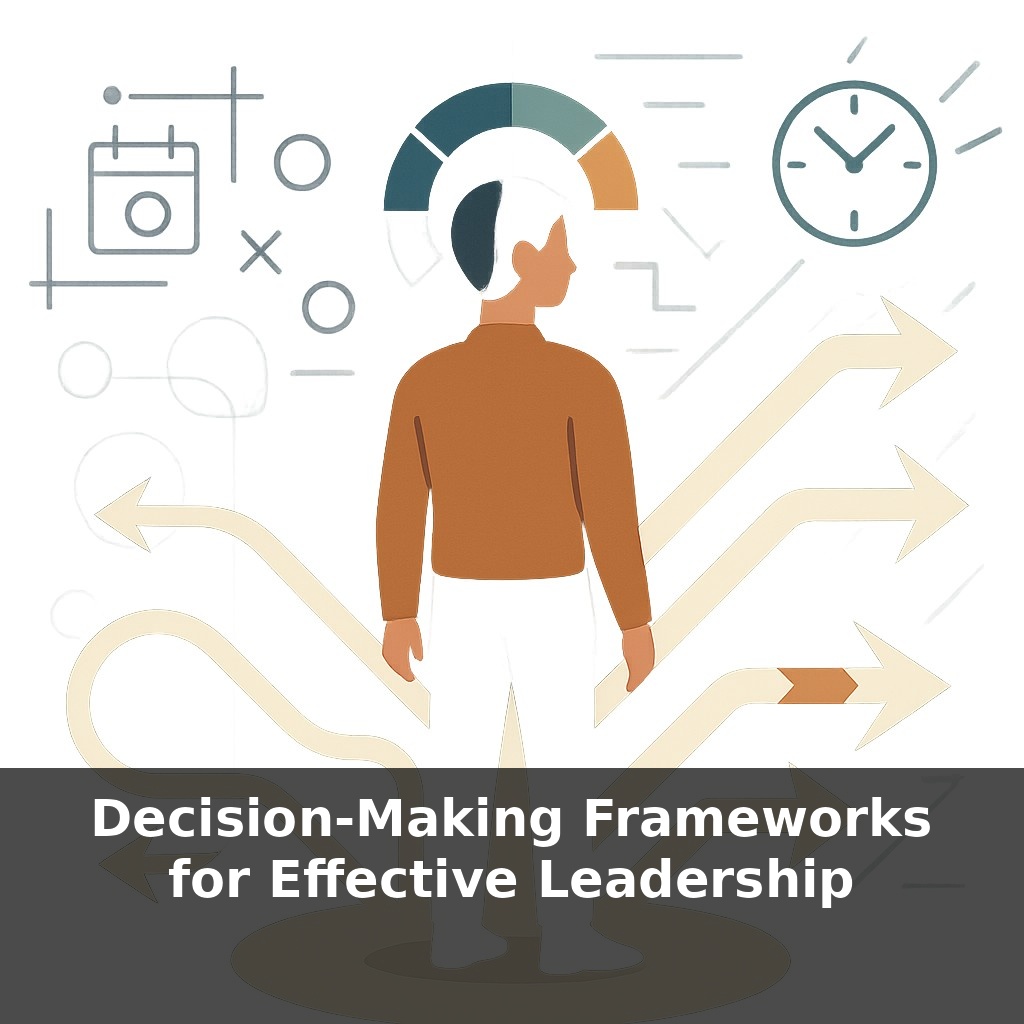
"Most leaders don’t fail because they lack ideas; they fail because they choose the wrong decision playbook. One day you’re calmly planning next year’s strategy, the next you’re in a crisis call. Same leader, totally different rules. So how do you know which rules to follow, and when?
Here’s the twist: even when leaders know they need different approaches for different situations, most still default to one familiar style—usually whatever got them promoted. That’s like using the same lens on a camera for portraits, landscapes, and close‑ups: technically it works, but you’re constantly compromising on what really matters in each shot. The research is blunt about the cost of this habit. Organisations that treat decision making as a discipline, not an instinct, dramatically outperform those that don’t—yet only a small minority of managers believe their companies are any good at it. The real leverage isn’t memorising more models; it’s learning to quickly read the situation, then consciously choose the right framework for that moment, rather than letting the moment choose for you.
Here’s where the numbers get uncomfortable. Bain & Company found that organisations good at decisions can outperform peers by up to 95%, yet a McKinsey survey shows only 1 in 5 managers think their companies decide well and fast. That gap is your opportunity. Frameworks like the Rational Model, OODA Loop, Cynefin, Vroom–Yetton, or Six Thinking Hats aren’t academic toys; they’re rigor for different kinds of bets—high‑speed calls, messy uncertainty, political minefields, ethical trade‑offs. Your real job isn’t to master them all at once, but to notice which “game” you’re in before you pick your next move.
If you strip away the labels, every decision you face lives somewhere on three sliding scales:
- How *clear* is the problem? - How *fast* do you need to move? - How many *people* must be truly on board?
The art is matching those three realities to a fitting process—not the one you’re most comfortable with.
Start with clarity. When the problem is well‑defined and the stakes are high but stable (think: major investment, new product line), evidence‑heavy, structured approaches usually win. This is where data‑driven firms pull ahead: the MIT Sloan findings on productivity and profitability aren’t about hoarding dashboards, but about leaders who consistently turn murky questions into testable choices, with explicit criteria and trade‑offs. They treat ambiguity as something to be progressively reduced, not wished away.
Shift to speed. In fast‑moving environments, delay *is* a decision—usually the worst one. But “moving fast” doesn’t mean winging it; it means shrinking each cycle of observe–decide–act while still learning on purpose. Good leaders design tiny, reversible bets that reveal information quickly, then update their stance. Poor ones add more meetings and more slides, confusing motion with progress.
Now look at people. Some calls are technically simple but politically explosive: reorganisations, resource reallocations, visible promotions. Here, *how* the decision is made can matter as much as *what* you decide. Skipping structured input because you “already know the answer” often backfires. Notice that J&J’s famous recall wasn’t just an ethical stance; it was a visible, principled process that employees and the public could understand. The $100 million hurt less than a lingering doubt about whose interests came first.
Here’s the trap: under pressure, most leaders overuse one muscle—analysis, speed, or consensus—and underuse the others. Bias plays a quiet role too: we seek confirming data, we overestimate our intuition, we confuse everyone talking with everyone aligning. A light‑touch framework acts like a circuit breaker. It interrupts the autopilot long enough to ask, “Is this problem actually clear? Is speed really the bottleneck? Whose commitment will make or break execution?”
Your goal isn’t to become a walking textbook of models, but to build a small, personal “decision library” you can reach for quickly. Think less about memorising steps, more about recognising patterns in the wild, then choosing a process that fits the pattern better than your reflexes do.
Think about the last three big calls you made at work. Chances are, each one quietly “asked” for a different kind of process. Maybe you had a budget decision where the trade‑offs were numeric and stable; an escalation from a key client where hours mattered more than elegance; and a team conflict where the real risk was trust erosion, not missed revenue. Those are three different games that look deceptively similar on your calendar.
Here’s where a personal “decision library” becomes practical. For a highly structured call, you might pull out a criteria grid and force‑rank options. For something volatile, you could default to a fast, iterative loop with explicit checkpoints. For a politically sensitive issue, you might start by mapping stakeholders and choosing who gets input, who gets a vote, and who just needs to understand the “why.”
One useful mental move is to label the decision *before* you tackle it: “This is a speed play,” or “This is a coalition play.” Naming it nudges you toward a better‑matched framework instead of sliding back into your favourite pattern. Over time, those labels become a quiet language in your head—and eventually in your team—so people know not just what’s being decided, but how you intend to decide it.
95% higher returns for better decision makers hints at where this is heading: leaders who treat frameworks as shared infrastructure, not personal tools. As AI copilots surface patterns and simulate scenarios, your real edge shifts to *framing* the question and setting ethical guardrails. Think of it like editing code that an engine helps you write—your judgment decides what ships. Expect promotion criteria to shift from “who decides fastest” to “who designs the clearest, fairest decision process.”
In the end, effective leadership is less about heroic intuition and more about quietly designing how choices get made. Frameworks are just scaffolding: they support bolder bets, cleaner ethics, and faster course‑corrections. As stakes rise and data multiplies, your real leverage is learning which scaffold to erect, how quickly to adjust it, and when to dismantle it.
Before next week, ask yourself: Which 1–2 recurring decisions on my plate (e.g., hiring approvals, pricing exceptions, priority conflicts) could I move from “instinct-only” to a simple framework like a decision matrix or guardrails, and what exact criteria would I weight most heavily (e.g., impact, risk, reversibility, team capacity)? In the next big decision I face, how will I deliberately separate reversible vs. irreversible choices, and what’s the “good enough” information threshold I’ll commit to before deciding instead of endlessly gathering more data? When I next meet with my team, what’s one high-impact decision where I can consciously shift from “I decide” to “we decide” or “you decide,” and what constraints, success metrics, and time frame will I clearly share so they can own it confidently?