Understanding What Employers Look For
📝 Transcript
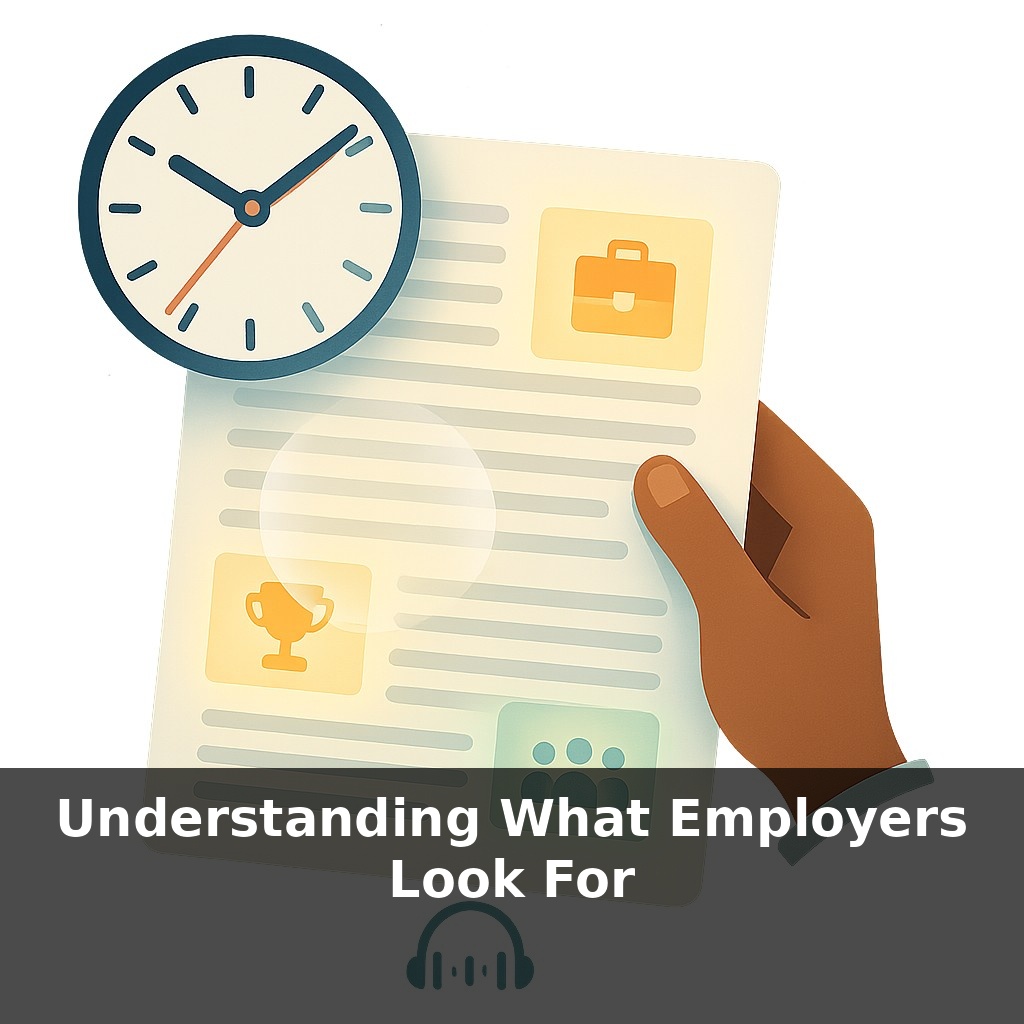
In the time it takes you to take a slow breath, a recruiter has already decided your fate. One glance, a few heartbeats, and your years of experience either stick… or disappear. Today, we’re stepping into that tiny window to explore what really survives that first scan.
That snap judgment isn’t random—it’s pattern recognition. Recruiters are scanning for three things at once: “Can you do this job? Have you proven it? Will you fit how we work?” If your resume doesn’t answer all three quickly, it quietly slides out of contention.
This is where most candidates drift off course. They describe responsibilities instead of outcomes, list tools instead of skills, and hope the “full story” will emerge in an interview that never comes. Meanwhile, the resumes that move forward act more like well-structured dashboards than diaries: key metrics up front, clear labels, no clutter.
Think of how you browse a streaming platform. You skip vague titles, skim right past confusing covers, and pause only when the summary speaks your language. Recruiters do the same with resumes—just at 6–8x the speed.
Most candidates assume that if they “cover everything,” something will resonate. But employers aren’t hunting for possibilities; they’re hunting for proof. They’re under pressure to defend every hire, so they lean hard on signals that are easy to justify: specific skills that match the role, measurable wins, and evidence you thrive in real teams, not just in theory. Behind the scenes, ATS systems filter for the right language while hiring managers sift for a story that makes sense: growth, consistency, and judgment. The resumes that win are built for both audiences—machine and human—without feeling robotic.
Think about what happens *after* that first snap judgment. If your resume survives, it doesn’t get leisurely reading time—it gets tested. Each section has to “prove” something different, and the weak parts quietly drag down the strong ones.
The top third answers: “Why should I care about this person right now?” That’s where a tight headline and summary can tilt the odds. Instead of a generic label (“Experienced professional seeking new opportunities”), sharpen it into a role-aligned signal: “Data analyst specializing in marketing funnels and A/B testing,” followed by 2–3 lines that preview your strongest skills and outcomes. You’re not telling your life story; you’re setting expectations for what the rest of the page will confirm.
Next, skills and tools aren’t just a checklist—they’re an index. Employers use them to connect the dots between your headline and your history. Group them intentionally: “Data Analysis: SQL, Python, Excel (advanced)” reads very differently from a random scatter of tools. This also anticipates the growing use of skills assessments: if you list something as a core skill, you should be able to back it up under pressure.
Your experience section then becomes the “evidence log.” Each bullet should answer three quiet questions: What problem were you facing? What did you do differently? What changed, and by how much? Instead of “Managed social media accounts,” you might write, “Increased Instagram engagement 47% in 6 months by testing short-form video formats and posting cadence.” You’re showing judgment, not just activity.
Employers also read for *trajectory*. They scan job titles, dates, and verbs to see if you’re leveling up: assisting, then owning, then leading. Even lateral moves can show depth if the scope or complexity grows (“from supporting one product line to coordinating across three regions”).
Think of this like refactoring legacy code: you’re not rewriting your past—you’re cleaning up structure and naming so the logic is instantly clear to anyone reading it under time pressure. The bones of your career stay the same; the pathways become obvious.
When you zoom in on those “evidence log” bullets, subtle choices do heavy lifting. Verbs are your playbook: “designed,” “tested,” “negotiated,” “simplified,” “recovered,” “relaunched” each hint at different strengths. Swap “helped with client projects” for “coordinated weekly status reviews with 5 enterprise clients, cutting unresolved issues by 22% in one quarter”—suddenly there’s scope, rhythm, and consequence.
You can also layer soft skills without naming them directly. “Aligned sales and ops on a shared quarterly forecast, reducing last-minute order changes by 18%” shows collaboration, influence, and follow-through—no buzzwords required. When in doubt, ask: “Who else was affected? What changed for them?”
An architecture mindset helps here: each bullet is a load‑bearing beam, not decoration. If you removed it, would a key aspect of your value vanish, or would nothing important change? Keep only the beams that hold up the story you want this specific role to see most clearly.
Soon, your “paper self” may be less like a static document and more like an interactive profile. Verified skills, project links, and tests you’ve passed could act like clickable proof, shrinking the gap between claim and evidence. Employers might query talent the way they filter datasets: “show me marketers with SQL, healthcare experience, and leadership signals.” Your edge comes from treating every project as data you’ll later surface, not just work you quietly complete.
Your challenge this week: Pick one recent project and retroactively “instrument” it. List 3–5 concrete signals a future system could verify (metrics, links, artifacts, endorsements), and store them in a simple tracking doc.
Treat every role like a season in a long-running series: each episode (project) should introduce a new skill, raise the stakes, and leave a trace others can review later—metrics, code, slides, outcomes. Over time, those “episodes” compound into proof. The more intentional you are now, the easier it becomes for employers to binge-watch your career on fast‑forward.
Try this experiment: Pick one job posting you really want and, using the episode’s advice, rewrite your resume and LinkedIn “About” section so every bullet and sentence clearly shows outcomes (numbers, impact, tools used) that match what that employer is asking for. Then send that tailored version to three people: one friend, one current or former manager, and one person in your target industry, and ask each of them a single question: “If you only read this, what job would you think I’m perfect for?” Compare their answers to the actual role you’re targeting and tweak your resume/LinkedIn again until all three people independently describe something very close to that job.
From this course
The Art of Crafting Impactful Resumes
5 episodesUnlock all episodes
Full access to 5 episodes and everything on OwlUp.
Subscribe — $1.99/monthLess than a coffee ☕ · Cancel anytime