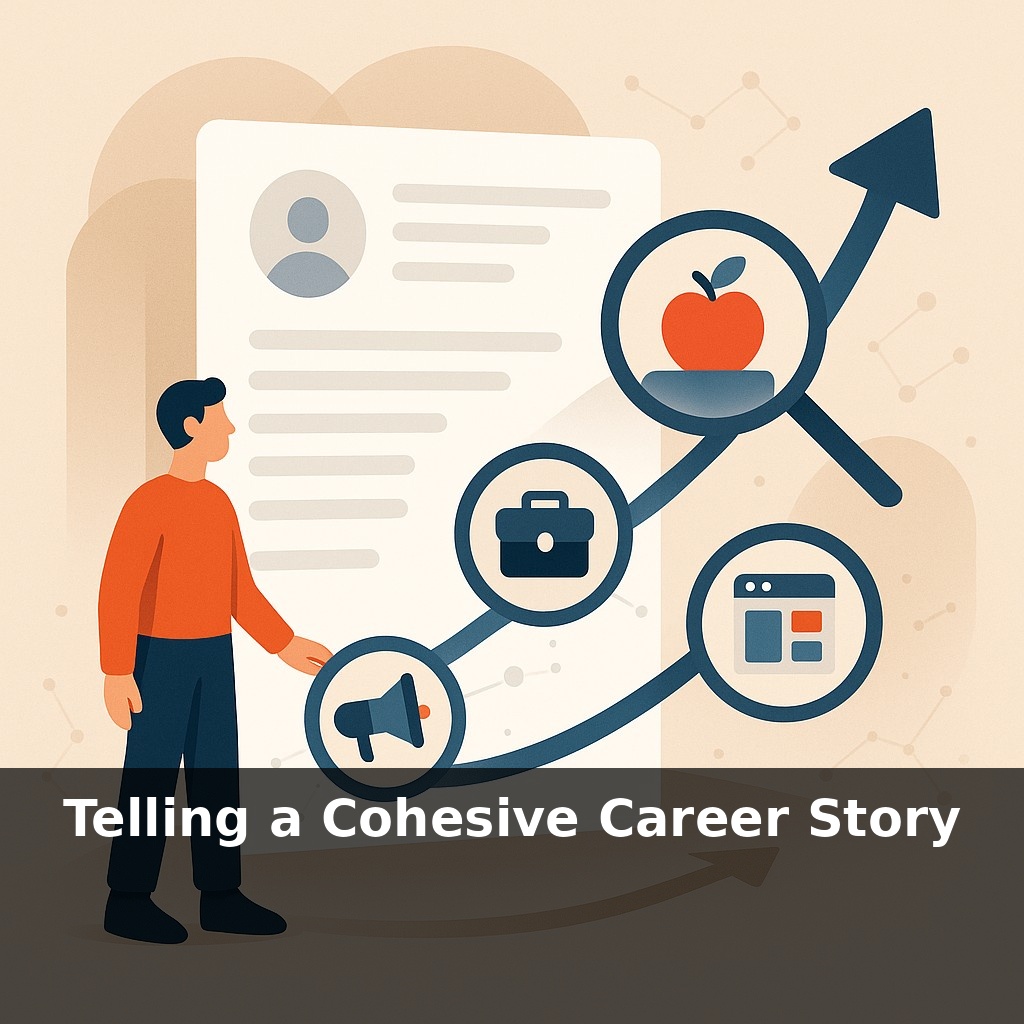
Recruiters glance at your résumé for less time than a TV ad break, yet one thing can stick: a story. A marketer turned teacher, then product manager, doesn’t look “scattered” if each role becomes a chapter. The twist is this: your past is fixed, but your story about it isn’t.
A cohesive career story doesn’t mean airbrushing reality; it means deciding what your work has *been about* and making that through‑line obvious. Recruiters skim for that signal: “This person consistently leans toward X, gets better at Y, and now wants to do more of Z.” If your résumé reads like a playlist on shuffle—consulting, then hospitality, then operations—your job is to show how each track developed the same core themes. Maybe every move pulled you closer to solving messy customer problems, or building systems from scratch, or turning ambiguity into structure. Those themes are what convert “job hopping” into “intentional exploration,” and “career detour” into “strategic pivot.” The more clearly you name them, the easier it is for a hiring manager to see you not just as what you’ve done, but as where you’re obviously headed next.
Think of this step less as “selling yourself” and more as editing a documentary about your work life. The footage is already shot: projects that lit you up, environments that drained you, skills that came easily, and moments you were totally in over your head. Now you’re choosing which clips belong in the trailer. Neuroscience and hiring data both point to the same move: foreground patterns, not incidents. That means noticing how certain types of problems, people, and results keep reappearing, even when your titles and industries change. Those recurring elements are your raw material for a sharper, more deliberate narrative.
A Stanford marketing professor found that stories can be *up to 22× more memorable* than standalone facts. Hiring data quietly echoes that: profiles with narrative summaries attract roughly three times more recruiter outreach. The implication isn’t “be theatrical,” it’s “be intentional about how you connect the dots.”
Now that you’ve thought about your “trailer,” zoom into the scenes themselves. Each role, project, or even career gap is doing narrative work for you—whether you design it or not. Your job is to decide the *function* each one plays in the story you want to tell next.
A practical way to do this is to assign each experience a narrative “job”:
- **Setups**: roles that introduced you to a theme you now care deeply about (your first exposure to data, people leadership, regulated industries, etc.). - **Escalations**: moves where the stakes or scope increased around that theme (larger teams, more complex products, tougher markets). - **Turning points**: moments where you changed direction on purpose (switching industries, going back to school, leaving a prestige brand for a scrappy build). - **Proof points**: experiences that strongly validate a claim you want to make about yourself now (“I build from zero,” “I fix what’s broken,” “I scale what works”).
Notice what isn’t on that list: “random detours I hope nobody asks about.” Gaps, short stints, or left turns can all be setups, turning points, or proof points—if you’re honest and specific about what changed because of them.
This is also where you separate **facts** from **framing**. Facts are the dates, titles, metrics, and responsibilities that must stay accurate. Framing is how you connect those facts into a pattern: what you emphasize, what you put in the background, and what you say a transition was *for*. You’re not rewriting history; you’re deciding which cause‑and‑effect relationships to highlight.
Think of an architect reviewing old building plans before pitching a new project. They won’t show every sketch they ever drew; they’ll curate the ones that make the client say, “Of course you’re the person to design *this*.” Your work history deserves the same level of curation. When you decide what each chapter *proves* about you, you stop sounding like a list of jobs and start sounding like someone who has been moving—sometimes messily, always humanly—toward something that now clearly matches the role in front of you.
A useful test: if someone skimmed only your job titles, would they *guess* the thread you care about now? If not, your examples need to do more narrative lifting. Think of each bullet as answering one quiet recruiter question: “So what did this *change* about how you work?”
Concrete examples help:
- “Retail Associate → Customer Insights”: Instead of “helped customers,” frame the moment you started tracking repeat questions, spotted patterns, and shared them with your manager. That’s your seed of product thinking. - “Office Manager → Ops Lead”: Show how coordinating supplies evolved into redesigning vendor processes, then creating lightweight dashboards. That’s operations maturity in motion. - “Gap Year → Data Curiosity”: Maybe you logged your expenses while traveling, experimented with spreadsheets, and realized you love turning chaos into structure. Name that shift; don’t just list the trip.
AI tools are already drafting “good enough” résumés from raw data. The edge soon won’t be *having* a story, but flexibly *deploying* it. You’ll tailor one version for a 30‑second intro, another for a 3‑minute portfolio video, another for a threaded LinkedIn post. Treat each as a different camera angle on the same plot, highlighting scenes your target audience cares about while keeping your core arc recognizable and consistent across platforms.
Your challenge this week: Draft a 90-second “career story” script you could record as a video bio. Then create two alternate cuts: one emphasizing leadership, one emphasizing craft or technical depth. Compare the three. Which roles or projects stay in every version? Those are your load‑bearing scenes—the ones you’ll want to feature consistently on your résumé, LinkedIn, and in interviews as AI and human screeners converge on the same narrative signals.
Treat this as an ongoing prototype, not a finished product. As your skills, interests, and markets shift, update your story the way a game designer ships new levels: same core mechanics, richer worlds. When a role, course, or side project pulls at you, ask, “If this became a new chapter, what would it prepare me to do next?”
Here’s your challenge this week: By Friday, craft a 3–minute “career throughline” story that connects at least three seemingly unrelated roles you’ve had (e.g., teacher → project manager → UX designer) using one consistent theme (like translating complexity or advocating for users). Then, test it live with one real person: record a 10–minute mock interview (audio or video) where you answer “So, walk me through your career” using this new story. Afterward, replay the recording once and underline every sentence that doesn’t clearly support your chosen theme, then revise your story so every beat earns its place.