Most hiring managers spend less time on your resume than on reading a single email—yet that tiny window can completely change your career path. In one industry, your experience is “meh.” In another, the exact same story makes you a must‑interview candidate.
“Six to eight seconds.” That’s the average time a recruiter spends skimming your resume before deciding whether to keep reading—or move on. In those few heartbeats, they’re not just asking “Is this person good?” but “Is this person good for *this* world—our industry, our problems, our language?”
That’s where most strong candidates quietly lose. They list solid achievements, but those achievements are still “translated” in the dialect of their old field. Meanwhile, behind the scenes, an ATS is scanning for signals that you understand what success looks like in *this* space.
In this episode, we’ll explore how to recast your existing wins using the metrics, tools, and priorities each sector cares about—without faking or inflating anything—so your resume feels native whether it lands in tech, finance, nonprofit, or healthcare.
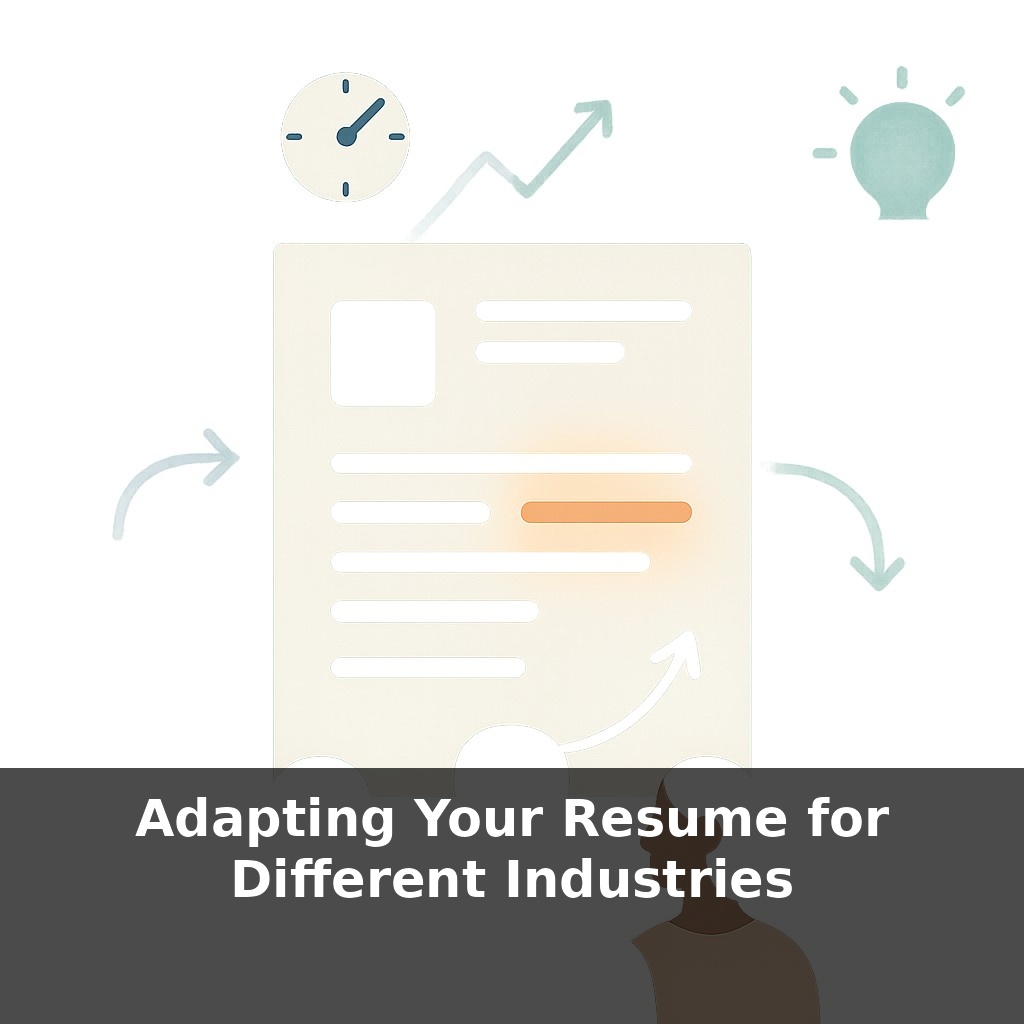
In practice, this means your “base” resume becomes more like a modular system than a fixed document. You keep a stable backbone—roles, dates, major wins—but you swap in different front panels depending on whether you’re aiming at SaaS, consumer goods, government, or healthcare. Each sector quietly rewards different signals: some care about experimentation and speed, others about compliance, cost control, or community impact. The risk isn’t that your background is wrong; it’s that your stories are sorted under the wrong headings, so the right people never recognize their value.
“20–60%.” That’s the documented jump in interview callbacks when candidates actually adapt their resume to the target industry instead of firing off one generic version. The key isn’t changing *who* you are—it’s changing *what you spotlight* and *how you measure it*.
Start with the industry’s scoreboard. Every sector has a different definition of “win”: - Tech: speed, user growth, feature delivery, experimentation. - Finance: risk reduction, revenue, margin, compliance. - Healthcare: patient outcomes, safety, accuracy, regulatory alignment. - Nonprofit/public: impact, equity, reach, stewardship of resources.
Pull 5–10 job descriptions from your target space and treat them like a dataset. What keeps repeating in responsibilities and “about you” sections? Tools? Methods? Outcomes? That cluster is your translation key. If multiple postings scream “process improvement,” “change management,” and “stakeholder communication,” those become the lens for reframing your past.
Now, map your existing wins to that lens. Don’t invent new achievements—relabel and re-measure what you already did: - “Handled customer emails” in retail becomes “Resolved 40–50 customer issues per shift with a 95% satisfaction score,” which reads like support or success in SaaS. - “Did scheduling” in hospitality becomes “Optimized weekly staffing for a 25-person team, cutting overtime by 12%,” which fits ops in logistics or healthcare.
This is where metrics matter. Many industries care less about *task variety* and more about *repeatable, quantified outcomes*. If your old world didn’t use numbers, reconstruct them: volumes, error rates, time saved, dollars influenced, scale of responsibility.
Visually, keep one eye on ATS and one on norms in the field. Overdesigned templates often break parsing, yet some creative and startup environments expect more visual polish than, say, government. A useful rule: clean, text-first structure that *nods* to the sector. A UX role might feature a concise “Selected Projects” section; a clinical role might surface “Certifications & Licensure” higher; a consulting path might lean on “Selected Client Engagements.”
Think of your resume like an app’s interface: the underlying code (your history) is stable, but the layout, labels, and default views adapt so each type of user can instantly find what they care about most.
A practical way to think about this: ask, “If this industry filmed my work as a highlight reel, which clips would they keep?” For a pivot into product management, “coordinated internal meetings” becomes “aligned sales, ops, and engineering on scope for a $280K client rollout.” Same actions, but you’re now speaking in cross‑functional, revenue‑adjacent terms a product leader instantly recognizes.
In creative fields, instead of “led social media,” you might write “developed a content series that lifted engagement 27% and drove 3 brand partnerships,” then pair it with a tight portfolio link. In highly regulated spaces like aviation or pharma, the same raw skill—say, improving a workflow—gets framed as “standardized process across 4 locations without audit findings.”
Before each application, scan for one missing “thread” and add it: maybe it’s experimentation for startups, stewardship for nonprofits, or vendor management for manufacturing. Over time, those subtle shifts turn a scattered record into a coherent, sector‑fluent story.
As AI-driven platforms begin to “co-write” job ads in real time, static resumes will age quickly. You’ll likely maintain a living document that shifts like a playlist—auto‑reordered based on which skills are trending for each role you target. Blockchain badges may sit alongside degrees, turning each verified skill into a kind of “achievement unlocked,” while cross‑industry moves become normal enough that fluency in re-framing your story is treated like basic spreadsheet literacy.
Treat each version of your resume as a small hypothesis about where you’re headed, not just where you’ve been. As you test it in different sectors, track which phrases, metrics, and sections attract responses—those are your career “heat maps.” Over time, you’re not only tuning a document; you’re discovering the markets where your strengths naturally spike.
Try this experiment: Pick one target role in a new industry (e.g., switching from education to project management), then create *two* versions of your resume: Version A written in your current industry’s language, and Version B fully translated into the target industry’s keywords, tools, and metrics pulled from 5 real job postings. Apply to 5 roles with Version A and 5 similar roles with Version B over the next week, tracking which version gets more views, callbacks, or interviews. At the end of the week, compare responses and double down on the phrases, bullets, and metrics from the better-performing version to refine a “master” cross-industry resume.