You’ll forget most of this episode—except the stories. Studies show we’re dramatically more likely to remember a story than a list of facts. So here’s the twist: the leaders who seem naturally charismatic? Often they’re just carrying a secret stash of ready-to-go stories.
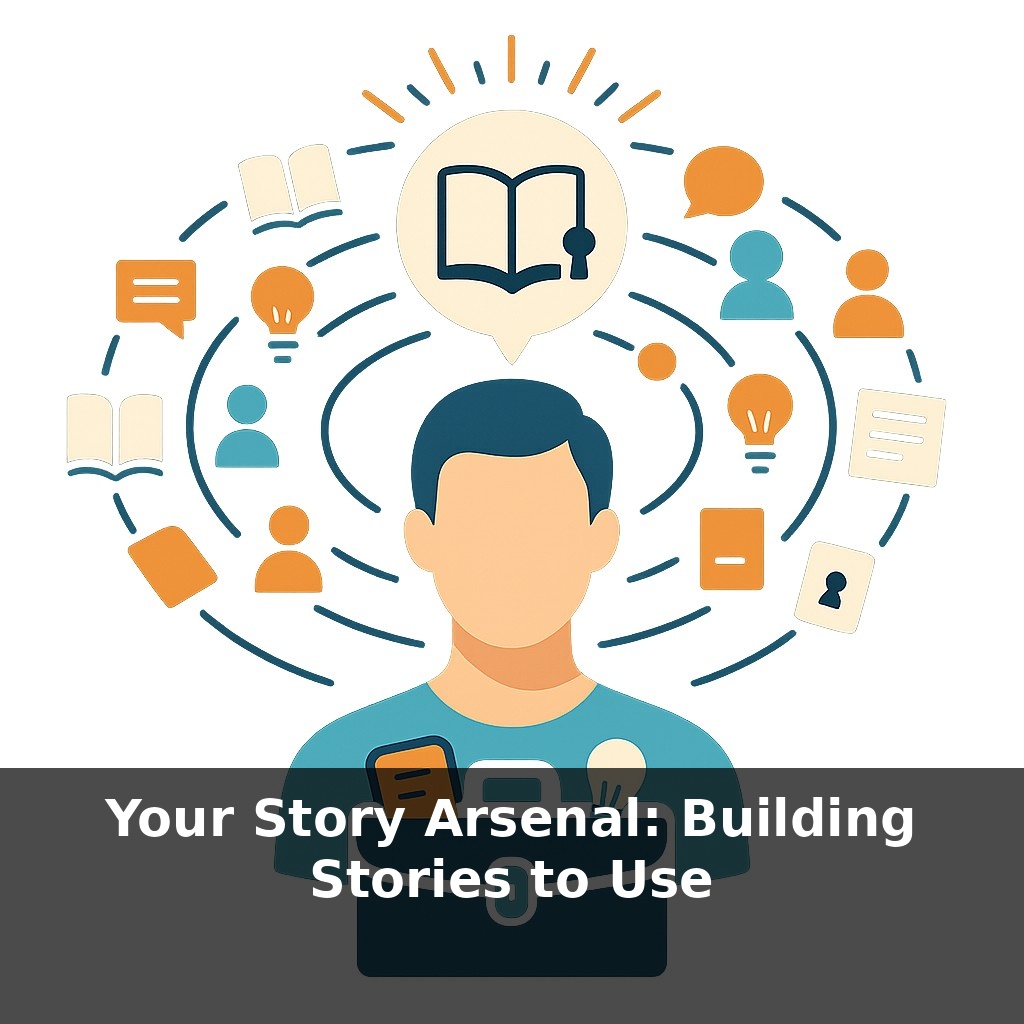
Most people treat stories like something you “come up with in the moment.” Professionals don’t. They pre-build a *story arsenal*—a small, organized set of 10–20 stories they can adapt in seconds for a pitch, interview, all‑hands meeting, or tough 1:1.
Think of how Amazon runs meetings with written narratives instead of slides, or how 90 % of top TED Talks follow a deliberate story arc: none of that happens by accident. Behind the scenes, there’s structure and reuse.
In this episode, you’ll start building your own repeatable system: - 4 core categories every arsenal needs - How to mine your past for high‑leverage moments - Simple tags so you can retrieve the right story in under 10 seconds
By the end, you won’t just “know” good stories—you’ll have them ready on command.
A strong arsenal isn’t about having *more* stories; it’s about having the *right* 12–15, each stress‑tested in real situations. Notice how top fundraisers reuse the same 3–4 origin stories across dozens of campaigns, or how a great manager leans on a handful of examples in every calibration cycle. Behind that is intentional curation. In this phase, you’ll zoom in on quality control: trimming stories that fall flat, pressure‑testing them with at least 3 different audiences, and tracking which ones reliably move metrics—whether that’s closing a client, shifting a team decision, or landing a “yes” from a stakeholder.
Start with raw material. Set a 15‑minute timer and list *30 specific moments* from your life and work—no judging, no editing. Use prompts to jog memory: “first day at…,” “biggest mistake at…,” “time I almost quit…,” “unexpected compliment from…,” “project that went off the rails…,” “customer/users who surprised me…,” “decision I changed my mind on…” The goal is volume: 30 moments, not 5 polished anecdotes.
Next, filter for usefulness. Go down your list and score each moment 1–5 on three axes: 1) Emotional charge (how much you *felt* something) 2) Relatability (how easy it is for a stranger to “get it”) 3) Teachable shift (is there a clear before/after or decision?)
Anything with a total score under 7? Archive for later. Your best candidates will score 10–15. You’re aiming to keep roughly 20 of the 30.
Now compress. Take one of your 20 and force yourself to write a *100‑word version* and a *30‑second spoken version* (about 75 words). That constraint kills rambling. Focus on: situation → tension → decision → outcome. Skip side characters and subplots. Do this for at least 5 stories. You’re not polishing language yet—just proving each story can be told quickly without losing its spine.
Then stretch. For two of those 5, create a “long cut” you could tell in 3–4 minutes: add 2–3 sensory details, one concrete number (a metric, date, or count of people), and a short reflection at the end (“what I’d do differently now”). You now have multi‑length versions for different contexts—email, hallway chat, keynote.
Finally, stress‑test formats. Take one story and draft it three ways: - as a 6–8 sentence email - as a 6‑slide outline (headline per slide, no design) - as a 90‑second audio note to a colleague
Notice what changes: wording, emphasis, pacing. That flexibility is what will let you plug the same narrative into a status update, a podcast interview, or a client pitch without rewriting from scratch.
Your challenge this week: pick *one* story from your list and complete all five steps above—list, score, compress, stretch, and reformat. By next week, you’ll have your first fully “battle‑ready” story.
A product manager at a fintech startup keeps 12 stories in a shared doc. One describes a failed launch that lost 37 % of active users in 2 weeks—then shows how the team rebuilt trust by shipping 3 small fixes in 10 days and personally emailing 400 power users. She tags it with “risk,” “ownership,” and “user empathy.” In leadership meetings, she uses it to argue against rushed releases. In hiring panels, she shortens it to 60 seconds to illustrate how the team handles failure. Same story, different cut, new impact each time.
Your single origin story can also do triple duty. A founder I worked with used one 90‑second story about growing up in a family restaurant to: 1) close a $250k angel round, 2) recruit their first salesperson, and 3) open a keynote to 600 attendees. The only changes were which numbers they emphasized and where they paused.
Your task now is to note, for each story, *three* distinct settings where it could pull weight you’re currently spending extra effort.
Treat your arsenal like a living dataset, not a scrapbook. In the next decade, professionals who *measure* story performance will outpace those who just “go with their gut.” Track which 5–7 stories consistently shorten sales cycles, unblock decisions, or land promotions. Use simple metrics: reply rates, meeting outcomes, deal size. Then prune: if a story hasn’t earned its keep in 90 days, rewrite or replace it. Over time, you’ll own a small set of narratives with proven, compounding ROI.
Treat this like skill training, not a side hobby. Schedule a 20‑minute “story rep” twice a week for 30 days—8 sessions total. Each time, rehearse 2 stories out loud and record them. After session 8, pick the 3 that feel most natural and script a version you could deliver in under 90 seconds during a real‑world high‑stakes moment.
Try this experiment: For the next 24 hours, every time you catch yourself about to give a “because I’m passionate about…” answer (in a meeting, email, or intro), stop and instead tell a 60-second story about a specific moment when that passion *actually showed up*—a client you helped, a time something went wrong, or the first time you realized this work mattered to you. Use the same simple spine each time: “Before → Something happened → After.” Notice which versions make people lean in, ask a follow-up question, or share their own story back. By the end of the day, pick the one version that got the strongest reaction and save it in a “Story Arsenal” document labeled with where you’ll use it next (e.g., “interviews,” “sales calls,” “team meetings”).