A global health report traced hundreds of thousands of deaths not to war or disease—but to long work hours and relentless striving. In one office, a “top performer” quietly crosses a line. In another, a straight‑A student’s passion mutates into panic. What went wrong with their motivation?
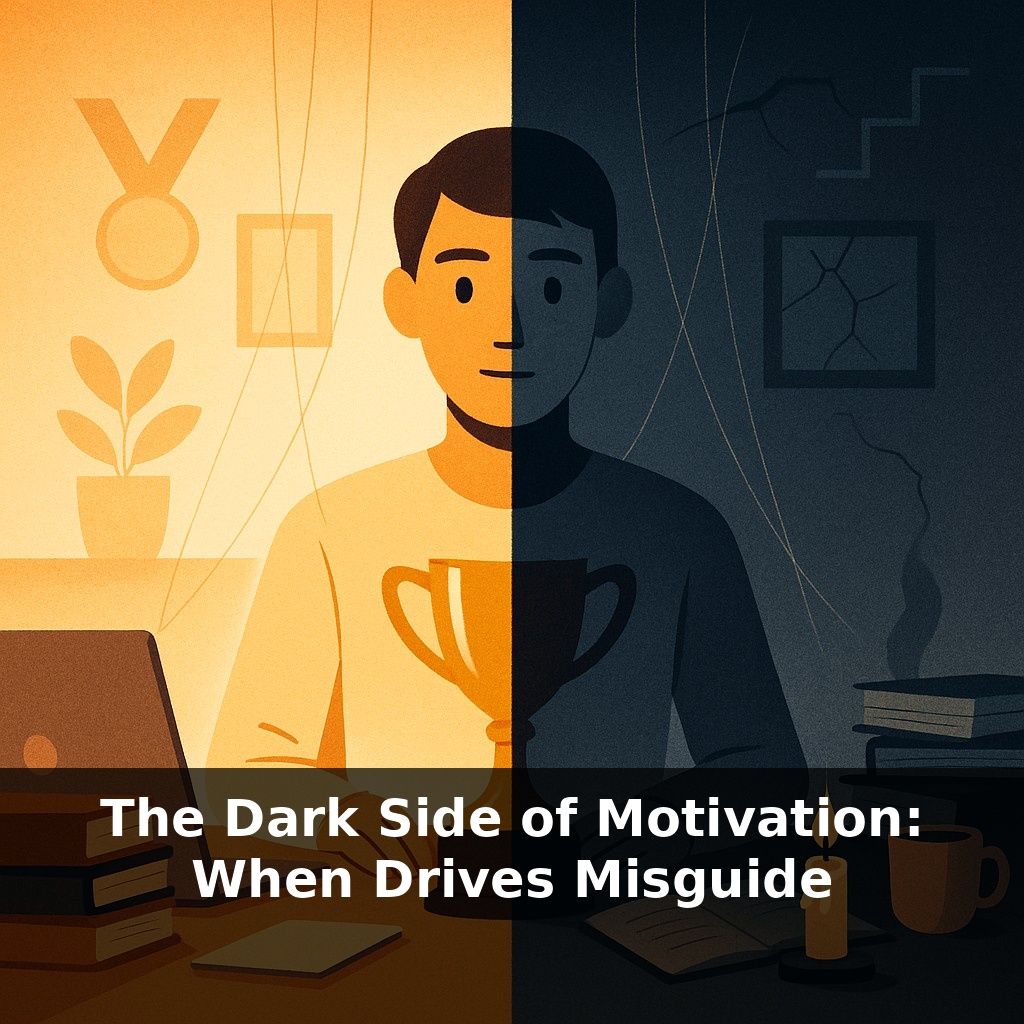
One of the strangest things about human motivation is that the same force that helps us win scholarships, promotions, or medals can quietly push us toward exhaustion, dishonesty, or collapse. A student starts staying up “just one more hour” to protect a perfect GPA. A startup founder insists every metric must “crush it,” then feels personally attacked by any dip in the numbers. A sales team ties self‑worth so tightly to monthly targets that they begin bending rules they once believed in. These aren’t people who “lack balance” in some vague sense; they’re caught in a specific psychological trap where intensity, identity, and external rewards start steering behavior more than values, health, or long‑term judgment. To see how this happens, we need to look at when passion stops serving you—and you start serving it.
Psychologists call this flip side of drive the “dark side of motivation”: the point where what once felt energising begins to narrow your vision, warp your choices, and crowd out everything else. It often starts subtly. A researcher tweaks data “just this once” to protect a grant. A manager quietly sidesteps feedback because it threatens a cherished narrative of being “the best.” A gamer pushes through migraines to maintain a leaderboard spot. Over time, the goal stops being meaningful progress and becomes non‑negotiable preservation of status, certainty, or self‑image—no matter the collateral damage.
Psychology offers three especially useful lenses on this dark turn.
First is arousal and performance. The Yerkes–Dodson law shows that performance tends to follow an inverted‑U: too little activation and you’re sluggish; too much and your brain’s error‑detection and working‑memory systems start to misfire. Under heavy pressure, people don’t just feel worse—they literally perceive fewer options, default to habits, and become more impulsive. That’s why emergency rooms, trading floors, and exam halls can produce both brilliance and catastrophic lapses, depending on where someone sits on that curve.
Second is the quality of the passion behind the effort. Researchers distinguish between “harmonious” and “obsessive” forms. Harmonious passion lets you stay committed while still flexing: you can step back, rest, or say no without feeling like you’re erasing yourself. Obsessive passion feels more like a debt: you “have to” keep going, because slowing down threatens your self‑worth or security. On the surface, both can look like dedication; under stress, they diverge sharply. Harmonious passion will usually bend. Obsessive passion tends to double down, even when feedback, fatigue, or ethics are flashing red.
Third is where the drive is coming from. Self‑determination research suggests that motivation grounded in autonomy, competence, and connection is more stable and less toxic than motivation driven mainly by control, fear, or status. Yet many systems—from grading curves to sales rankings—nudge people toward contingent self‑esteem: “I’m okay only if I win this round.” That shifts attention from learning to image‑management, and from long‑term goals to short‑term scorekeeping.
These forces interact. A perfectionistic student with rising anxiety, working inside a hyper‑competitive culture, is far more likely to slide into over‑arousal and obsessive patterns than someone with similar talent but more psychological slack. And organisations can quietly amplify the risk when every metric is framed as existential, every setback as unacceptable, and every success as the new baseline that must never be lost.
A tech startup launches a “stretch sprint”: shipping a complex feature in half the usual time. At first, the team feels sharp and alive; decisions are crisp, collaboration tight. By week three, bug counts are climbing and tempers are short. One engineer starts hiding defects to avoid blocking release. Output looks heroic on the slide deck—but customers inherit the cost.
In a university lab, a PhD candidate sets a private rule: every experiment must produce a “usable” result. When reality fails to cooperate, she subtly reclassifies ambiguous data, then slowly convinces herself it’s “just cleaning.” Her original curiosity hasn’t disappeared; it’s been crowded out by an internal scoreboard no one else can see.
On a trading floor, a new analyst hits a bonus target early in the year. Instead of relief, he feels a tightening: now this level is the minimum acceptable. He begins checking prices compulsively, skipping risk checks to keep pace with his own record, as if yesterday’s success has turned into a debt he’s required to repay daily.
Hyper‑connected tools will soon nudge us 24/7: smartwatches flag “idle time,” dashboards rank us in real‑time, and AI coaches propose “one more push” before bed. The risk isn’t robots replacing us, but amplifying our most compulsive streaks—like adding high‑frequency trading to your own habits. Expect a cultural split: some firms will chase short spikes; others will treat recovery, boundaries, and dissent as core infrastructure for thinking clearly in a metrics‑saturated world.
When drive turns murky, the real skill is learning to zoom out. Instead of asking, “How do I push harder?” try, “What is this effort silently costing—and to whom?” Notice who benefits, who bends, who breaks. Like code shipped without tests, unexamined striving can pass review today yet seed failures later. The dark side isn’t a flaw to delete, but a signal to debug.
Start with this tiny habit: When you feel that surge of “I have to prove myself” (like when you’re about to say yes to extra work just to look impressive), quietly ask yourself: “Is this moving me toward what I actually want, or just away from feeling not-good-enough?” and pause for one slow breath. If it’s the second one, downgrade the action: instead of volunteering for the whole project, offer just one small, concrete help (like reviewing a single document or joining one meeting). This way you’re still engaged, but you’re training yourself to spot when your drive is coming from fear rather than genuine values.