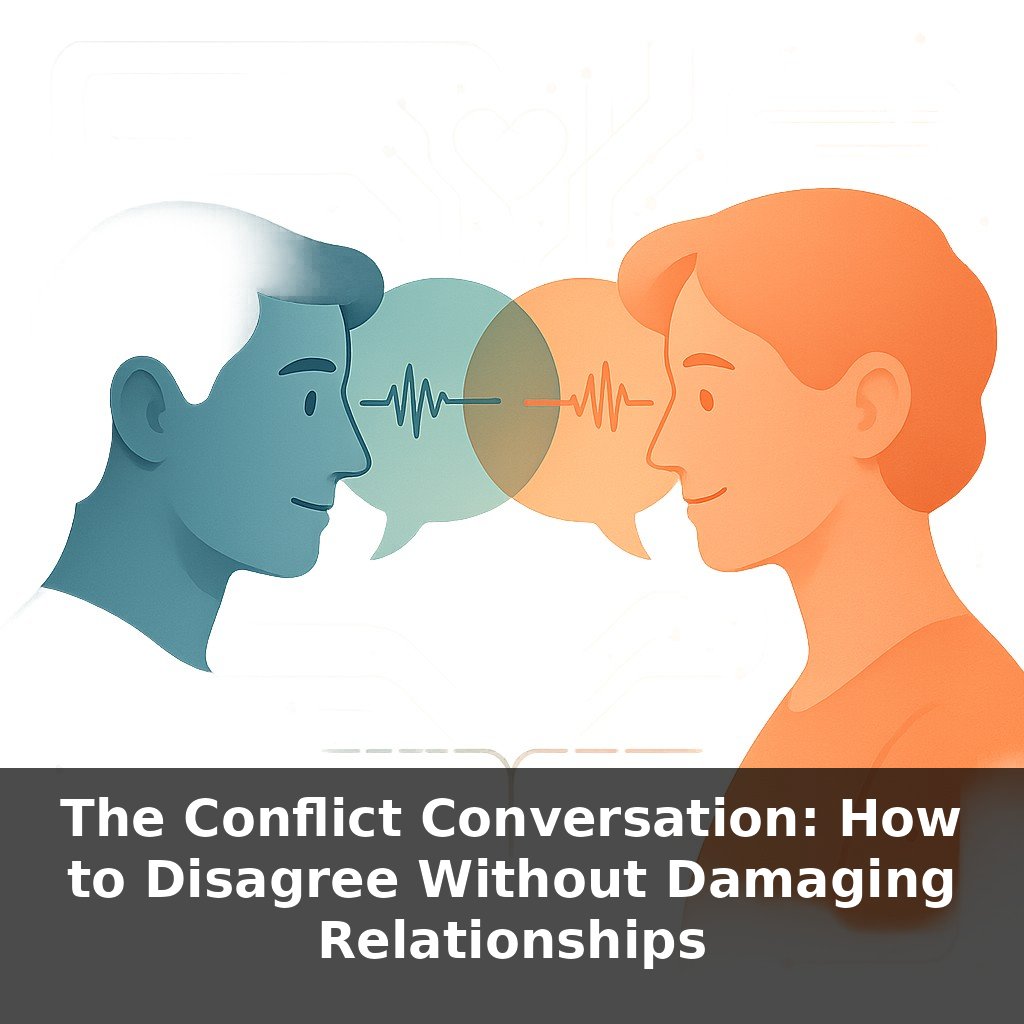
Two friends are mid-argument when one suddenly says, “I still care about you more than I care about winning this.” The conflict doesn’t end—but the tension drops. Here’s the paradox: the moment we stop trying to win the debate is often when real insight finally shows up.
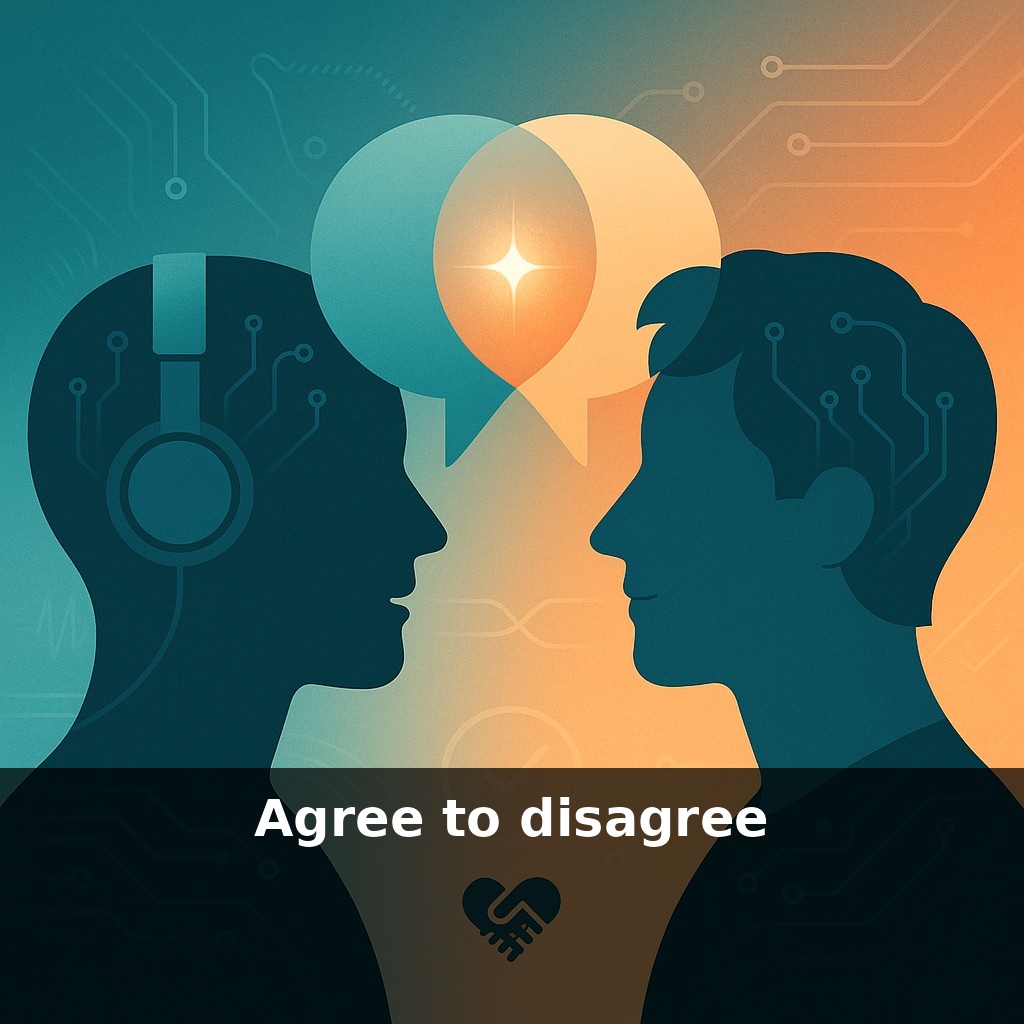
A 2018 study found that teams using a simple “agree to disagree” protocol cut meeting time by a quarter—without losing decision quality. That’s not just efficiency; it’s a different way of understanding what a “good” conversation looks like. In most conflicts, we quietly assume that talking only “worked” if someone changed their mind. So we keep pushing, clarifying, escalating—like turning up the volume on a song that’s already distorting. “Agree to disagree” interrupts that reflex. It treats disagreement as data, not a disaster: a signal that you’ve reached the edge of what this moment can productively hold. Instead of forcing premature unity, you mark the difference, protect the relationship, and leave the door open for cooperation anyway. This is less about giving up and more about choosing what you’re not willing to sacrifice just to be right.
Most of us never learned how to stop a conflict without “settling” it. At work, that means debates drag on until the clock, the manager, or sheer exhaustion decides. At home, it can mean circling the same argument so often it becomes a script—you both know your lines, and nothing actually moves. Research on long-term relationships and team dynamics suggests there’s a missing skill here: naming that a topic is bigger than this moment, and still choosing how to move forward. Instead of squeezing consensus out of each conversation, you start to design boundaries for it—like setting time limits in a game so it stays fun, competitive, but contained.
An 18th‑century Methodist preacher has something in common with your next product meeting. When John Wesley wrote in 1770 that he and a rival theologian might need to “agree to disagree,” he wasn’t being polite; he was inventing language for a move we still struggle to make: protecting a working relationship while staring at a disagreement that’s not going anywhere today.
What makes that move powerful isn’t the phrase itself—it’s the micro‑skills underneath it. Psychologists point to three ingredients that reliably shift a conversation from combative to constructive without forcing a fake resolution.
First is **precision**. Vague clashes like “you’re being unreasonable” keep the whole person on trial. A contained version sounds more like: “We see the timing of this launch differently—I’m cautious, you’re optimistic.” You’re shrinking the disagreement down to the narrowest accurate frame. That small shift matters: brain‑imaging studies show that when people label a conflict specifically, the stress response drops, and the prefrontal cortex—the planning, reasoning part—comes back online.
Second is **relational signaling**. In stable marriages, the couples who endure don’t magically solve more problems; they send constant side‑messages that say, “You and I are okay, even when this issue isn’t.” In practice, that’s adding sentences like: “You’re still the person I want on this with me,” or “Our goals are aligned; our route is different.” You’re separating the value of the person from the friction of the topic.
Third is **continuity**. “Agreeing to disagree” works when it’s paired with a clear next step, not a shrug. That might be a decision rule (“We’ll run both versions and let the data decide”), a time‑box (“We’ll revisit after one quarter of results”), or a division of ownership (“You lead the implementation; I’ll own the risk checks”). The point is to show that progress doesn’t have to wait for philosophical harmony.
Notice what all three have in common: you’re not collapsing difference; you’re **containing** it. Well‑run organizations and resilient families both rely on this containment. They make room for durable disagreements about politics, parenting, strategy, or risk—without letting those disagreements bleed into every interaction.
Used this way, “agree to disagree” becomes less of a white flag and more of a design principle: you deliberately decide which conversations must end in alignment, and which can end in clarity about the disagreement plus a plan for moving anyway.
At a product startup, two co‑founders lock horns over pricing: one pushes “premium and scarce,” the other wants “accessible and fast‑growing.” They don’t try to convert each other. Instead, they write down both logics, pick one approach for the next release, and commit to reviewing churn and revenue in 60 days. The disagreement becomes a hypothesis list, not a personality clash, and both stay engaged because their views are explicitly on the record.
In a family, adult siblings might clash every election cycle. Rather than banning politics, they agree that shared meals are for logistics and support; deeper debates move to one‑on‑one walks, and either person can say, “Let’s park this for now,” without it counting as a win or loss. That small ritual protects birthdays and holidays from becoming referendums.
Think of a jazz band on stage: the trumpet and piano don’t always resolve to the same notes, yet the performance works because everyone knows when to solo, when to lay back, and how to land on the same final bar.
An 80% lower divorce rate for couples who manage “perpetual problems” without solving them points to a bigger frontier: institutions built to hold tension, not erase it. As AI tools start nudging us mid‑conversation—suggesting pause phrases, reframes, or cooling‑off prompts—“respectful stalemate” could become a learned reflex. Picture school debates, shareholder meetings, even city councils using dashboards that track when to pause, log dissent, and still keep the shared project moving.
So the next frontier isn’t perfect harmony; it’s learning which frictions we can carry together without burning out. Think less courtroom, more hiking trail: you and a partner can favor different routes yet still share a map, supplies, and pace checks. As tools evolve, the real upgrade may be this—systems that track the journey without forcing the same footsteps.
Before next week, ask yourself: 1) “The next time I feel the urge to ‘correct’ someone’s opinion, what’s one curious follow-up question I could ask instead (like ‘Can you walk me through how you see it?’) to stay in dialogue rather than debate?” 2) “Thinking of a person I strongly disagree with right now, what is one value or concern underneath their view that I can genuinely acknowledge out loud the next time we talk?” 3) “When I notice my body tightening in a disagreement (raised voice, racing thoughts), what simple line—such as ‘I care about you more than this argument’—can I use to pause and reset the tone in real time?”