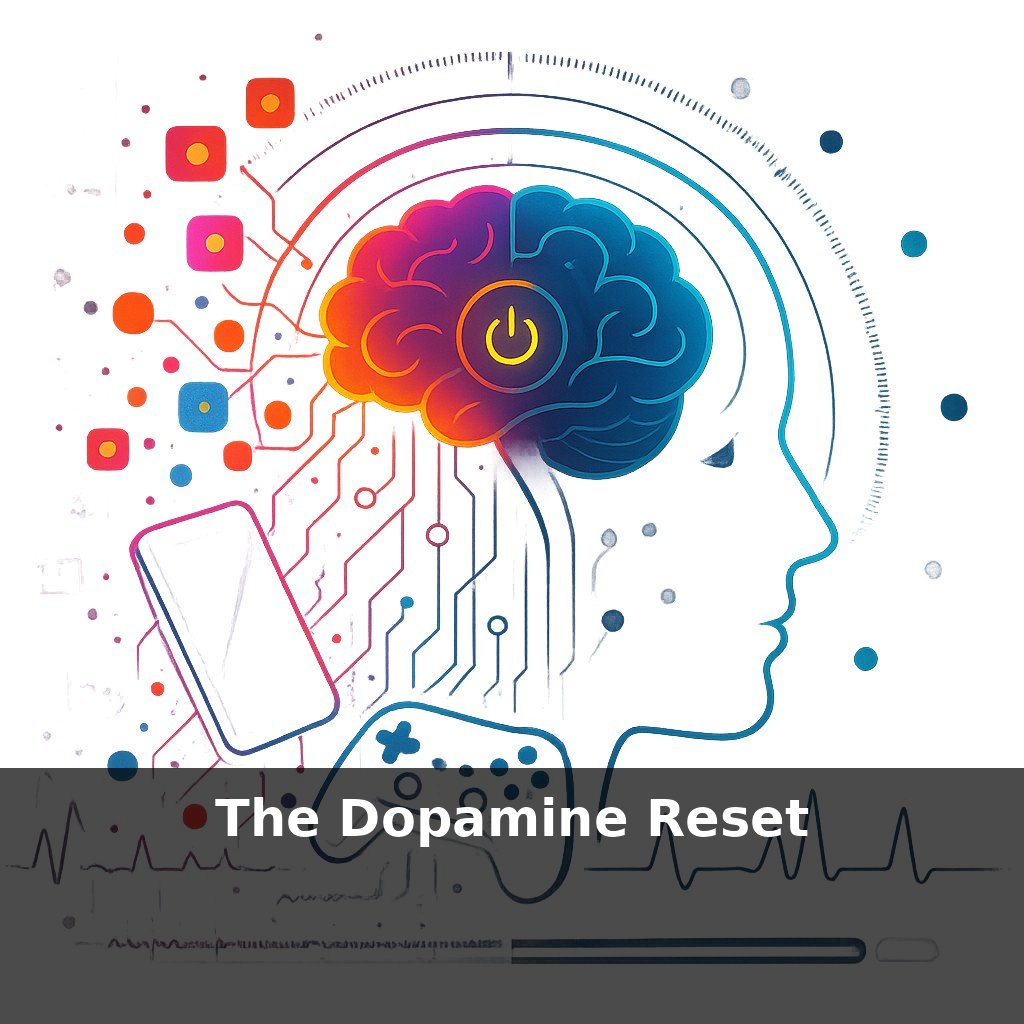
The average person taps their phone thousands of times a day—yet still feels bored. In this episode, you’ll meet three versions of you: the one who scrolls, the one who white-knuckles through cravings, and the one who quietly resets their brain in just a month.
The 30‑day protocol is where your “reset” self stops being an idea and starts becoming a schedule on your calendar. Rather than relying on willpower spikes—those heroic days when you delete every app and swear off sugar forever—this approach treats your brain like a system you can tune, step by step.
Across clinics and self‑experiments, a pattern keeps showing up: when people commit to a month‑long abstinence‑and‑replacement plan, cravings drop, focus improves, and the endless itch to “just check” things quiets down. Not because life gets easier, but because the background noise in your nervous system gets lower.
In this episode, we’ll map out that month: a short, sharp fast from your main trigger, a deliberate re‑build with low‑dopamine activities, and daily practices that quietly push your brain toward balance again—no drama, just data and consistent reps.
Most people try to change by attacking the obvious habit—delete the app, lock the snacks, cancel the account—while leaving the rest of their day untouched. That’s like swapping one song on a playlist that’s still on repeat 12 hours a day. The 30‑day protocol works because it zooms out: it asks *when* cravings spike, *what* they’re soothing, and *which* parts of your routine quietly keep the loop alive. Instead of chasing motivation, you’ll be adjusting levers you usually ignore: light, timing, movement, even who you text first in the morning. The goal isn’t perfection; it’s running a real‑world experiment on your own brain.
Think of the 30 days as four overlapping phases, each asking something different from your brain.
**Phase 1: 3–7 days of a clean break**
Here you’re creating contrast. You pick one specific trigger—TikTok, sports betting, ultraprocessed snacks at night—and remove *only that* completely. No “just on Wi‑Fi,” no “only after work.” You’re not rebuilding your life yet; you’re simply letting your system notice what happens in the silence.
Two things to watch for: - Withdrawal‑style symptoms: irritability, restlessness, “everything feels flat.” - Substitution creep: your brain trying to swap in a cousin behavior (YouTube for TikTok, “healthy” candy for pastries).
You’re not trying to fix these yet, just observe them like a scientist taking baseline measurements.
**Phase 2: Deliberate replacements (days 4–14)**
Once the initial shock settles, you start inserting alternatives *in the same time and place* the trigger used to live. If you scrolled in bed at midnight, now that slot gets 10 pages of a physical book, stretching, a podcast you queue before you lie down. The rule: the replacement must be easier to start than your old habit would be to reinstall.
This is where exercise, mindfulness, and better sleep timing quietly enter—not as moral upgrades, but as strategic swaps that feed the same needs: stimulation, comfort, escape, or connection.
**Phase 3: Load‑bearing routines (days 10–25)**
Here you look for the hinges of your day: the first 60 minutes after waking, the 60 minutes before bed, and the two energy crashes that reliably hit you. You’ll assign each hinge a simple structure: a movement anchor, a focus anchor, and a wind‑down anchor. You’re teaching your brain, “When this time comes, this script runs,” so there’s less room for improvising your way back to old loops.
**Phase 4: Recalibration, not graduation (days 21–30)**
The last stretch is not victory laps; it’s data review. You experiment with *tiny* reintroductions, or you extend abstinence if you’re still too reactive. The key question shifts from “Can I have this?” to “What dose lets me keep the gains I’ve made?”
Think of this month like rehearsing a new setlist. Early on, you’re mostly *muting* the loud tracks; now you’re deciding which quieter tracks you want to headline your day. For example, someone who used to binge sports clips every evening might discover during Phase 2 that a 20‑minute walk plus calling a friend hits the same “unwind” need without leaving them wired at midnight. Another person might notice that when they move their first coffee 60–90 minutes after waking, the mid‑afternoon crash shrinks—and with it, the urge to “take a quick break” that turns into an hour online.
Real people running this protocol often stumble into surprising upgrades: better digestion after a stricter bedtime, fewer arguments when phones stay out of the bedroom, or a sudden spike in creative ideas during commutes that used to be filled with passive scrolling. The point isn’t to live like this forever; it’s to learn which small, repeatable choices give you the most leverage on how each day actually feels.
If this 30‑day approach scales, it could reshape how we design days, not just detox from apps. Workplaces might schedule “deep-focus blocks” the way they schedule meetings, and families could treat screens like dessert—intentional, portioned, and earned. Think of it as redesigning the *architecture* around you: fewer default traps, more default supports. The bigger shift isn’t moral; it’s infrastructural—tools and policies that make the “reset” path the path of least resistance.
Your brain won’t “flip” on day 30—it will whisper. A slightly calmer commute, an argument that doesn’t spiral, a quiet pull toward work you’d been avoiding. Your challenge this week: pick one daily moment that feels hijacked and run a 7‑day micro‑reset there. Treat it like rearranging furniture: small shifts, big change in how the room—and your day—feels.