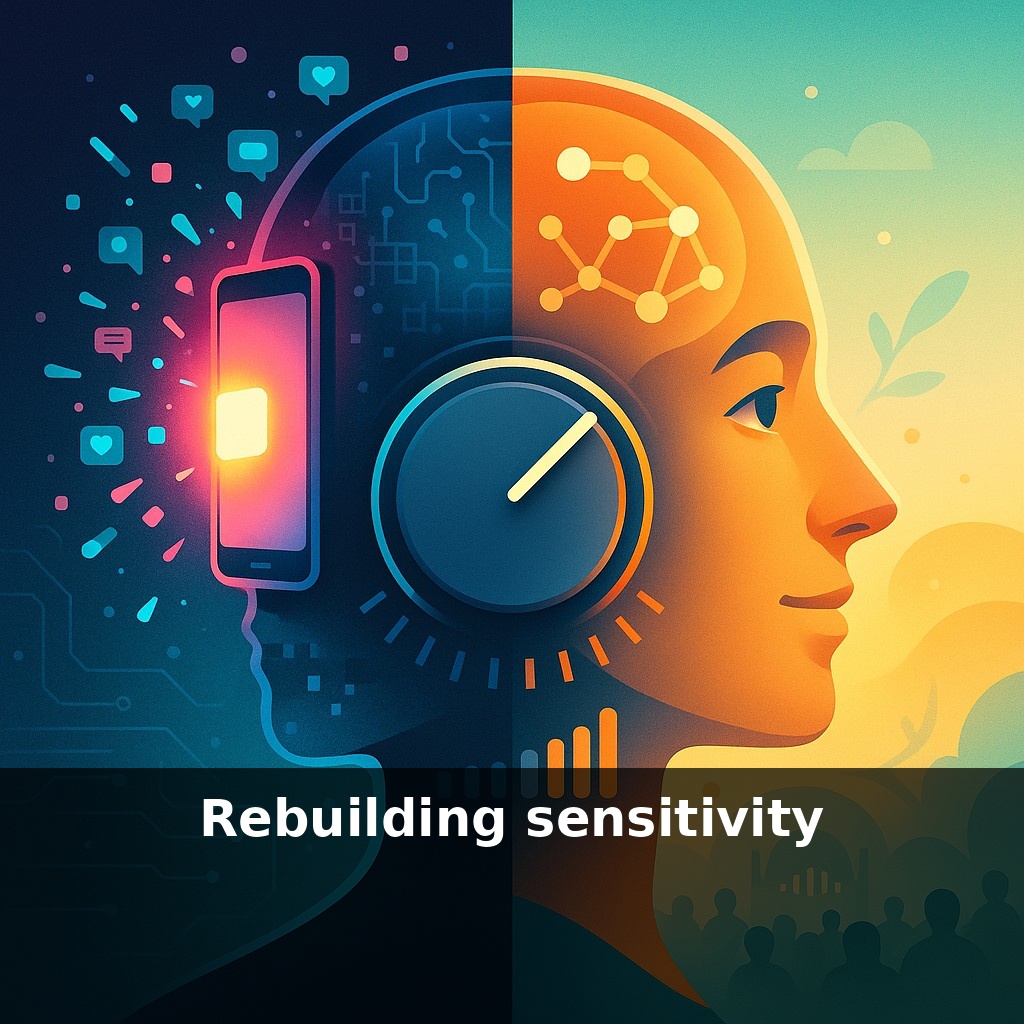
Right now, millions of people can scroll for hours yet feel bored at a live concert. On your phone: constant mini‑hits of reward. In real life: silence. In this episode, we’ll unpack why your “pleasure dial” got turned down—and how to train your brain to feel joy again.
In this episode we move from theory to repair work. Overstimulation doesn’t just make you “like things less”; it physically reshapes your reward circuits. In heavy stimulant misuse, D2 receptor availability can drop by 15–30 %, and even high‑intensity screen use shows similar patterns of blunted response to normal rewards. One striking 2022 finding: teens using social media more than 3 hours per day had about a 60 % higher risk of reporting that “nothing feels enjoyable anymore.” The good news: the same plasticity that dulled your responses can be used to rebuild them. Across studies, 6–10 weeks of repeated, modest rewards—exercise, real‑life conversations, focused creative work—begin to carve new, healthier loops. Think of what follows as a protocol: specific levers, timelines, and habits to methodically restore sensitivity, not just “feel better someday.”
Here’s the catch: you can’t “think” your way out of a dulled reward system—you have to *train* it with very specific inputs. Researchers see the fastest recovery when three ingredients line up: predictable routines, physical effort, and real‑world feedback. For example, 30 minutes of moderate exercise, 5 days a week for 8 weeks, reliably lifts mood scores by 20–30 %. A single weekly meetup, kept for 6–10 consecutive weeks, can measurably reduce loneliness scales. In this episode, we’ll translate numbers like these into a concrete 8‑week rebuild plan you can actually run in your own life.
The first step in rebuilding sensitivity is not heroic willpower; it’s **controlling the inputs** your system sees each day. For about 2 weeks, you’re creating a “quiet lab” so new reactions can be measured and reinforced.
Start by capping your biggest artificial reward source. If it’s social media, choose a hard limit like **40 minutes per day**, enforced with an app‑blocker or by deleting the app from your phone and using only desktop. If it’s gaming, define **3 fixed sessions per week, max 90 minutes each**, no spontaneous late‑night runs. The goal is not zero, but **predictable, low‑volatility hits** so your baseline can begin to rise.
Next, you deliberately insert **anchor activities** that give clear, reliable feedback:
- **Movement block:** Aim for **20–30 minutes** of moderate effort, **5 days a week**. Brisk walking that raises your breathing, light cycling, or stairs. Log start time, duration, and a simple mood score (1–10) before and after. Many people see a **1–2 point average lift** within 10–14 days.
- **Face‑to‑face contact:** Lock in **two 30‑minute conversations per week** where your phone is out of sight. Coffee with a friend, a class, a support group. You’re training your system to associate eye contact, tone of voice, and shared stories with “this matters.”
- **Focused making:** Pick one small creative or constructive project: writing **200 words per day**, practicing an instrument **10 minutes**, or cooking one new recipe each week. Keep the bar low enough that you can **succeed 80–90 % of days**. Consistency beats intensity here.
Crucially, you layer **immediate positive reinforcement** on top of these. Each time you complete an anchor activity, you mark a visible tally: a wall calendar X, a habit app streak, or a short note of what felt even slightly rewarding. Studies in digital health show that even tiny, consistent acknowledgments boost adherence by roughly **20 %** over a month.
Think of this phase like a **medical titration**: you’re slowly adjusting both “dose” and “frequency” of natural rewards, watching for side effects (fatigue, irritation, urges to binge) and making **5–10 % changes**, not drastic swings. Your job is to create **predictable, repeatable conditions** under which the system can start responding again, setting up the heavier rewiring work of weeks 3–8.
A practical example: someone coming off a year of nightly binge‑watching might start with a **28‑day rebuild experiment**. Week 1, they trim streaming to **60 minutes at a fixed time**, then schedule **one 15‑minute walk after work** plus **one in‑person chat** before any shows. Week 2, they keep the same cap but add a **Saturday morning class** (language, dance, or woodworking) that runs **60–90 minutes** and repeats weekly—structured practice that pushes attention beyond passive consumption. By Week 3–4, they swap one streaming night for a **90‑minute deep‑work block** on a single project, like assembling a portfolio or learning a song. Progress is tracked with **three numbers** each evening: energy (1–10), urge to binge (1–10), and sense of accomplishment (1–10). Seeing energy climb by even **1–2 points** while urges drop guides further tweaks. Your challenge this week: design your own 28‑day version with **one cut, one class, one project**, then commit it to a visible schedule.
Within a decade, expect phones and wearables to surface “load alerts”: after, say, 90 minutes of high‑stimulation use, your device could suggest a 10‑minute walk plus 5 slow breaths before you continue. Schools may timetable 3–4 short “reset blocks” per day, mixing movement, daylight, and quiet focus to prevent chronic emotional flatlining in students. Your role now is to prototype this for yourself: set one 5‑minute reset after every 45–60 minutes of demanding or highly stimulating activity.
Treat this as data, not drama. In 6–10 weeks, you can literally chart change: maybe 5 % less craving by day 10, 20 % better sleep by day 30, 2–3 more “actually enjoyed this” moments per week by day 45. Keep numbers visible, adjust one variable every 7 days, and treat each month as a version update of your nervous system.
Before next week, ask yourself: 1) “Where in my day do I most often numb out—scrolling, overeating, overworking—and what tiny moment could I instead spend simply noticing my body (temperature on my skin, tightness in my chest, tension in my jaw) without trying to fix it?” 2) “When I feel ‘too sensitive’ around other people, what exact words, tone, or situation tends to trigger that feeling, and how might I gently tell myself a different story about what my sensitivity is trying to protect or reveal?” 3) “If I treated my sensitivity as a strength for just one conversation this week, what would I do differently—would I pause longer before replying, name the emotion I’m feeling out loud, or excuse myself for a moment to breathe—and how did that choice change the interaction?”