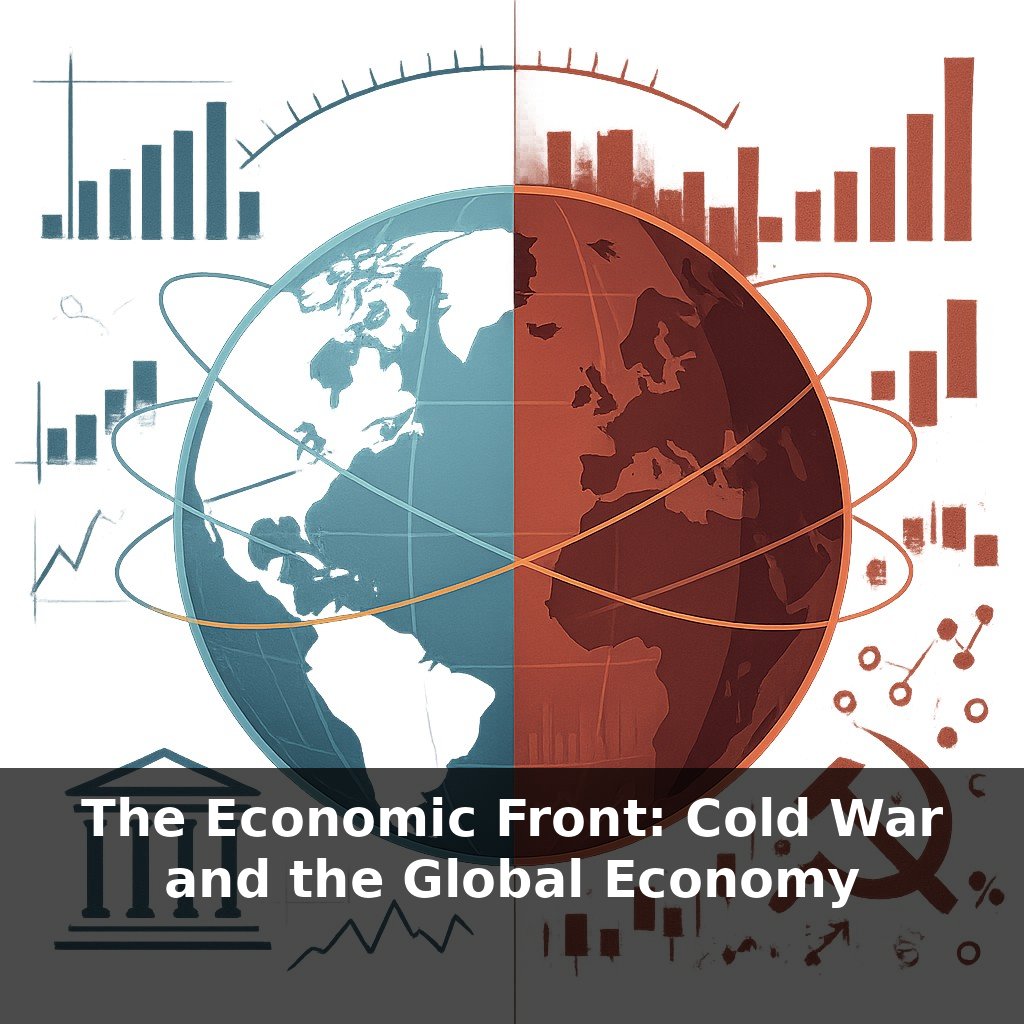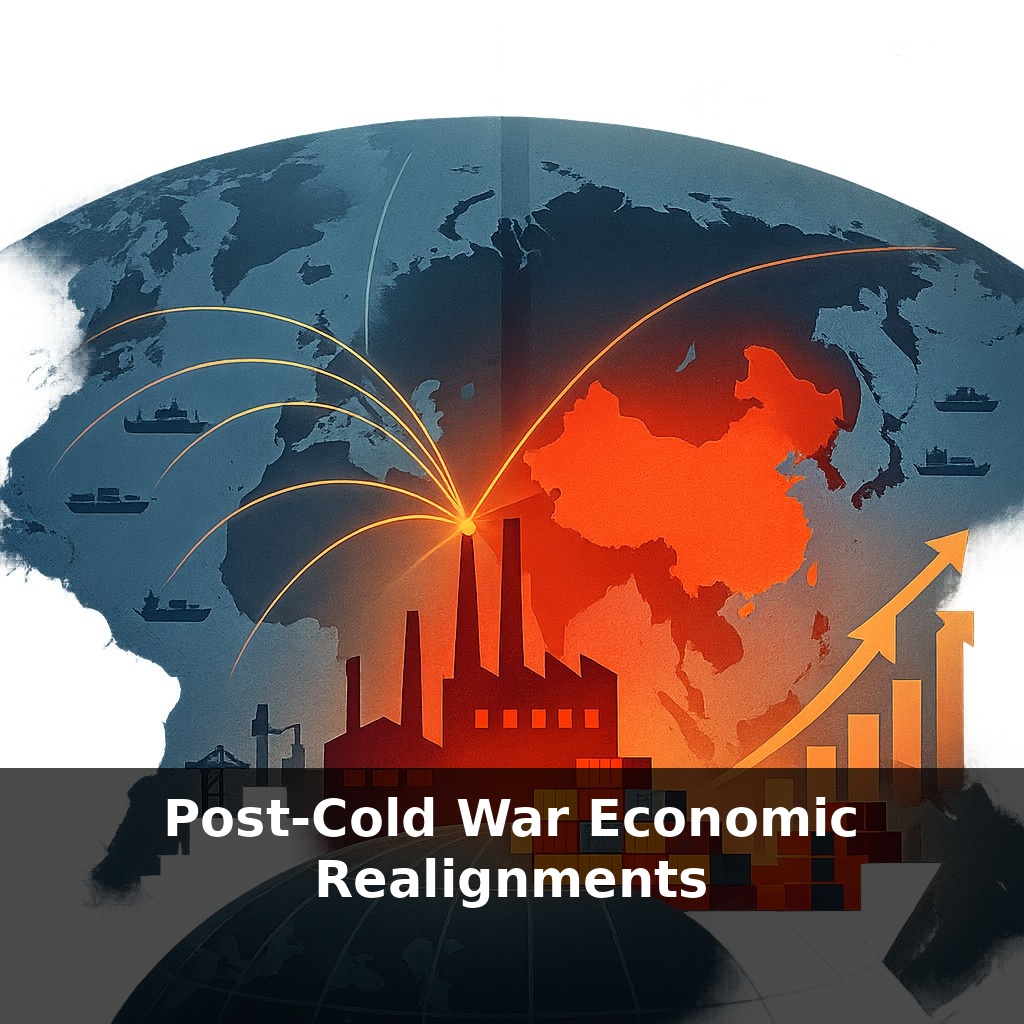
One country went from a minor exporter to the world’s factory in just a few decades. At the same time, trade deals multiplied, and old Cold War alliances quietly rewired themselves around markets, not missiles. In this episode, we step into that chaotic economic rewiring.
China’s exports didn’t just grow—they exploded: from under 2 % of global merchandise exports in 1990 to almost 15 % by 2022. While we’ve already seen how trade deals and alliances set the stage, this episode looks at what happened once countries actually stepped onto that new stage and started competing under a neo‑liberal rulebook. Former socialist economies sold off state assets at scale—over US$650 billion in privatisations by 2005—while emerging markets opened their capital accounts, chasing investment and credibility. The headline result looked impressive: extreme poverty worldwide tumbled, especially in Asia. But beneath those averages, inequality in many rich countries climbed, feeding today’s political backlash. Think of this period less as a smooth victory lap for capitalism and more as a stress test that exposed who gained, who lost, and why.
Former socialist states, from Poland to Vietnam, now had to rewrite their economic software almost overnight. Western advisers arrived with “best practice” playbooks, while investors scanned the map like bargain‑hunters at a clearance sale, searching for undervalued assets and cheap labour. Regional trade agreements ballooned, stitching together production chains that crossed multiple borders before a single product reached a store shelf. At the same time, international institutions tightened their influence, attaching policy conditions to loans much like lenders embossing fine print onto a mortgage contract.
The first big shift was strategic: security ministries quietly ceded ground to finance and commerce. In many capitals, the most important conversations moved from war rooms to treasury offices. Instead of asking, “Who are our enemies?” officials asked, “Who are our investors, and what will keep them here?”
For ex-socialist states, that meant sequencing choices rather than a single “shock.” Some, like Poland, pushed prices and trade open early but slowed changes to pensions or labour protections. Others, like Russia, flipped ownership quickly while leaving weak legal systems in place. The result was what analysts called “capitalism without capitalists”: factories and mines changed hands on paper faster than real entrepreneurs or regulators could emerge.
China took a different route again: it ring‑fenced experimental zones, tested rules in coastal regions, then scaled up policies that worked. Instead of selling off everything, it let new private firms grow alongside old state giants, creating a kind of dual‑track system. That mix allowed foreign brands to plug into Chinese supply chains while Beijing still steered credit and technology.
Meanwhile, production itself stopped being a single‑country story. A smartphone might be designed in California, use chips fabricated in Taiwan, screens from South Korea, and final assembly in Shenzhen. Regional agreements multiplied not just to cut tariffs, but to standardise rules on investment, data, and intellectual property so that this kind of slicing of value chains was legally and financially manageable.
Global finance amplified all of this. As capital controls eased, portfolio flows surged into “reforming” economies—until confidence wobbled. The 1994 Mexican crisis, the 1997–98 Asian crisis, and Russia’s 1998 default showed how quickly enthusiasm could reverse. Governments learned that pleasing bond markets could be as constraining as pleasing a superpower had once been.
Over time, a new hierarchy emerged. Countries that combined low labour costs with improving infrastructure and relatively predictable rules—think Vietnam or Slovakia—became key links in manufacturing networks. Others, slower to upgrade institutions or education, stayed stuck exporting raw materials. The same global architecture that reduced average hardship also locked in new forms of dependence, setting the stage for today’s arguments over “decoupling,” “friend‑shoring,” and economic security.
Some of the starkest post‑Cold War shifts show up in where specific products now come from. In 1990, Eastern Europe was still turning out tanks and heavy machinery for Comecon partners; by the 2010s, Slovakia was producing more cars per capita than almost any country on earth, hosting plants for Volkswagen, Kia, and Peugeot. Vietnam, once associated with war footage, became a major node for Nike, Samsung, and furniture suppliers, climbing from basic assembly to more sophisticated electronics and services.
A single container ship today might carry Colombian coffee beans, Ethiopian cut flowers, and Polish auto parts, all headed to distribution hubs that barely existed when the Berlin Wall fell. India’s rise in IT services followed a different path: instead of factory floors, it plugged educated, English‑speaking workers into global value chains for code, accounting, and design. Policy choices mattered: countries that built reliable power grids, ports, and courts tended to lock in long‑term contracts; those that didn’t often saw investors pivot to the next contender on the map.
Rival green subsidies, sanctions, and data rules now pull supply chains in competing directions. Chips, batteries, even rare earths are treated less like everyday inputs and more like strategic chokepoints. As climate risks bite and AI spreads, expect governments to mix old market tools with new industrial tactics—screening investors the way airports screen luggage, and nudging firms to “friend‑shore” key links. The risk: resilience for some, but higher costs and new fault lines for many.
In our next episode, we’ll follow how this new order frays when shocks hit—financial crises, pandemics, and sanctions that ripple like a power outage through a crowded subway network. Your challenge this week: trace one everyday item you use back two steps in its supply chain; note how many countries and rules silently knit your routine together.