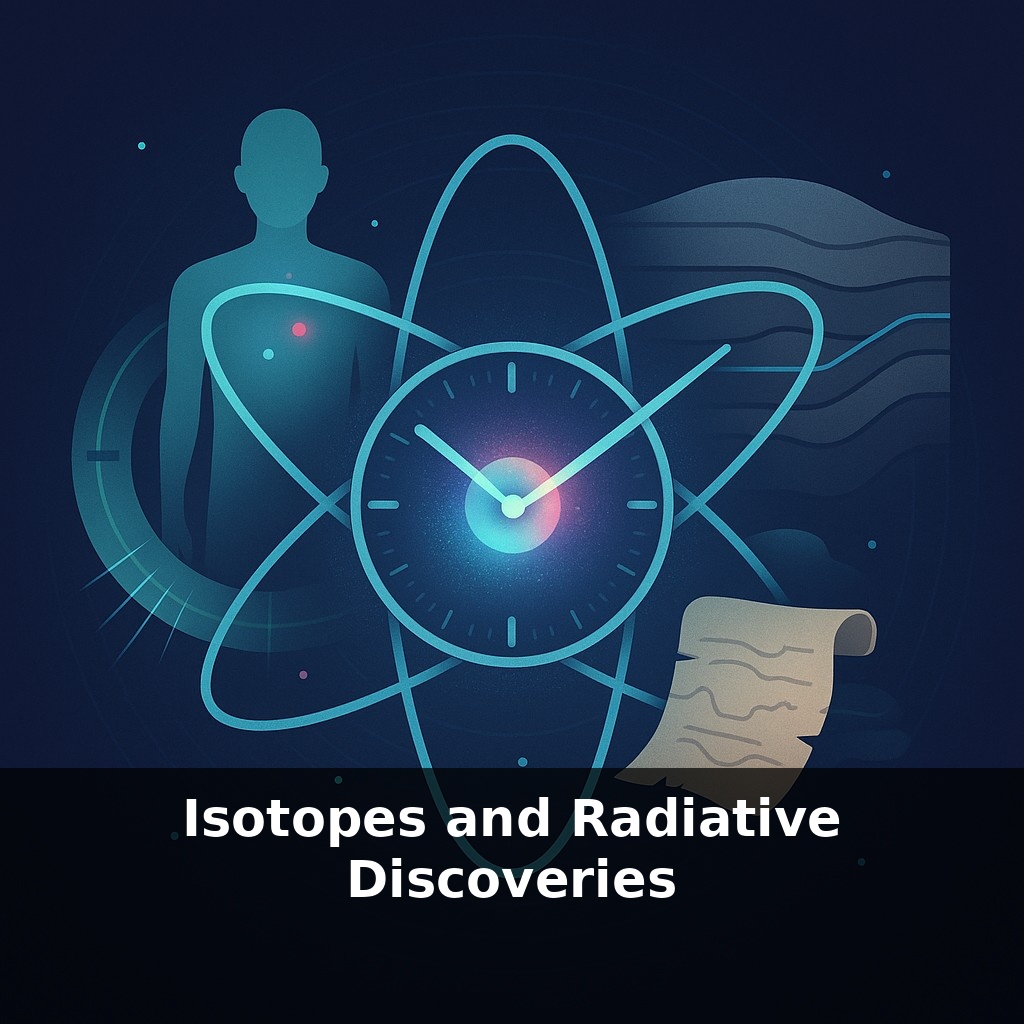
Some of the atoms in your body are quietly ticking like microscopic clocks, keeping time over tens of thousands of years. In hospitals, others are lighting up scanners to reveal hidden tumors. Same elements, same chemistry—yet their different “weights” rewrite what matter can do.
Some of the “ticking” in your body isn’t just poetic—it’s precise enough to reconstruct history. The carbon-14 in ancient parchment can reveal when a scribe sharpened their pen; potassium-40 in volcanic rock can timestamp eruptions older than human language. That’s the strange power of isotopes: they turn ordinary material into evidence.
In medicine, this same idea gets weaponized and domesticated. A technetium-99m dose is tiny, but its controlled bursts of energy sketch out blood flow through a stressed heart. Iodine-131 doesn’t just glow; it seeks out overactive thyroid tissue and quietly shuts it down.
And on the grandest scale, long-lived isotopes act like audit logs for the planet itself, letting us infer Earth’s age and thermal past—not from guesswork, but from the decays silently accumulating since before there were oceans.
Some of the most revealing isotopes aren’t in ancient scrolls or hospital vials—they’re under highways, in crop fields, even in your tap water. Radiotracers follow fertilizer through soil, showing exactly how much reaches plant roots versus rivers. In industry, tagged molecules map tiny leaks inside massive pipelines, like a dye test that works through solid steel. At the planetary scale, isotope “signatures” in ice cores and seashells let us reconstruct past climates, tracking when oceans warmed or ice sheets retreated. Each decay event is tiny, but together they outline stories no witness ever saw.
Follow a drip of water from a mountain stream into your kitchen, and isotopes can tell you where it stopped along the way. Ratios of light and heavy oxygen in that water shift as clouds form, rain falls, and snow melts. Hydrologists read those ratios to figure out how long groundwater has been underground, which aquifers are being over-pumped, and how fast glaciers are feeding rivers that cities rely on.
In your body, subtle differences in hydrogen and oxygen track metabolism with similar precision. “Heavy” water—used in tiny, safe amounts for experiments—lets researchers measure how fast you burn calories, how quickly cells turn over, and how diseases like cancer hijack normal growth patterns. No scalpel, no biopsy: the information rides on which version of an element ends up where.
Climate science leans heavily on this kind of detective work. Layers of Antarctic ice, compressed over hundreds of thousands of years, trap not just bubbles of air but a year‑by‑year isotope ledger of temperature and rainfall. Marine sediments store parallel records in the calcium carbonate of ancient shells. When those independent archives agree, we get a high‑confidence picture of past warm periods and abrupt climate swings—critical baselines for judging today’s changes.
In nuclear forensics, the same logic turns into security. After a weapons test or reactor incident, analysts scrutinize isotope mixes in dust and debris to reconstruct what kind of fuel was used, how it was processed, even whether material came from a reactor or a medical source. It’s closer to reverse‑engineering a complex software system from its log files than it is to traditional chemistry.
And then there’s power. Reactors depend on carefully balanced mixtures of fissile and non‑fissile uranium and plutonium. Over time, those mixtures evolve, building up fission products and new transuranic elements. Tracking that evolution through precise isotope measurements tells operators when fuel is spent, how much energy has been extracted, and how to design safer, more efficient next‑generation systems.
Your challenge this week: whenever you hear news about climate, health, or nuclear energy, ask: “Is there an isotope story hiding underneath?” Then look it up—once. Over time, you’ll start seeing the hidden layer of measurements that quietly hold those claims together.
A leak at a nuclear plant, for instance, isn’t just “radiation somewhere.” Analysts check which fission fragments show up and in what proportions, narrowing down whether the problem came from fuel, coolant, or waste streams. In doping scandals, anti‑cheating labs compare the isotope pattern of an athlete’s testosterone to that of natural hormones: synthetic versions carry a subtly different “accent,” revealing lab origins even when concentrations look normal. Food fraud labs do something similar. Honey marketed as “local” can betray a tropical flower signature; wine labeled as a particular vintage can be unmasked when its composition doesn’t match the atmospheric testing records for that harvest year. Even explosions in remote regions leave behind telltale combinations embedded in dust and rainwater, letting investigators distinguish a mining accident from a covert test. Across all these cases, the periodic table doesn’t change—but the nuanced mixture of each element’s variants quietly records which story is true.
Hospitals, labs, and space agencies are quietly turning isotopes into multipurpose tools. New particle beams are like ultra‑precise scalpels for tumors, leaving nearby tissue almost untouched. Deep ice cores tagged with rare gases are extending climate records into previously “blind” eras. Even museum vaults are changing: handheld detectors can now probe statues or scrolls on the spot, flagging forgeries without taking a sample—more like scanning a QR code than chiseling off a chunk.
In the next decade, you’ll likely give a blood sample, drink water, or board a flight whose safety quietly depends on this hidden layer of physics. Research reactors are being retooled to produce medical doses without weapons‑grade byproducts, and space probes now carry tiny nuclear “campfires,” using controlled decay to power instruments where sunlight never reaches.
Here's your challenge this week: Pick *one* medical or industrial use of isotopes mentioned in the episode (like PET scans, carbon dating, or tracers in pipes) and spend 20 minutes tracing its “isotope journey”: which specific isotope is used, how it’s produced, how long its half-life is, and exactly what problem it solves. Then, before the week ends, explain that isotope story out loud to a friend or family member in under 2 minutes—no notes, just you teaching it like the podcast hosts did. If they can clearly tell you what the isotope is, why its half-life matters, and how it helps people, you’ve nailed the challenge.