Decoding Churchill: The Secret Meetings
📝 Transcript
“During Churchill’s first months as wartime leader, his top team met behind closed doors more than once a day on average. Yet almost none of those conversations were recorded. Tonight, we slip into those missing hours, where a handful of voices quietly rewrote the fate of the war.”
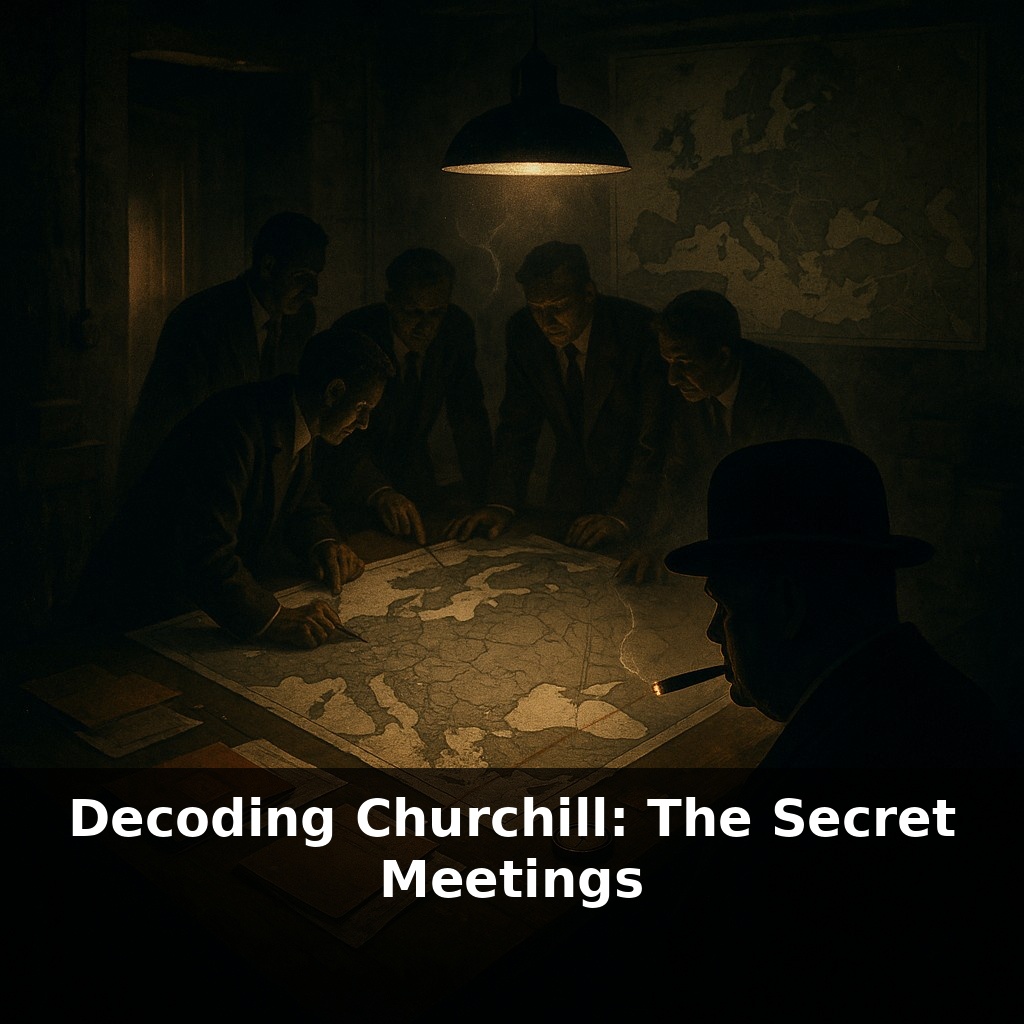
The paper trail of World War II is thick with memos, directives, and grand communiqués—but Churchill’s real work often happened in rooms designed never to be noticed, let alone remembered. Below the traffic rumbling through Whitehall, the Cabinet War Rooms were cramped, low‑ceilinged, and stale with cigarette smoke, yet they functioned like the war’s hidden operating system, quietly routing decisions that the public only saw as headlines weeks later. Churchill moved through this network of secret spaces—from underground London to sealed train carriages and warship cabins—conducting meetings where maps were redrawn, invasions resized, and risks pushed a little further than his advisers liked. To outsiders, he was delivering stirring speeches; inside this closed circuit, he was constantly trading certainty for speed, gambling that secrecy plus urgency might outrun disaster.
Those meetings were not just frequent; they were dense. In Churchill’s first 100 days, the War Cabinet convened roughly 115 times, each session layering decisions that could redirect whole campaigns. Around the table, service chiefs, ministers, and intelligence chiefs arrived with slivers of the picture—decrypts from Bletchley, bombing reports, shipping losses—and Churchill forced those fragments into a single, usable story. Think of it less as one man issuing orders and more as a constantly updated dashboard, where every new graph or warning light threatened to reorder the entire strategy by nightfall.
If the underground rooms were the nerve centre, Churchill’s real leverage came from how he linked them to a much wider, invisible network of conversations. One layer up sat the Chiefs of Staff Committee, meeting in almost permanent session, turning raw reports into options and probabilities. Churchill often dropped in unannounced, challenging assumptions, but just as often he let them argue without him—and backed their collective judgment even when it ran against his instincts. That balance between intrusion and deference is why operations like TORCH, the first big Anglo‑American landing in North Africa, emerged as negotiated products rather than one‑man brainwaves.
Beyond London, secrecy had a geography of its own. Decisions were hammered out in moving spaces designed to leave almost no footprint: overnight train compartments with blinds drawn, cabins on battleships steaming through the Atlantic, sealed hotel floors in Washington. Each setting came with its own security choreography—cover names for journeys, bogus diary entries, decoy luggage—to conceal not just the meeting’s content but the fact that it was happening at all. The fewer people who could even guess that Churchill and Roosevelt were in the same time zone, the safer the eventual operation.
Inside those rooms, the most guarded presence was often not a person but a file. ULTRA decrypts arrived in thin, bland folders, their origin disguised, their circulation tightly rationed. Churchill called them his “golden eggs” and insisted they go straight into the decision stream—but only a handful of attendees were told what they were really reading. This created oddly asymmetrical meetings: some participants argued from patterns they could not fully name, while others, sworn to deeper secrets, steered discussion just enough to protect the advantage without revealing its source.
All of this fed into a separate, almost parallel track of diplomacy. When Churchill crossed the ocean to draft the Atlantic Charter with Roosevelt, or sat opposite Stalin at Tehran, the public script was lofty principles and photographic handshakes. The private script, unfolded over late‑night sessions, was brutally specific: tonnage of shipping, landing dates, front priorities, post‑war borders. In those hours, strategy, intelligence, and ideology were stacked like floors in a single, heavily guarded building—each level inaccessible unless you had the right key, but all bearing the weight of the same war.
Churchill’s secret meetings worked a bit like a prototype lab bolted onto the side of a vast, conservative factory. Out in the open, policy moved slowly through departments, committees, and formal cables. Inside the lab, a tiny team stress‑tested ideas at speed, then quietly slipped only the workable designs back into the official pipeline. That’s why some of the most controversial choices—the shift to “Germany first,” the escalation of strategic bombing, the timing of opening a second front—first surfaced not in big, ceremonial conferences but in cramped side rooms where a map could be cleared, a timetable erased, and a line of advance redrawn in minutes.
You can see this most clearly in how alliances were managed. Before Tehran locked in OVERLORD, Churchill hosted narrower, exploratory sessions in Cairo and Moscow, using each as a controlled trial of what Roosevelt or Stalin might accept next. The public communiqués were carefully bland; the real value was in discovering how far each partner would bend before the relationship itself began to creak.
Churchill’s closed circles preview today’s crisis “war rooms,” where leaders fuse classified feeds, expert hunches, and politics under brutal time pressure. The pattern travels well: cybersecurity cells, vaccine taskforces, even central banks in a meltdown borrow that model of fast, shielded coordination—and face the same dilemma. The tighter the circle, the sharper the decisions, but the weaker the outside trust. In a leak-saturated world, the real frontier is designing secrets that can later withstand daylight.
In later years, Churchill claimed he’d only kept “the minimum of secrets,” yet whole corridors of discussion never reached his memoirs. That gap matters now: it’s where we see how private doubts, grudges, and side-deals quietly bent public strategy, like hairline cracks in concrete that decide which way a building will fall when the pressure finally comes.
Start with this tiny habit: When you sit down with your morning drink, spend 30 seconds imagining you’re briefing Churchill before one of his secret wartime meetings and say out loud one key decision you need to make today, as if you’re reporting it to him. Then whisper to yourself one “code name” for that decision (like “Operation Budget,” “Operation Courageous Email,” or “Operation Early Bedtime”) to make it feel deliberate and strategic. Commit to taking just the *first* step on that operation before lunch—nothing big, just the smallest move Churchill’s war room would have greenlit.
From this course
The Enigma of Churchill's Secret Decisions
6 episodesUnlock all episodes
Full access to 6 episodes and everything on OwlUp.
Subscribe — $1.99/monthLess than a coffee ☕ · Cancel anytime