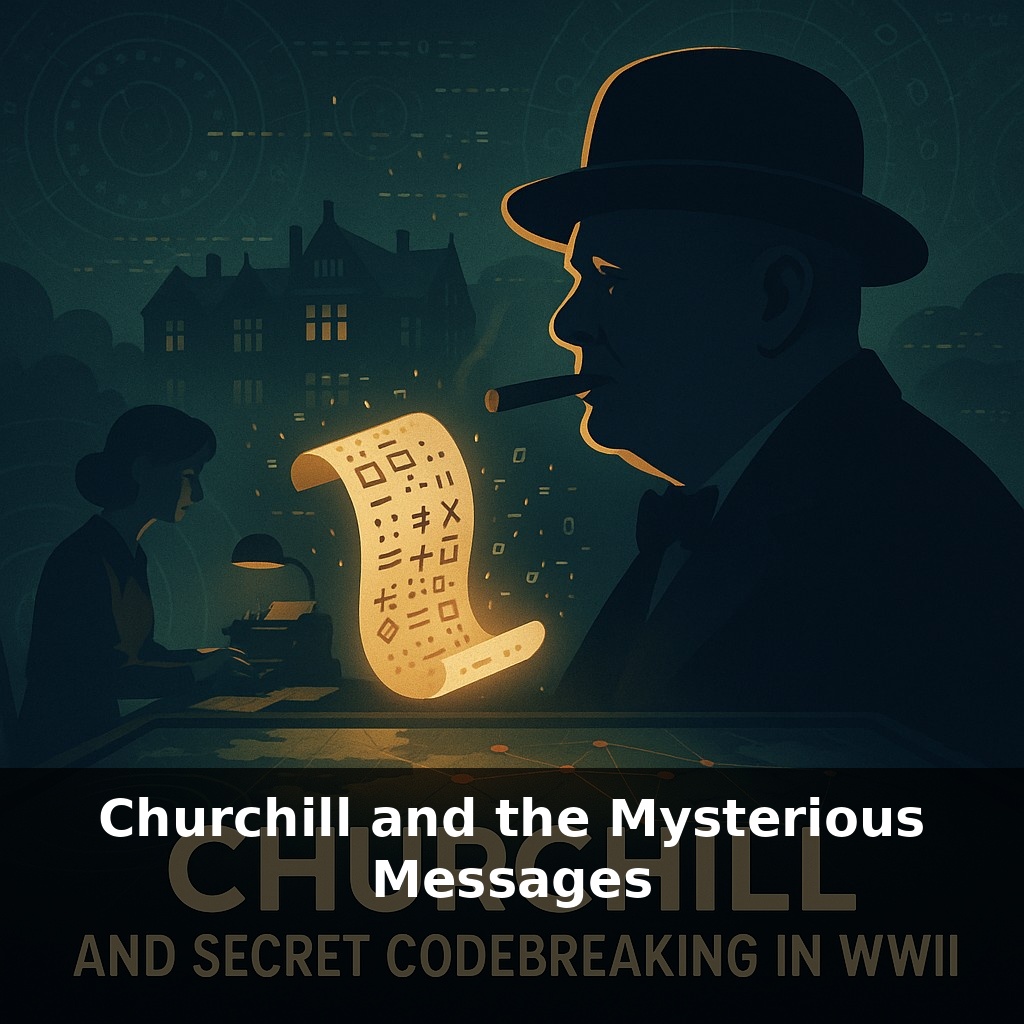
A war led by a man who hated paperwork… yet won with secret messages he rarely touched. In a quiet English estate, thousands of mostly young women cracked codes that Churchill called his “golden eggs.” But how do hidden numbers steer the biggest decisions of a world war?
Churchill quickly learned that secret information was both a gift and a trap. If he acted too obviously on an intercepted German plan, the enemy might suspect their systems were compromised. So his war cabinet built a kind of “firewall” between raw secrets and visible action: only a tiny circle saw the full ULTRA picture; most commanders received fragments, disguised as if they’d come from reconnaissance flights or captured documents. This setup created odd tensions. A naval officer might be furious his convoy route was changed at the last minute, never knowing it was to dodge a U‑boat pack. A general might be praised—or blamed—for decisions quietly nudged by signals he was never allowed to see. Over time, Churchill had to decide not just *what* he believed, but *how much* he dared show that he believed it.
Churchill responded by reshaping how information moved, not just what it said. He demanded “the essence, not the embroidery,” pushing analysts to boil down torrents of intercepts into a few sharp signals he could act on fast. New logistic rhythms emerged: special couriers, red‑bordered folders, codeword briefings that arrived like scheduled trains, rain or shine. Yet even in Downing Street, some reports were quietly delayed or softened so that patterns in his reactions wouldn’t betray the source. In effect, the British state was teaching itself to *perform ignorance* in public while thinking with a hidden, faster brain.
Churchill’s answer was to treat signals as a weapon system in their own right, with rules of engagement as strict as any frontline unit. ULTRA wasn’t just locked in safes; it was rationed like ammunition. Only a handful of senior officers were cleared to know *that* such material existed, and even they were warned that overusing it could “burn” the source. The result was a strange kind of discipline: sometimes the British chose to let small convoys be attacked, or minor raids succeed, so that bigger, better‑timed interventions remained believable to the Germans.
This invisible calculus shaped whole campaigns. In the Battle of the Atlantic, decrypted traffic on U‑boat wolfpacks let the Admiralty reroute key convoys just enough to look lucky, not omniscient. Staff mixed in routine air patrols or “chance” sightings to create a plausible trail. When the statistics began to tilt—U‑boats sinking less, merchants arriving more—few outside the inner ring connected the curve on the chart to rooms full of headphones and punched cards.
The same logic steered preparations for D‑Day. By 1944, ULTRA could often read German reactions to Allied deceptions in near real time. Churchill and his planners watched as fake radio chatter and dummy formations convinced Hitler that the real landing would come at Pas‑de‑Calais. Each time decrypted orders showed German reserves holding back from Normandy, it confirmed the ruse was working—and warned how fragile it was. A single overly precise pre‑emptive move might have revealed just how much was known.
To keep this edge, the machinery behind it had to evolve constantly. New Enigma variants, fresh cipher habits, and changing traffic volumes forced Bletchley Park to scale up from hand methods to electromechanical “Bombes,” and then to the Colossus machines targeting high‑level German teleprinter traffic. That progression—from exhausting manual routines to programmable electronics—quietly pushed Britain toward the era of modern computing. Decisions in the war rooms of London, in other words, were increasingly powered by rows of humming racks that processed patterns far faster than any human staff could manage alone.
Some of the strangest ripples of Churchill’s hidden “second brain” showed up in places that looked utterly ordinary. A clerk in Liverpool might see ship schedules altered three times in a week and assume mere bureaucratic chaos; buried in those changes were patterns drawn from signals she would never read. At Bletchley, a 19‑year‑old linguist could spend months nudging a single statistical hunch, only to see it materialize later as a one‑line order in a naval diary: “Convoy route modified.” Neither worker ever saw the other, yet their efforts locked together like gears in a clock.
Modern secure video calls between presidents echo the wartime SIGSALY links: bulky, temperamental at first, but designed so carefully that delay stayed low enough for real conversation. One way to picture the discipline involved is to think of a football team that knows the opponent’s playbook but must still sometimes allow short gains, blitzing only on key downs so the pattern stays hidden. Churchill’s circle played that kind of long game across continents and months, betting that restraint today would buy credibility for decisive moves later.
Today’s ciphers sit on smartphones and undersea cables, but they inherit Churchill‑era dilemmas: How much should leaders reveal about defensive strength? Who gets to hold the master keys—companies, states, or alliances? Quantum tools will pry at today’s locks, forcing rivals to quietly co‑design standards, much like architects agreeing on load‑bearing rules even while competing on style. The next scramble won’t just be to read secrets, but to prove what’s authentic in a world of flawless fakes.
In Churchill’s era, the real revolution wasn’t just what leaders knew, but how quietly they learned to coordinate around that knowledge. Today, every secure login, every scrambled call, is a faint echo of those experiments in controlled trust. As future tools blur truth and forgery, the hardest problem may be agreeing on which “whispers” deserve to guide us.
Start with this tiny habit: When you close an app or browser tab, take 5 seconds to ask yourself, “What ‘mysterious message’ is my day sending me right now—am I acting like Churchill (decisive) or like the confused codebreakers (unsure)?” Then, in your head, choose just ONE small “Churchill move” for the next hour (e.g., “send that email,” “start the first 5 minutes of that project,” “have that honest conversation”). Keep it playful—pretend you’re decoding your own life like Bletchley Park decoded secret cables, and you’re just choosing your next tiny, clear signal instead of staying in the fog.