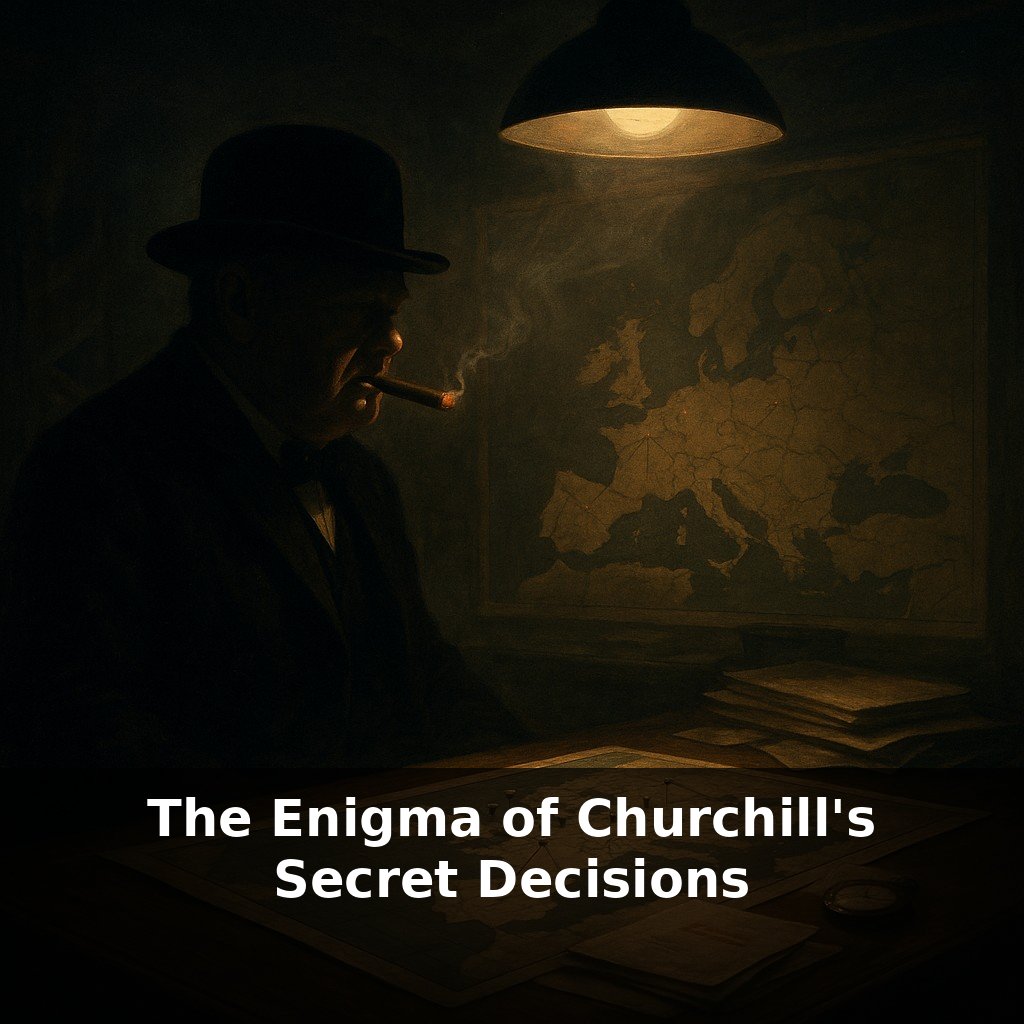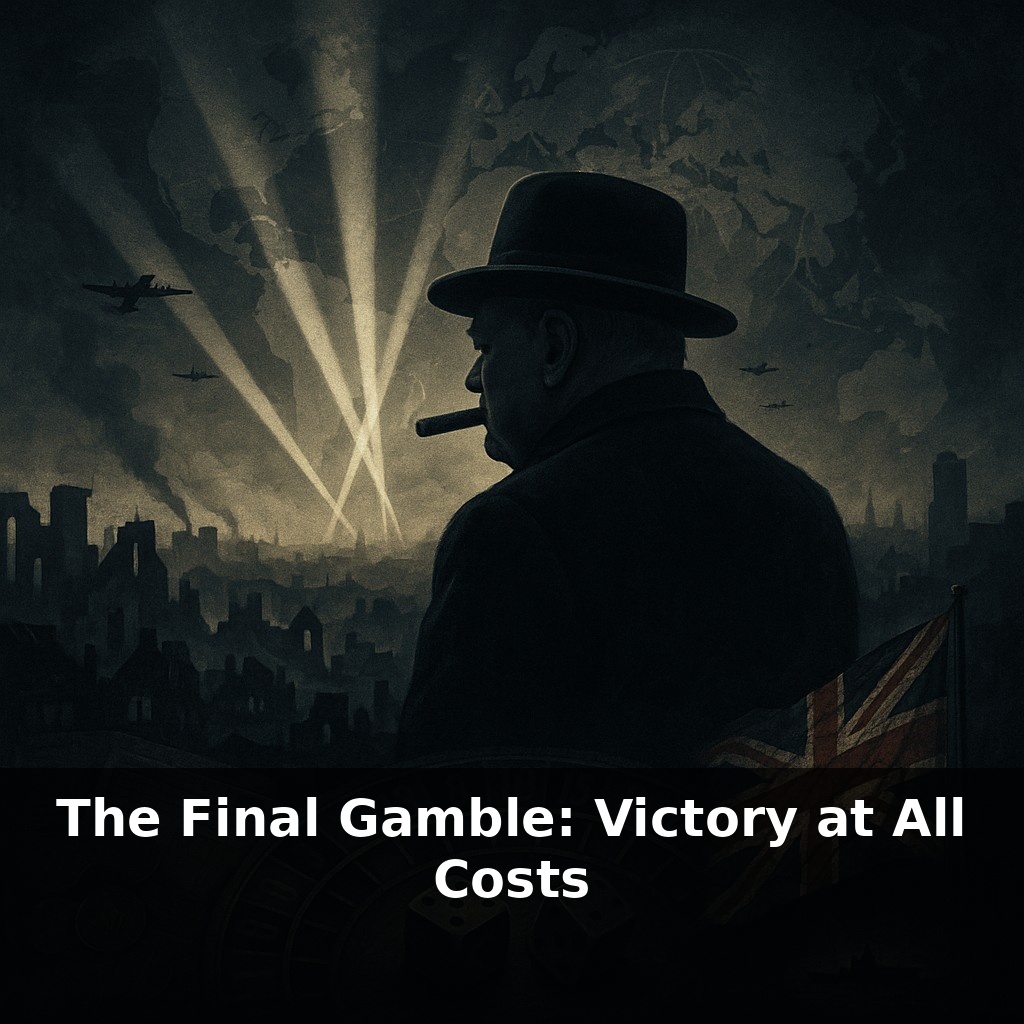
“Victory at all costs,” Churchill told Parliament in 1940—yet Britain was already drowning in debt and facing possible defeat. In this episode, we drop into the moment he gambled everything: no peace deal, no backup plan, just one final, desperate push to win or lose it all.
By 1943, Churchill was steering a country that looked powerful on maps but hollow in its cupboards and bank ledgers. British factories roared, yet shop shelves were bare. Empire troops fought on three continents, yet the state was effectively paying with borrowed money, stacking IOUs higher than London’s skyline.
In this episode, we follow how that earlier commitment to press on, regardless, hardened into a set of concrete bets: tying Britain’s survival to American industry, accepting staggering RAF losses in a bombing offensive, and pushing for an invasion of Europe that many generals feared was a bridge too far.
Think of it as trying to keep an overworked engine running in the red—every extra mile promising either a triumphant finish line or sudden, catastrophic breakdown. We’ll trace how each decision narrowed Churchill’s choices even as it widened the path to possible victory.
Yet Churchill’s risks weren’t only military—they were financial, political, and moral wagers layered on top of each other. Lend-Lease turned Britain into a client of American production lines, as 8.6 million tons of supplies crossed the Atlantic like a conveyor belt feeding a machine that couldn’t be switched off. At home, debt quietly swelled to 250% of GDP, locking future governments into years of repayment. Meanwhile, each bombing raid and planning meeting for a cross-Channel assault raised a sharper question: how far could a democracy stretch its people before consent began to fray?
Churchill’s gamble first became clear in the summer of 1940, when some of his own colleagues searched for an exit. Over 30 MPs signed what became known as the “Peace Party” letter, urging negotiations while Britain still had something to bargain with. Churchill read the mood differently. In his view, even talking about terms would signal weakness to Berlin and panic to Washington. So he locked the door on compromise and, in doing so, raised the stakes of every future move. There would be no soft landing—only survival or collapse.
From that moment, each strategic choice layered risk upon risk. To keep the Atlantic lifeline open, he backed brutal convoy battles in waters where German U‑boats were sinking ships faster than new ones could be launched. Losses in the early war years were so severe that senior officers feared the sea bridge might simply snap. Churchill doubled down anyway—more escorts, more codebreaking resources, more air patrols—because without those 8.6 million tons of American supplies, none of his later plans were conceivable.
At the same time, he championed a bombing offensive whose cost was measured not only in German cities destroyed but in British crews who never returned. Over 55,000 Bomber Command airmen were killed—disproportionately volunteers from across the Empire. Churchill understood the arithmetic; he received the casualty lists. Yet he believed that without constant pressure on German industry and morale, Stalin might cut his own deal with Hitler, leaving Britain isolated again.
The last and most contested wager was over where and when to strike on land. Churchill’s instincts pulled him toward peripheral operations—in the Mediterranean, the Balkans, the Aegean—places where a weakened Britain might still punch above its weight. American planners, led by Marshall and Eisenhower, argued relentlessly for a direct cross‑Channel blow. After months of argument, Churchill accepted a course that frightened many British commanders: a single massive landing in France with 156,000 troops committed on day one, and millions more to follow. It was, effectively, accepting that Britain could no longer shape the war primarily on its own terms; the centre of gravity was shifting toward Washington and Moscow.
By 1944, his position resembled a software engineer who’s pushed a risky update into a live system: once deployed at scale, rollback isn’t really an option. Churchill had staked his country on a chain of decisions that, if any major link failed, offered no easy way back.
Churchill’s choices ripple into modern boardrooms and war rooms. Think of the 2008 financial crisis: central bankers in Washington and London extended emergency liquidity on a scale that stunned critics, arguing that not acting boldly enough was the greater danger. Their spreadsheets, like Churchill’s war maps, couldn’t guarantee success—only outline degrees of ruin if they hesitated.
You see similar patterns in Ukraine today. Western governments calibrate arms deliveries and sanctions, aware that each added layer of support raises both the chance of Ukrainian survival and the risk of wider confrontation. They face questions Churchill knew well: how much strain can home fronts absorb, and how long will voters back painful trade‑offs?
Even in technology, leaders at firms like SpaceX or DeepMind commit vast resources to projects that may transform their industries—or fail spectacularly. The logic is recognisable: some objectives can’t be reached by edging forward; they demand a leap that, once taken, reshapes every decision that follows.
Leaders today face similarly unforgiving trade‑offs. AI‑driven weapons, cyber tools, and orbital systems can act like accelerants, turning misjudgment into catastrophe at machine speed. The lesson isn’t to avoid risk, but to ask earlier: what hidden prices trail each “necessary” step? Like architects planning for earthquakes, policymakers must design alliances, supply chains, and red lines that won’t crumble when the ground inevitably shifts beneath them.
In the end, Churchill’s bets left Britain exhausted yet victorious, like a marathon runner breaking the tape with nothing left in reserve. Post‑war voters promptly removed him, a reminder that publics tolerate extreme risk only temporarily. Our open question is whether today’s leaders can pursue bold strategies while still leaving room for repair, retreat, and genuinely shared consent.
Here’s your challenge this week: Block out a single 3-hour “all-in” session to tackle one high-stakes goal you’ve been hesitating on, and treat it like a do-or-die final gamble—no phone, no email, no multitasking. Before you start, define one concrete win condition (for example: “send the proposal,” “make the sales calls,” or “launch the landing page”) that must be completed by the end of those 3 hours. During that window, any urge to delay or “optimize later” gets overruled by the rule: progress over perfection, victory at all costs.