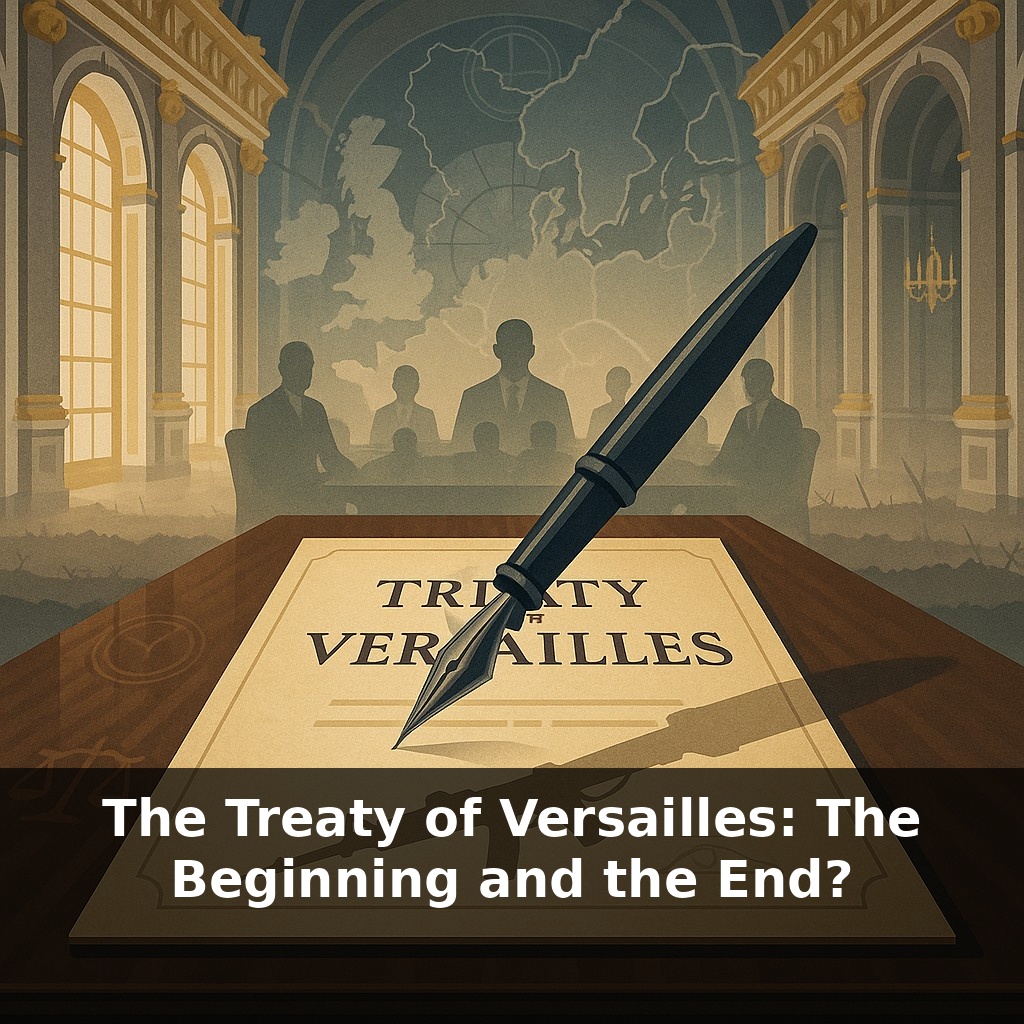
The Treaty of Versailles: The Beginning and the End?
📝 Transcript
Guns fell silent in 1918—but the peace terms were still being loaded like weapons. In a palace built for kings, not peacemakers, leaders haggled over borders, debts, and blame. They weren’t just ending a war; they were quietly drafting the opening chapter of the next one.
The real drama at Versailles wasn’t just about who “won” or “lost” the war; it was about who would control the story of why it happened and who should pay for it. Around the conference tables, leaders weren’t only drawing lines on maps—they were trying to lock in moral verdicts that would echo for generations. That’s where Article 231, the infamous War Guilt Clause, came in. By pinning primary responsibility for the conflict on Germany and its allies, it turned a battlefield defeat into a permanent stain on national honour. At the same time, the new League of Nations promised a more cooperative future, yet crucial powers stayed out or joined half‑heartedly. The result was a peace that looked modern on paper but felt, to many, like an old‑fashioned power grab wearing new legal clothes.
What makes Versailles so revealing is how many different negotiations were stacked on top of each other. Publicly, leaders spoke in soaring language about a new world order; privately, they were trading railways, ports, and industrial regions like high‑value assets in a tense merger deal. Britain worried about safeguarding sea routes and loans, France about future invasions, the US about embedding new rules, smaller nations about simply being heard. The treaty that emerged was less a single, coherent vision than a patchwork of overlapping bargains, half‑fulfilled promises, and unresolved grudges.
If the talks at Versailles were layered, the treaty itself was even more so—part contract, part punishment, part wish list. Start with money. Reparations weren’t just a number on a page; they were tied to coal deliveries, shipping, and tax reforms, monitored by Allied commissions that could pry into Germany’s finances. This oversight felt, in Berlin, less like accounting and more like occupation-by-ledger. Yet even among the victors there was no single view: France wanted hard guarantees funded by German payments, Britain feared strangling a key trading partner, and the US Senate was already drifting away from European entanglements.
Territory came next, not as an abstract map game but as a reallocation of industrial muscle. The loss of Upper Silesia’s coal and iron, the internationalisation of the Saar, and the detachment of resource-rich areas shifted production capacity out of German hands. Self‑determination was invoked selectively: plebiscites were held in some contested regions, ignored in others. Newly enlarged states like Poland and Romania gained security and assets, but also inherited sizable minorities who felt marooned overnight.
Military clauses turned the German army into a tightly capped force with no tanks, aircraft, or submarines, while the Rhineland was demilitarised and later occupied. To French planners, this was an insurance policy; to many Germans, it looked like a permanent vulnerability. Crucially, enforcement depended less on the treaty text than on whether London and Paris would actually mobilise—politically and militarily—if Germany pushed back.
On paper, institutions and legal rules suggested a step toward a rule‑bound order. In practice, much depended on day‑to‑day discretion: how strictly to collect payments, whether to adjust terms during downturns, when to treat infractions as technical and when to call them threats. The same clauses could be applied flexibly to stabilise Weimar democracy—or rigidly in ways that fed its critics.
As crises hit in the 1920s, the treaty began to be revised piecemeal through follow‑up conferences and plans. Rather than a fixed endpoint, Versailles functioned as a starting framework that states kept testing, bending, and rewriting, revealing how fragile “final” settlements become once power and priorities start to shift.
Instead of viewing Versailles as a single “bad deal,” it’s more revealing to treat it like an operating system pushed out before it was fully tested. The core code—the written clauses—looked ambitious, but the real story lay in the patches and workarounds that followed. The Dawes Plan in 1924 and the Young Plan in 1929 effectively rewrote the reparations timetable, with US bankers acting like external consultants called in to stabilise a failing deployment. Locarno in 1925 soft‑guaranteed Germany’s western frontiers but left the east ambiguous, a kind of selective security update that reassured France while leaving Poland and Czechoslovakia exposed. Each revision showed how quickly “final” terms became provisional once markets, elections, and street politics reacted. German leaders learned they could win concessions by stalling or provoking minor crises; Allied governments discovered that voters had little appetite to enforce distant clauses. The treaty’s real legacy, then, was as a live experiment in how much pressure a defeated power—and a shaky international system—could absorb.
Versailles still shadows today’s ceasefires. Modern mediators juggle drones, sanctions and social media storms that can flip public opinion overnight. Think of current talks over frozen conflicts or cyber‑attacks: negotiators must design rules that adapt like flexible building codes, not rigid blueprints. Your challenge this week: when you see news of a “historic” deal, ask what happens if one side grows stronger—does the agreement bend, or does it break?
Versailles reminds us that signing a treaty is closer to launching a beta than shipping a finished product. The code only works if users keep updating it. Later accords, from nuclear arms limits to digital trade rules, face the same test: can they evolve as power, technology and grievances shift, or will yesterday’s fixes become tomorrow’s security bugs?
Try this experiment: Pick one specific clause from the actual Treaty of Versailles (for example, Article 231 on “war guilt” or the reparations section) and then pick one concrete German reaction to it from the early 1920s (like Ruhr occupation resistance or hyperinflation protests). Spend 15–20 minutes tracing how that single clause traveled from the negotiation table in 1919 to a specific moment of crisis or resentment, using at least two different sources (e.g., the treaty text plus a historian’s article or documentary clip). As you do this, keep asking yourself, “If this one clause had been written differently—or not at all—would Hitler’s rise have been harder, easier, or about the same?” Notice whether this focused cause-and-effect trail makes you see the treaty more as a tragic inevitability machine or as a series of fixable human choices.
From this course
The Great Negotiations: Deals that Changed History
5 episodesUnlock all episodes
Full access to 5 episodes and everything on OwlUp.
Subscribe — $1.99/monthLess than a coffee ☕ · Cancel anytime