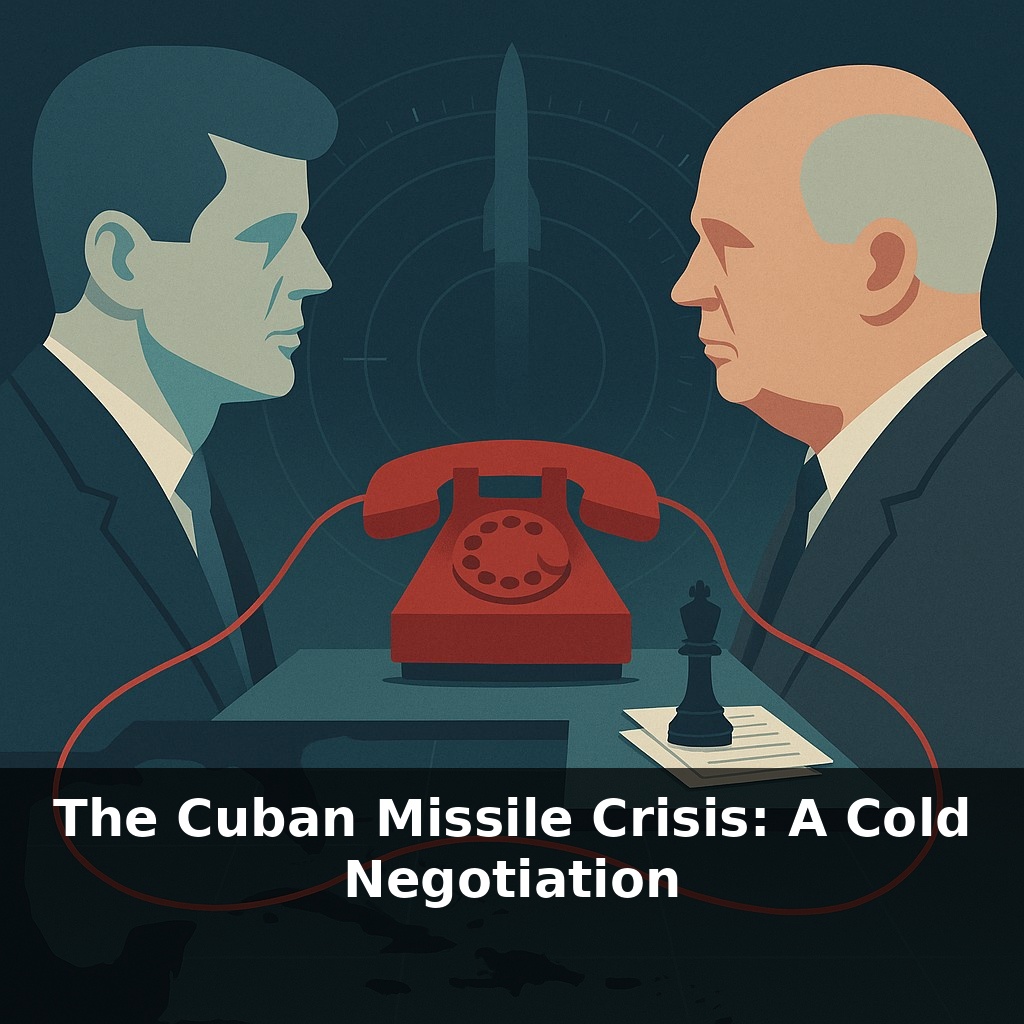
On a quiet October afternoon, the U.S. military moved to its last stop before all‑out nuclear war—a level it has reached only once. While generals readied bombers, two men, thousands of miles apart, began trading secret messages that would decide whether millions lived or died.
Kennedy wasn’t starting from a blank page. By the time those private cables began to cross the Atlantic, he’d already rejected his most obvious options. An air strike looked clean on paper—fast, decisive, no drawn‑out drama—but he knew that “clean” in a crisis is often like a freshly painted door hiding a broken lock: it looks solid until you actually need it. An invasion promised control, yet risked triggering Soviet moves far beyond Cuba.
Inside the White House, his advisors were split into rough camps—hawks pushing for force, others arguing for pressure without open conflict. Instead of choosing a side, Kennedy created a third path: a naval “quarantine” plus intense, multilayered diplomacy that let him squeeze, signal, and still leave Moscow room to step back.
Publicly, Kennedy projected firmness: speeches, UN debates, visible ships at sea. Privately, he treated the crisis like debugging a crashing system—testing one change at a time, watching for unexpected reactions from Moscow, then adjusting. He kept his inner circle small, shielded options from leaks, and staggered signals so allies, Congress, and Khrushchev each heard slightly different emphases. Meanwhile, Khrushchev juggled his own pressures: hardliners in the Kremlin, a fragile position in Cuba, and the risk that any perceived retreat could weaken Soviet influence far beyond the Caribbean.
Kennedy’s real leverage wasn’t his arsenal—it was time. From the moment the missiles were discovered, the clock ran on several, often conflicting, timers: how long before Soviet sites in Cuba were fully operational, how long before U.S. allies panicked, how long before a nervous officer on either side made a fatal “local” decision. He had to stretch that shrinking window without letting it snap.
The first move was to separate audiences. ExComm debated options in marathon sessions, but their conclusions were filtered into careful, staged signals. NATO allies got reassurance that Washington wouldn’t bargain away Europe. Khrushchev got a mix of pressure and off‑ramps. The American public got enough information to accept risk without demanding immediate retaliation. Each message was true, but none were the whole truth.
Then came the stress test: Soviet ships steaming toward the quarantine line. Kennedy’s order was not “stop everything at once,” but a ladder of steps—challenge, signal, pause, reassess. When tankers and freighters slowed or turned back, it wasn’t just relief; it was data. Moscow was responsive, not reckless. That single observation ruled out some nightmare scenarios and made room for bolder diplomatic experiments.
Communication channels multiplied. Public speeches locked in red lines; private letters explored trade‑offs; a flurry of intermediaries—journalists, diplomats, even the Soviet ambassador’s conversations at Georgetown parties—carried trial balloons. For negotiators, this is like adding redundancy to a critical network: if one path fails or is misread, another can still carry a clarifying signal.
The sharpest turn came when two messages from Khrushchev arrived within 24 hours: one emotional and conciliatory, another harsher and aligned with hardliner demands. Instead of treating them as a single, confused offer, Kennedy’s team made a deliberate choice: answer only the softer note, as if that were the real position, and ignore the escalation. It was a calculated bet on the more moderate Khrushchev, and it framed the eventual deal as his own proposal rather than a forced retreat.
Behind this, Robert Kennedy’s late‑night meeting with Ambassador Dobrynin floated a possibility that never appeared in public: a quiet trade involving U.S. missiles in Turkey. The condition was strict—no linkage in any written record, and removal on a timeline that could be portrayed as routine modernization. That face‑saving element mattered. The Soviets needed to claim a tangible gain; Washington needed to avoid looking like it swapped European security for its own. The solution was to encode the real bargain in timing and silence rather than in formal text.
Kennedy’s team treated each signal like a carefully calibrated software update: never roll out a change you can’t roll back. Before announcing any move, they asked two questions: “What does this commit us to?” and “How can the other side say yes without publicly eating dirt?” That’s why they obsessed over phrasing—“quarantine,” not “blockade”; “offensive weapons,” not “Soviet presence.” Small word choices created space for Moscow to adjust course without appearing to surrender.
One useful way to see their approach is as architectural staging. You don’t demolish a load‑bearing wall in one swing; you prop, cut, measure, then cut again. Kennedy phased pressure the same way: a line at sea, then inspections, then private assurances, always leaving intact beams the Soviets could still lean on—like a promise not to invade Cuba—if they chose to step back.
In modern negotiations—salary talks, vendor disputes, boardroom standoffs—the same pattern holds. Durable deals emerge when you design steps, language, and timing so the other side can move without collapsing their own foundations.
The deeper lesson is that high‑risk talks shouldn’t wait for high‑risk moments. The “hotline mindset” can be built into everyday negotiations: regular, low‑stakes exchanges where both sides practice sharing bad news early and correcting small misreads before they harden. Think of it like updating a shared map in real time—each side adds landmarks, removes dead ends, and flags roadblocks so no one speeds blindly into a cliff edge when pressure suddenly spikes.
In your own deals, the “Cuba rule” is simple: don’t treat talks as a single showdown. Stack small, reversible moves—like trial terms, pilot projects, or provisional clauses—so you can feel for the edges without crashing through them. Your challenge this week: in one live negotiation, add a low‑risk test step that makes saying “let’s try it” easier than “no.”