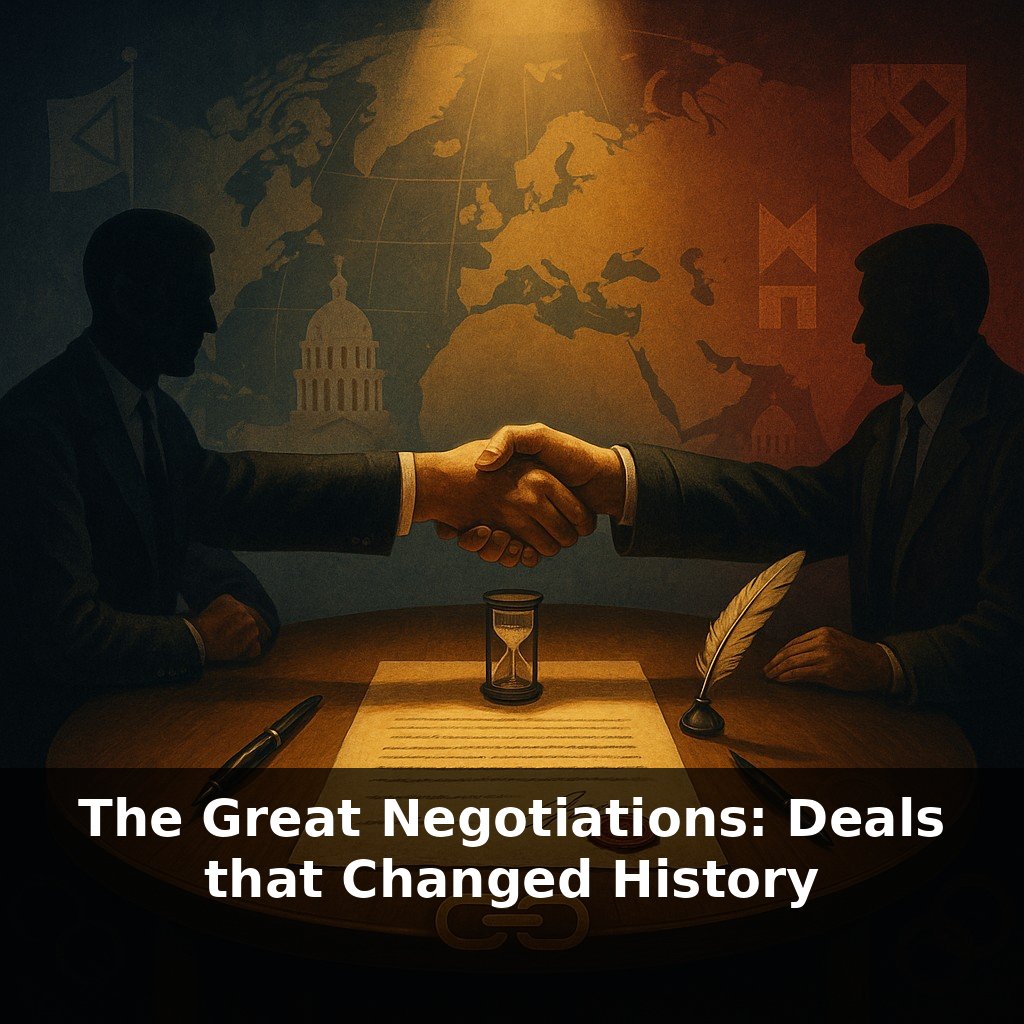
In a hidden forest retreat, three men spend nearly two weeks arguing over every word of a document. Outside, their countries are technically at war. Inside, they’re debating commas, handshakes, and who calls whom “friend.” By the end, the entire Middle East map will feel different.
They didn’t start with trust; they started with constraints. Carter knew Sadat couldn’t return to Cairo without land, and Begin couldn’t return to Jerusalem having “given up” security. So instead of asking them to like each other, he asked a sharper question: “What can each of you *survive* signing?” That shifted the mood. Now every proposal had two tests: Would it pass parliament? Would it avoid getting a leader killed?
From there, Carter quietly changed the game board. He controlled the schedule, the flow of drafts, even who saw which map when. He used separate meetings to explore risks leaders couldn’t admit in front of each other, then tested narrow trade‑offs in joint sessions—like a coder toggling one feature flag at a time to avoid crashing the system. Step by step, the “impossible” started to splinter into solvable pieces.
Carter also narrowed the mission. He didn’t ask them to fix the whole region; he asked for two concrete products: a blueprint for Egyptian‑Israeli peace and a framework for Palestinian self‑rule. That clarity let him zoom into specifics: airfields, early‑warning stations, timelines, phrases like “full autonomy” versus “self‑governing authority.” Each word carried domestic consequences back home. So he kept zooming between levels—one hour arguing where a border ran on a map, the next hour exploring how a leader would sell that line on television—like switching between code view and user interface.
Carter’s next move was counterintuitive: he shrank the room to grow the deal. No big delegations, no grand speeches—just three leaders pulled away from cameras, routines, and hard‑line advisers who normally stiffened their positions. That isolation let them say things they couldn’t risk in public: Begin could explore how far he might bend on territory; Sadat could probe what recognition might look like without being accused of betrayal in real time.
Inside that bubble, Carter pushed for specificity. It wasn’t “peace” in the abstract; it was: Who controls which airfields? How many troops on each side of a line? What kind of early‑warning systems, and monitored by whom? As details piled up, vague slogans lost power. If someone demanded “security,” he’d quietly ask, “Describe it in kilometers, aircraft, and signatures.” If someone insisted on “sovereignty,” he’d press, “On which village, under which flag, starting which year?”
The hardest part was sequencing. Each leader needed something first to justify what they’d give later. Carter mapped these political “payment schedules” and tried to line them up: interim withdrawals that Sadat could show on Egyptian TV; phased normalization steps Begin could defend in the Knesset; U.S. guarantees he could sell to Congress. It was closer to designing a complex software rollout than staging a single grand launch: dependencies, fail‑safes, and staged updates instead of a risky all‑or‑nothing push.
When talks stalled—twice—Carter switched from mediator to messenger. He hand‑wrote notes, carried photos of Israeli and Egyptian children to personalize the stakes, and even drafted alternative formulations himself when language became a trap. Crucially, he kept score on what each side had already conceded, so no one felt like the only one moving.
The final frameworks reflected this grind. One outlined concrete steps for Egypt and Israel: withdrawal, demilitarized zones, normalization. The other sketched a path—never fully followed—for Palestinian self‑governance. Not a sweeping reconciliation, but a carefully engineered corridor where guns and flags, armies and elections, could all coexist—barely—on paper first, and then, slowly, on the ground.
Carter’s method shows up in boardrooms more than history books. Think of a CEO mediating between a product team that wants radical redesign and an operations team terrified of disruption. Instead of asking them to “align,” she might pin them to concrete launch metrics, regulatory limits, and budget ceilings—then ask, “What can your department *live with* when this hits customers?” Like Carter, she might shuttle between one‑on‑one whiteboard sessions and brief joint check‑ins, always converting slogans into testable specs: load times, support coverage, migration windows.
You can see a similar pattern in major tech mergers. When Disney bought Pixar, leaders didn’t chase instant cultural harmony. They carved out specific domains: who greenlights projects, which tools stay, which pipelines merge. The breakthrough was not affection but a diagram of “yours, mine, ours” that both boards could defend.
One sports parallel: modern coaches scripting the first 15 plays. They don’t predict the whole game; they choreograph the opening so players survive the crowd, the pressure, the unknowns.
Camp David’s quiet lesson is that durable peace can grow from small, testable steps instead of sweeping promises. Future mediators might treat regional deals like updating a live operating system: patch one fragile interface at a time—airspace rules here, water coordination there—while keeping the whole network online. Your challenge this week: notice any conflict at work or home and ask, “What tiny, reversible step could lower tension without forcing full agreement yet?”
Camp David didn’t “solve” the region; it created a narrow bridge others still cross. Its real export is a method: carve out one calm corridor, then defend it fiercely while the rest stays noisy. In your own negotiations, think less like a hero, more like an urban planner—laying small, protected paths people can actually use before anyone redesigns the whole city.
Start with this tiny habit: When you hear news about conflict in the Middle East, pause for 10 seconds and whisper to yourself one specific detail you remember from the Camp David Accords (like “Sadat flew to Jerusalem” or “they agreed on a framework for Sinai”). Then, in that same moment, ask yourself a single question: “What was one fear both sides shared back then?” Over time, this little pause trains your brain to see today’s headlines through the lens of real people negotiating, not just abstract politics.