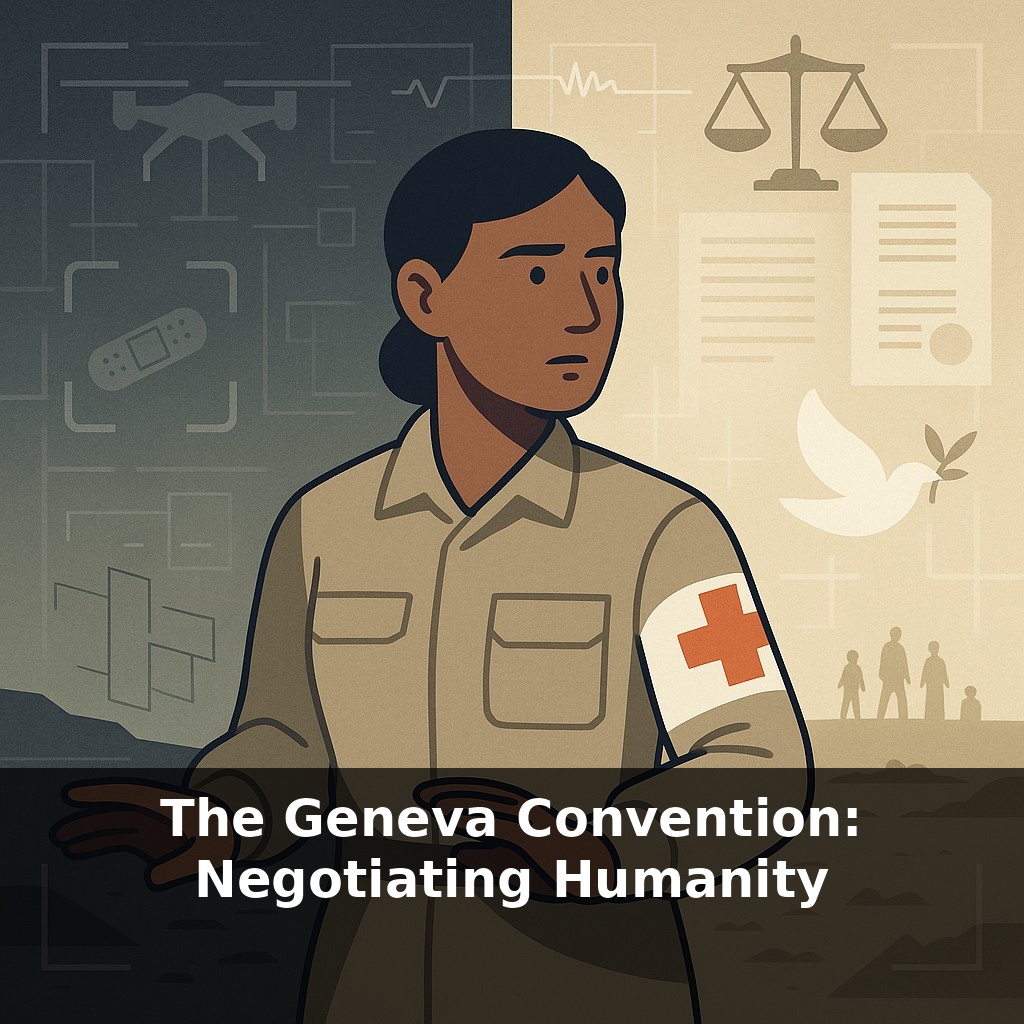
Nearly every country on Earth has signed the same promise: even in war, there are lines you do not cross. A medic frozen between helping an enemy soldier or obeying orders. A drone operator watching civilians move into the frame. When bullets fly, who negotiates what’s still human?
A strange thing about the Geneva Conventions: they were not negotiated in a moment of calm morality, but in the shadow of catastrophes that had already happened—and those everyone feared might come next. They’re less a manifesto and more a hard‑fought contract between military necessity and human survival. In closed rooms, diplomats, generals, and lawyers argued over details that, to a solder or a nurse, translate into life or death: How long can you hold a prisoner? Who counts as a civilian when fighters don’t wear uniforms? What if a hospital is also storing weapons? These aren’t abstract puzzles; they’re the pressure points where war’s brutal logic collides with any claim to civilization. The Conventions didn’t end that collision. They gave it a language, a framework, and—crucially—consequences when states cross the line.
In practice, the Geneva rules weren’t drafted by idealists alone; they emerged from negotiators collecting patterns from past wars like investigators piecing together a crash report. Delegates sifted testimonies from field surgeons, camp survivors, resistance fighters, and commanders, mapping where earlier agreements had failed or been twisted. They argued over stretcher markings, radio frequencies for relief corridors, how to label aid convoys so they’re visible through a bombsight. Each clause reflects a past abuse or loophole closed—proof that “never again” is less a slogan than an ongoing, technical negotiation with reality.
Walk through a battlefield with Geneva lawyers and you won’t hear big speeches about “humanity”—you’ll hear arguments about categories and thresholds. Much of the negotiation is about who falls inside which protective box, and what that triggers in practice.
Start with the most stubborn knot: internal conflicts. Civil wars, insurgencies, “counter‑terrorism operations”—labels change, but Article 3 quietly insists that once organized violence crosses a certain intensity, minimum standards snap into place. No declaration required. That was a political compromise: states refused to “internationalize” their domestic fights, but others refused to leave entire populations in a legal vacuum. The bargain was a floor so low no one could reasonably reject it—and still high enough to outlaw the worst atrocities.
Then there’s the problem of modern battlefields where front lines blur. Negotiators anticipated that fighters might ditch uniforms, melt into cities, or use civilian cover. Instead of pretending this wouldn’t happen, the rules lean on status and behavior: are you directly participating in hostilities right now? If yes, you’re a target; if not, you’re protected. That sounds tidy on paper, but it forces commanders into real‑time legal triage: a person with a laptop—civilian IT worker or drone pilot? A truck—aid delivery or weapons run?
States pushed back hard wherever they feared operational handcuffs. The resulting text is full of carefully vague phrases—“feasible precautions,” “excessive” civilian harm—that hand later interpreters a sliding scale rather than a stopwatch. In effect, the Conventions set up an ongoing negotiation between battlefield facts and legal hindsight. Military manuals, court cases, and ICRC guidance act like software updates, patching vulnerabilities exposed by each new conflict.
That’s why these treaties feel less like a single peace deal and more like an evolving operating system for how war is supposed to be fought: backward‑compatible with earlier battles, but constantly patched against new ways humans find to hurt each other.
A negotiator from a small neutral state once described his job in Geneva as “arguing over the width of a lifeline.” You see that in how rules emerged for things like hospital ships, marked with bright lights so submarines could spot and spare them at night, or in the color and size of Red Cross emblems—tested so they’d stand out through smoke and rain from the cockpit of a fast‑moving aircraft. When cluster munitions and anti‑personnel mines began leaving civilians injured decades after ceasefires, additional protocols and later treaties tried to “clean up” the battlefield’s long tail, much like cybersecurity teams patch exposed systems after a breach. Each revision followed specific scandals: prisoners paraded on television, relief convoys blocked at city checkpoints, “disappeared” detainees whose families received no word for years. The law responded with requirements for camp registers, tracing services, and unhindered access for neutral visitors—protections that sound bureaucratic until you’re the one missing.
Future implications
The next negotiation may be less about bullets and more about code. As AI systems start choosing targets and routes, lawyers are asking who “pulled the trigger” when an algorithm misfires. Climate‑stressed borders could turn whole regions into floating front lines, where displacement is normal and clear status is rare. Meanwhile, tools like satellite swarms and blockchain logs might play referee—capturing violations in near‑real time, long before diplomats are ready to admit they happened.
On your screen, those rules look distant; on the ground, they’re as practical as sandbags. A captured fighter hearing charges read in a language they understand. A mother tracing a missing son through a database instead of rumors. Your challenge this week: notice every news story about conflict and ask, silently, “Who’s enforcing the lines here—and how would we know if they weren’t?”