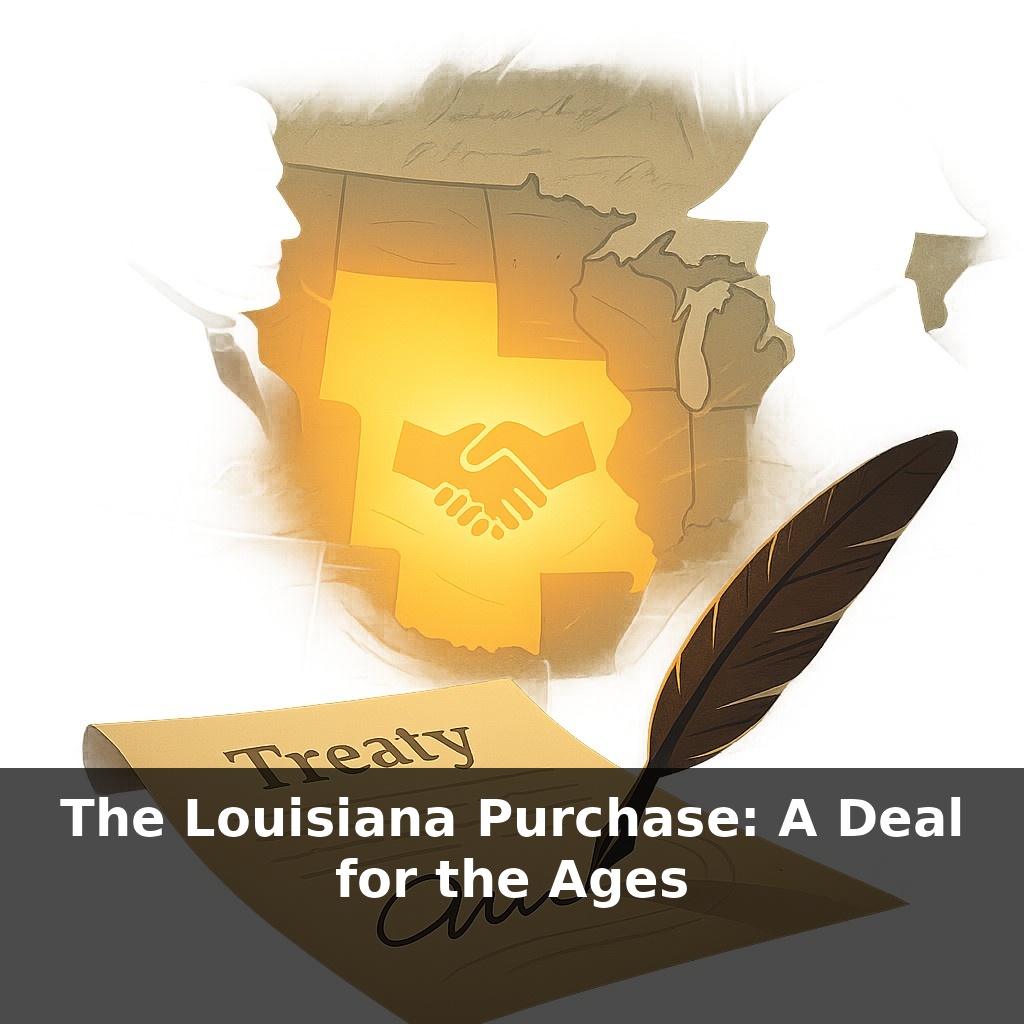
A single signature in 1803 quietly doubled the size of the United States—without a single shot fired. In this episode, we drop into the frantic weeks of secret letters, missed deadlines, and a risky offer from Napoleon that forced Thomas Jefferson to bet big on the unknown.
Jefferson’s bold acceptance of Napoleon’s offer was only the finale; the real story begins earlier, in the quiet grind of strategy and positioning. Before any grand bargain, there were years of tense trade disputes, fragile treaties, and anxious merchants in river towns wondering if their goods would ever reach the sea. Think of an entrepreneur watching their entire business hinge on a single, rented server they don’t control—one policy change away from disaster. That “server” was access to New Orleans. In this episode, we’ll zoom in on the often-overlooked groundwork: how smaller negotiations, missteps, and half-measures set the stage for one transformational deal. We’ll look at the pressure from western farmers, the diplomatic tightrope with Spain and France, and the way urgency quietly shifted America’s risk tolerance long before any treaty was signed.
Western settlers weren’t reading diplomatic cables; they were watching warehouses fill up and profits evaporate. When Spain briefly revoked the right of deposit in New Orleans in 1802, anger spiked into talk of secession and unauthorized militias marching south. Inside Jefferson’s cabinet, that unrest translated into a new question: how far would they go to secure a single city? Meanwhile in Paris, Napoleon’s shifting fortunes meant today’s handshake could be worthless tomorrow. It was a race against invisible clocks on two continents, with no guarantee the other side would still be at the table.
In Washington, the official plan was modest: send Robert Livingston to quietly explore options. Could the United States secure permanent trade access? Maybe buy a small strip of land near the mouth of the Mississippi? Nothing too dramatic, nothing that would spook Europe or ignite domestic controversy. On paper, this was a targeted mission; in practice, it was Jefferson’s team probing for leverage in a negotiation they didn’t fully control.
Livingston arrived in Paris to find the ground shifting under his feet. France had just re-acquired Louisiana from Spain, but the transfer wasn’t fully executed and the details were murky. Spanish officials still acted as gatekeepers, French ministers sent mixed signals, and British diplomats hovered, eager to block any American gains. Livingston was effectively trying to lock in a deal while the ownership of the asset itself remained in legal fog.
Complicating matters, Paris did not consider the United States a top-tier power. Livingston’s messages home carried a consistent subtext: we are not being taken seriously. He tried flattery, appeals to shared republican ideals, even subtle warnings that shutting out American commerce could drive the young nation toward Britain. Each tactic bought him conversations—but not commitments.
Back in Washington, Jefferson recognized that time was eroding his position. News traveled slowly; by the time a letter crossed the Atlantic, the situation might already be obsolete. So he escalated. James Monroe was dispatched as a special envoy, with broader authority and a clearer mandate: do what it takes to secure American interests at the river’s mouth, even if that meant stretching the original instructions.
Where Livingston had been operating as a solo negotiator, Monroe’s arrival created a two-person team with complementary strengths. Livingston knew the personalities in Paris and the rhythms of French politics; Monroe carried fresh political capital and a stronger signal that the United States was serious. Together, they could test bolder proposals, play off each other in meetings, and triangulate between their written orders and the fluid reality in Europe.
Crucially, Jefferson’s private instructions allowed more flexibility than his public rhetoric suggested. In modern terms, he was running a “publicly conservative, privately experimental” strategy: signal caution at home to maintain support, while quietly giving negotiators enough room to seize an unexpected opening if it appeared. That gap between stated limits and usable authority would prove decisive once France’s position suddenly flipped.
In dealmaking terms, Livingston and Monroe weren’t just “asking for land”; they were managing three levers at once: timing, uncertainty, and mandate. A useful parallel is a product team negotiating a major cloud contract while the provider is mid-merger and its pricing model is in flux. The team’s goal isn’t just a low rate—it’s securing options before the market hardens. Livingston probed for hints of what France *might* be willing to do if its situation worsened, logging every offhand remark as future leverage. Monroe’s arrival added something like a “senior sponsor” in a complex enterprise sale: his presence signaled that Washington could move fast on any serious proposal. Together, they tested the edges of their authority without snapping it—floating ideas, asking hypothetical questions, and carefully *not* closing doors. For modern negotiators, the lesson is practical: when the other side’s world is unstable, your advantage often lies in being the party most prepared to say “yes” the moment conditions break your way.
Jefferson’s gamble hints at a broader pattern: transformative deals often outpace existing rules. Today, think of contested seabeds, lunar mining rights, or AI data commons—legal gray zones where first movers quietly sketch tomorrow’s boundaries. The real leverage isn’t just cash or power; it’s the courage to act before the map is finished, then patiently turn that rough sketch into law, norms, and shared benefit instead of a land grab.
The real takeaway isn’t that one deal reshaped a map; it’s that bold commitments can quietly rewrite what’s “allowed” in your world. Careers work the same way: a stretch project, a lateral move, a bet on an uncertain team—each is its own private purchase. Over time, those choices redraw your personal borders long before anyone updates the official charts.
To go deeper, here are 3 next steps: 1) Pull up the Library of Congress “Louisiana Purchase” digital collection and skim at least three original documents (Jefferson’s secret instructions to Livingston, the 1803 treaty text, and a contemporary political cartoon) to see the deal through the eyes of people at the time. 2) Watch the PBS *American Experience* episode “Lewis & Clark: The Journey of the Corps of Discovery” (streaming on PBS or Amazon) and jot down how the expedition changed your view of why the Purchase mattered beyond land size. 3) Open Google Earth and trace the modern states carved from the Louisiana Territory, then cross-check with an online interactive map from the National Park Service’s “Lewis and Clark National Historic Trail” to visualize how this one deal reshaped the map of the United States.