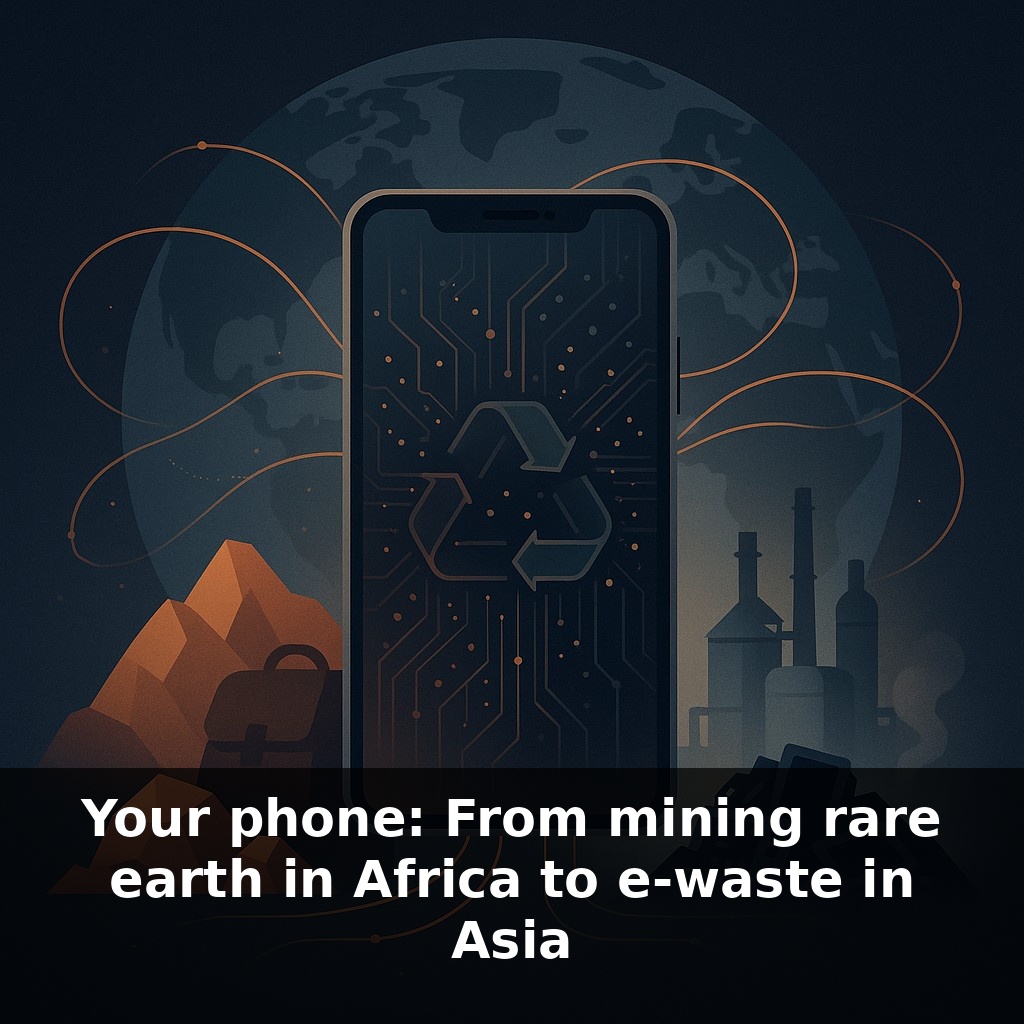
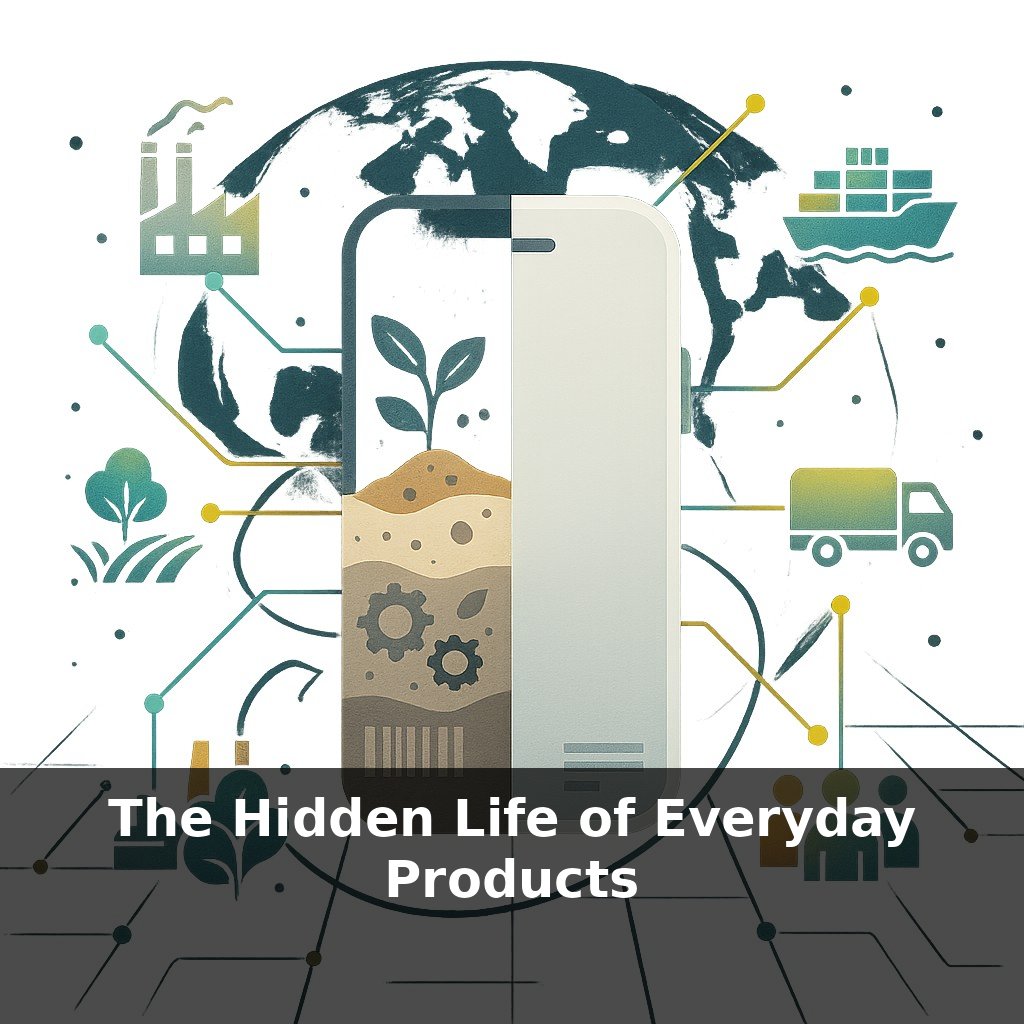
Your smartphone needed roughly a backpack’s worth of rock to exist. Right now, in the time it takes you to unlock it, cobalt may be leaving Congo, rare earths refining in China, and discarded phones burning in India—one small rectangle, stretched across the planet.
That global journey doesn’t stop once your phone lands in your hand. Inside that slim case, more than 40 different elements sit side by side: copper traces carrying signals like tiny city subway lines, silver making lightning-fast connections, a sprinkle of gold guarding the most sensitive contacts from corrosion, tin solder holding it all together like invisible rivets. Some are familiar—aluminium, glass, plastic. Others, like indium in your touchscreen or palladium in tiny capacitors, rarely make headlines but are quietly critical. Their stories are tangled: mines reshaping landscapes, smelters drawing huge amounts of energy, factories timing production to the second. And at the other end, when you upgrade, those same elements can either be locked in a drawer, buried in a landfill, or melted back into circulation—each path with very different consequences.
Every stage of that journey runs on trade‑offs we rarely see. The same phone that lets you video‑call across continents also depends on contracts negotiated in distant ministries, night shifts in assembly plants, and informal workshops where safety gear is a T‑shirt over the mouth. Regulations in Europe can reshape working hours in Zhengzhou; a spike in metal prices can push more families into digging or dismantling by hand. And hovering over it all is time: rapid product cycles mean designs change faster than recycling systems can catch up, leaving yesterday’s model stranded.
Follow the phone’s path back to its beginning and the numbers stop feeling small. Those 180 grams in your hand are the tip of an 86‑kilogram iceberg of rock, sand, oil, chemicals and water moved on your behalf. That material doesn’t come from one neat hole in the ground, either. Quartz sand for ultra‑pure glass may be melted in one country, aluminium smelted in another, and lithium brine evaporated on high‑altitude salt flats thousands of kilometres away. On maps in company boardrooms, these are tidy arrows and icons. On the ground, they’re open pits, tailings ponds and haul roads that redraw local geographies.
Energy is the invisible partner at each stage. Ore is crushed and roasted; metals are separated in acid baths; wafers for chips are baked, etched and doped in spotless cleanrooms. By the time a single smartphone rolls off a line, its “carbon budget” has mostly been spent—well before you ever charge it. That’s why, in many life‑cycle studies, the biggest slice of a phone’s climate impact isn’t years of use, it’s the first few months when it’s being turned from raw inputs into a finished object.
The labour footprint sprawls just as widely. In mining regions, work swings between industrial shifts and people digging with hand tools. In component factories, tasks are broken into motions timed in seconds: placing tiny speakers, testing screens, snapping cases shut. In final assembly hubs, tens of thousands of people may live in dormitories within walking distance of the line, their daily rhythms synced to global product launches and holiday sales in countries they may never visit.
Then the flow reverses. Distributors move pallets to warehouses, couriers move boxes to shops and front doors, and marketing turns technical specs into desire. Contracts and subsidies nudge you toward upgrading every two or three years, even if your existing device still works. The moment that upgrade happens, your old phone falls out of the “official” system. It might be traded in, resold, passed to a relative, dropped in a drawer, or tossed into a bin whose ultimate destination you never see.
At that point, all those carefully assembled elements either become a dispersed pollutant—or a concentrated urban mine, richer in some metals than any natural deposit.
Not all phones follow a single script. Think of two devices bought on the same day: one might be used gently for five years, repaired once, then resold to a student and finally dismantled in a regulated European plant where robots shred, sort and recover metals with dust filters humming. The other could be dropped in its first year, traded in, shipped in a bale of “second‑hand electronics” to West Africa, and picked apart by hand beside a roadside, where plastic insulation is burned just to free a few grams of copper.
There’s also a quiet fork in the road between brands. Some design phones with modular parts, using screws instead of glue so a cracked screen or tired battery can be swapped in minutes; others seal everything in sleek shells that make repair so costly that replacement feels like the only rational choice. The first path keeps materials in circulation longer; the second turns your upgrade cycle into a kind of subscription to fresh extraction.
Your phone’s afterlife is quietly being redesigned. Urban “mines” of old gadgets could soon be mapped like oil fields, with robots plucking parts the way surgeons remove organs for transplant. Policies such as Right to Repair may turn shopping malls into repair hubs, while brands compete on how many lives a device can have. But tighter mineral export rules and supply‑chain audits could also nudge prices up, forcing a choice: fewer phones, or far more circular ones.
Your next upgrade could be less like buying a shiny new toy and more like renewing a library book: extending the story instead of starting from scratch. Your challenge this week: each time you reach for your phone, ask, “How many more years can I give this one?” That simple question quietly tugs the whole chain—from mines to scrapyards—into a different shape.