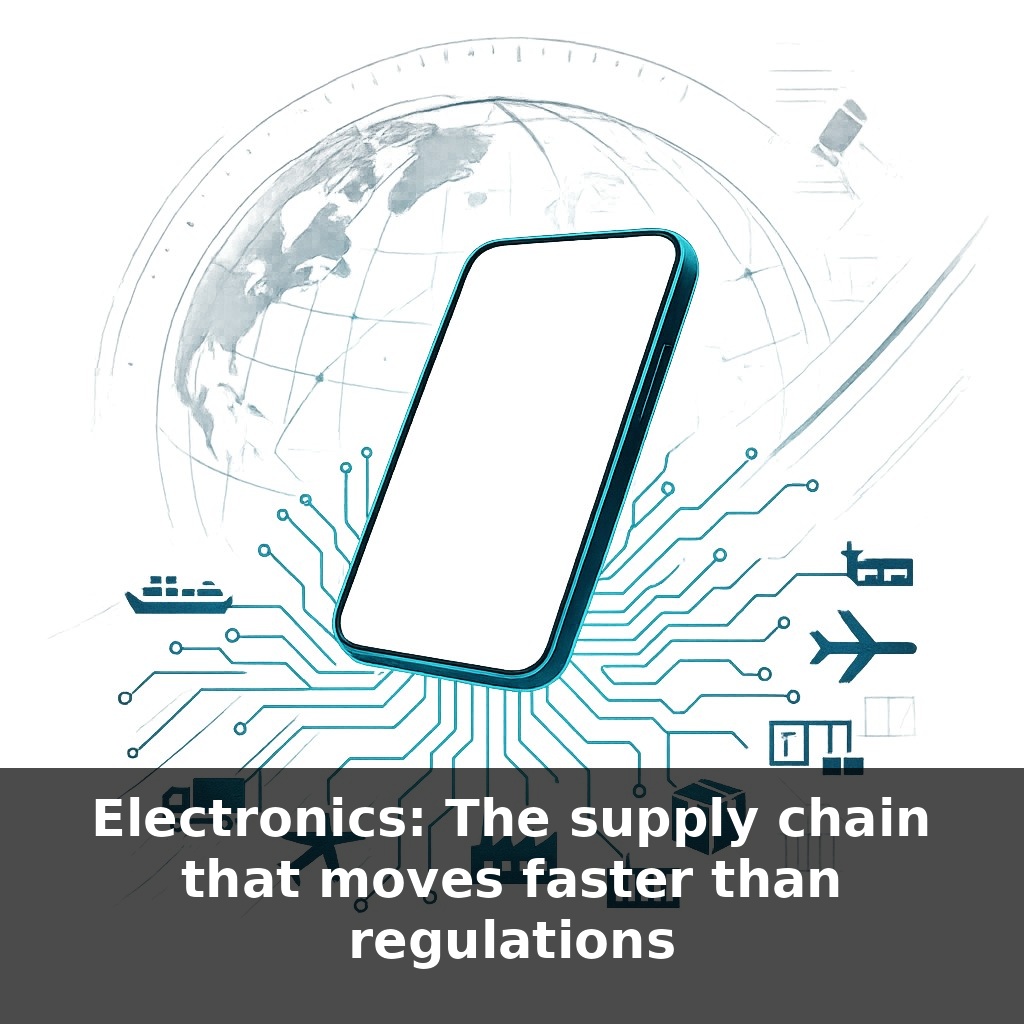
Somewhere right now, a new gadget is being sketched on a whiteboard—and in less than a year, it could be in your pocket. The twist? Laws meant to keep that device safe and ethical might not arrive until long after the first million units are already sold.
A single flagship device now rides on a supply chain so fast and intricate that it can quietly reshape labor markets, shift national security calculations, and redraw trade maps before most people even notice it exists. That phone in your hand isn’t just “made in” one country; it’s more like a passport filled with stamps from dozens of factories, testing labs, and logistics hubs. Each new design choice—changing a chip supplier, adding a sensor, moving an assembly line—can ripple outward like a sudden key change in an orchestra, forcing suppliers, governments, and rivals to adjust in real time. Meanwhile, standards bodies, regulators, and diplomats are stuck playing catch-up, trying to understand risks—rare earth dependency, firmware backdoors, energy-hungry data centers—long after the technical decisions are locked in and scaled. In this episode, we’ll follow how that race actually plays out, and who gets left behind.
Behind that polished screen is a relay race most of us never see: miners extracting cobalt in the Congo, chemical plants in Japan refining photoresists, Dutch engineers fine‑tuning lithography machines, and logistics teams nudging each shipment to arrive within a narrow time window. Each step is optimized for speed and cost, not for traceability or long‑term resilience. When a pandemic, drought, or political standoff hits just one link, factories continents away can stall overnight, while consumers mainly notice a “sold out” label and slightly higher prices. By then, adjusting course is like rebuilding tracks under a moving train.
Walk through a “typical” new phone launch and the speed gap becomes obvious. A product team green‑lights a design. Within weeks, procurement is locking in contracts for displays from South Korea, camera modules from Vietnam, power chips from the U.S. or Europe, and printed circuit boards from Thailand or Malaysia. Specialized firms in Singapore or Taiwan handle packaging and testing, while logistics providers stitch together just‑in‑time routes through ports and free‑trade zones. A device that doesn’t formally exist yet already has a global footprint on spreadsheets and factory schedules.
Now lay the regulatory timeline beside that. Environmental impact assessments, cybersecurity baseline requirements, export‑control debates—each moves through consultations, comment periods, and political bargaining. By the time a new rule is enforceable, the industry may have gone through three hardware generations and quietly shifted to new suppliers or materials. That’s how you get “forever chemicals” in flame retardants or opaque firmware in baseband chips spreading worldwide long before anyone can agree how to oversee them.
This velocity also changes who holds power. Contract manufacturers in China or India can switch between brands with minimal friction; the scarce, slow‑to‑replicate assets sit further upstream. TSMC’s advanced fabs, a handful of ASML lithography tools, and a few key Japanese and American materials suppliers act like strategic bottlenecks. Disrupt one, and suddenly car makers in Germany, game console plants in Mexico, and solar inverter vendors in Australia are all waiting on the same missing microcontroller.
And because financial markets reward short upgrade cycles, there’s little incentive to slow down and map risks fully. Many firms genuinely don’t know the full chain of sub‑suppliers behind their own products, especially beyond tier‑1 and tier‑2. That opacity makes it hard to answer basic questions: Which mines are feeding our refiners? Which third‑party libraries are embedded in our firmware? Which cloud region is training the models that decide power‑management or face unlock behavior?
The result isn’t a villainous conspiracy so much as a structural mismatch: systems tuned for quarterly releases colliding with governance processes measured in election cycles.
A mid‑range laptop today might quietly include a refurbished chip from a data center teardown, a recycled rare metal from an e‑waste facility in Ghana, and a security module designed originally for cars. Nothing in the store label reveals that tangled ancestry. The same speed that gets new models out yearly also lets design teams swap in “drop‑in” alternatives when a part is scarce—maybe a different Bluetooth radio from a lesser‑known vendor, approved in a late‑night meeting to keep launch dates intact. Months later, a bug report surfaces about flaky wireless in certain regions, and engineers have to reverse‑trace which batch used which substitute.
Think of it like a touring band that keeps changing backup musicians between cities: the set list stays the same, but the chemistry, timing, and weak spots shift every night. For governments, that means trying to monitor not just one fixed product, but a moving target of configurations, suppliers, and code bases that can change faster than any official registry or certification list can be updated.
A future where secure‑by‑design rules bite could feel like switching from casual cooking to running a commercial kitchen: ingredients logged, temperatures tracked, every swap documented. Vertical integration and friend‑shoring push firms to own more of that kitchen, shrinking the guest list but raising the bill. Carbon labels and circular practices might reveal how “heavy” each device is in resource terms, while quantum and 3‑D chips stretch export controls into unfamiliar, politically tense terrain.
As buyers, we mostly see glossy screens, not the tangled routes behind them. But as scrutiny grows, firms may treat component histories like nutrition labels, tracing each “ingredient” from origin to update. That could shift bragging rights: not just who has the fastest chip, but who can prove their device’s story is clean, stable, and ready for rules that don’t exist yet.
Before next week, ask yourself: Where in my own electronics use or business (phones, laptops, game consoles, smart home gear) am I most in the dark about who actually made the components and under what labor or environmental conditions? If I had to pick just one product I own to “trace back” through its supply chain today, which would it be—and what concrete step could I take right now (e.g., checking the brand’s supplier list, looking up their repairability score, or searching for teardown reports) to learn more about its origins? Given how much faster electronics move than regulations, what personal “rule” could I adopt this week—such as delaying upgrades by 6–12 months, favoring repairable/modular devices, or avoiding brands with opaque sourcing—that would still fit my budget and lifestyle but better align with my values?