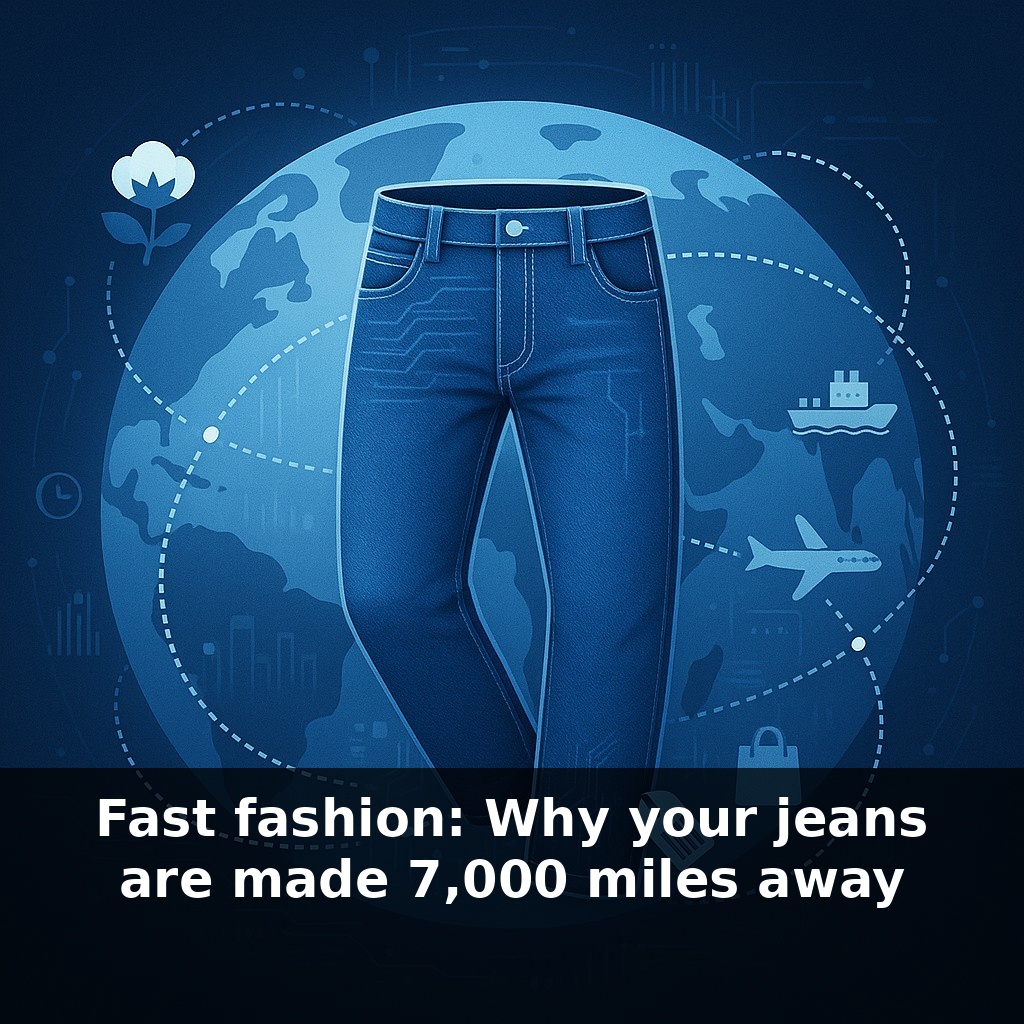
Your jeans probably travelled farther than you did last year. Cotton picked on one continent, dyed on another, stitched on a third—yet sold to you as if it appeared overnight. Why does it make more sense to ship denim thousands of miles than to sew it closer to home?
Those miles aren’t an accident; they’re the outcome of thousands of quiet calculations your favorite brands run every season. A designer in London tweaks a cut, a merchandiser in New York sets a target price, and somewhere in Dhaka or Ho Chi Minh City a factory manager decides how many night shifts that will require. The result is a kind of invisible auction, where countries compete to offer the lowest wage, the weakest regulations, the fastest turnaround. When a government loosens environmental rules, orders often rise. When another raises its minimum wage, orders quietly move next door. Your jeans’ route is less about geography than negotiation: trade deals, tax holidays, fiber subsidies, and port fees. In the time between you seeing “new in” on a website and clicking “add to cart,” that entire system snaps into motion—because every extra cent saved has already been promised to someone further up the chain.
Brands rarely talk about another part of the equation: where the real money is made. The journey of your jeans is orchestrated backwards from two numbers on a spreadsheet—the price you’ll tolerate and the margin investors expect. Everything in between becomes negotiable. Fiber quality can slip a little, wastewater treatment can be delayed, overtime can quietly stretch. Because costs are sliced across borders, no single link in the chain looks outrageous on its own. Auditors pass through, certifications get renewed, and the final product still feels like a bargain—partly because the most expensive “ingredient” is the logo on the waistband.
Follow the money and your jeans start to look less like clothing and more like a financial product wrapped in fabric.
The brand’s margin target decides everything from which cotton gets bought to how hot a dye bath can run. That’s why production clusters in places like Bangladesh, Pakistan, Vietnam, and Turkey don’t just “happen”—they’re deliberately cultivated. Machinery suppliers, laundries, button and zipper makers, freight forwarders, and chemical vendors pack tightly together because being next door to one another slashes time and cost. A factory owner can walk across the street to bargain for cheaper rivets or last‑minute thread instead of waiting weeks for imports. Brands love this density: it means they can change an order mid-season and still hit a launch date.
Labor is the other pillar. Sewing a pair of jeans is still intensely manual: aligning pockets, attaching waistbands, setting zippers. Robots struggle with soft, shifting fabric, so even the biggest brands rely on thousands of human hands. The catch: those hands receive only a sliver of what you pay—often around 2% of the retail price. The rest is eaten up by fabric, marketing, rent for flagship stores, and profit. When wages rise in one hub, buyers don’t need to redesign a robot; they just re-route the next order to a cheaper neighbor.
Then there’s compliance. Treating indigo wastewater, ventilating sandblasting rooms, and protecting workers from chemicals all cost money. In many production countries, the legal standards on paper are reasonable; the gap lies in enforcement. A factory might run its treatment plant when auditors visit and switch it off the rest of the week. From the brand’s perspective, the numbers still look good: certified supplier, competitive price, on‑time delivery.
Transport is the piece that intuitively feels worst but usually counts least on the spreadsheet. For one pair of jeans, the carbon from months of irrigating cotton, running spinning frames, and boiling dye baths typically dwarfs the emissions from a few weeks in a shipping container. That’s why simply “buying local” doesn’t automatically fix the footprint if the fabric is still thirsty cotton and coal‑powered dyeing.
The result is a system tuned to reward whoever can shave a cent without triggering a scandal—a quiet, relentless race that your jeans complete long before they reach your drawer.
Think of the denim “hub” in a city like Dhaka or Karachi the way musicians think about a legendary recording studio district. Once a few great producers set up there—specialist weavers, dye experts, laundry technicians—everyone who wants that particular “sound” flocks to the same streets. A brand that wants a hyper‑faded, vintage‑looking jean doesn’t just order “jeans”; it picks a laundry famous for its abrasion recipes and a mill known for fabric that frays in just the right way. Nearby, another facility has perfected laser finishing that avoids old‑school sandblasting, selling a cleaner image without necessarily changing who bears the overall risk. At the same time, data teams in Paris or Los Angeles watch which washes spike on social media and feed those trends straight back to the cluster, which can tweak chemicals and machinery settings within days. The geography you don’t see on the label is really a map of where very specific tricks of the trade—and the people who know them—have quietly accumulated.
Your jeans’ future may depend less on where they’re sewn and more on who controls the code behind them. As robotic sewing learns to handle flimsy denim and digital printers color fabric with almost no water, the cheapest option could quietly shift closer to where you live. Add carbon labels, repair credits, and take‑back laws, and brands might treat old jeans like a mined resource, not trash. Your closet becomes part of an urban “ore deposit” that factories are paid to dig through again and again.
In the end, the most powerful factory in this story is your attention. Search filters for “organic,” hesitations over a $7 pair, willingness to repair or resell—these behave like tiny votes that buyers and planners quietly track. As more of those votes cluster, routes redraw, budgets shift, and the 7,000‑mile journey starts to shorten from your side of the map.
Before next week, ask yourself: 1) “If I opened my closet right now, which 3 fast-fashion items (like those $20 jeans made overseas) would I actually commit to repairing, swapping, or reselling instead of replacing—and what’s my concrete next step for each?” 2) “Next time I’m tempted by a cheap online clothing haul, what specific questions will I ask about the brand’s supply chain (wages, factory location, fabric, certifications) before I even click ‘add to cart’?” 3) “Looking at the true cost behind a pair of jeans traveling 7,000 miles, which one habit could I change this week—buying secondhand, choosing a local or transparent brand, or doing a ‘no new clothes’ week—and when exactly will I try it?”