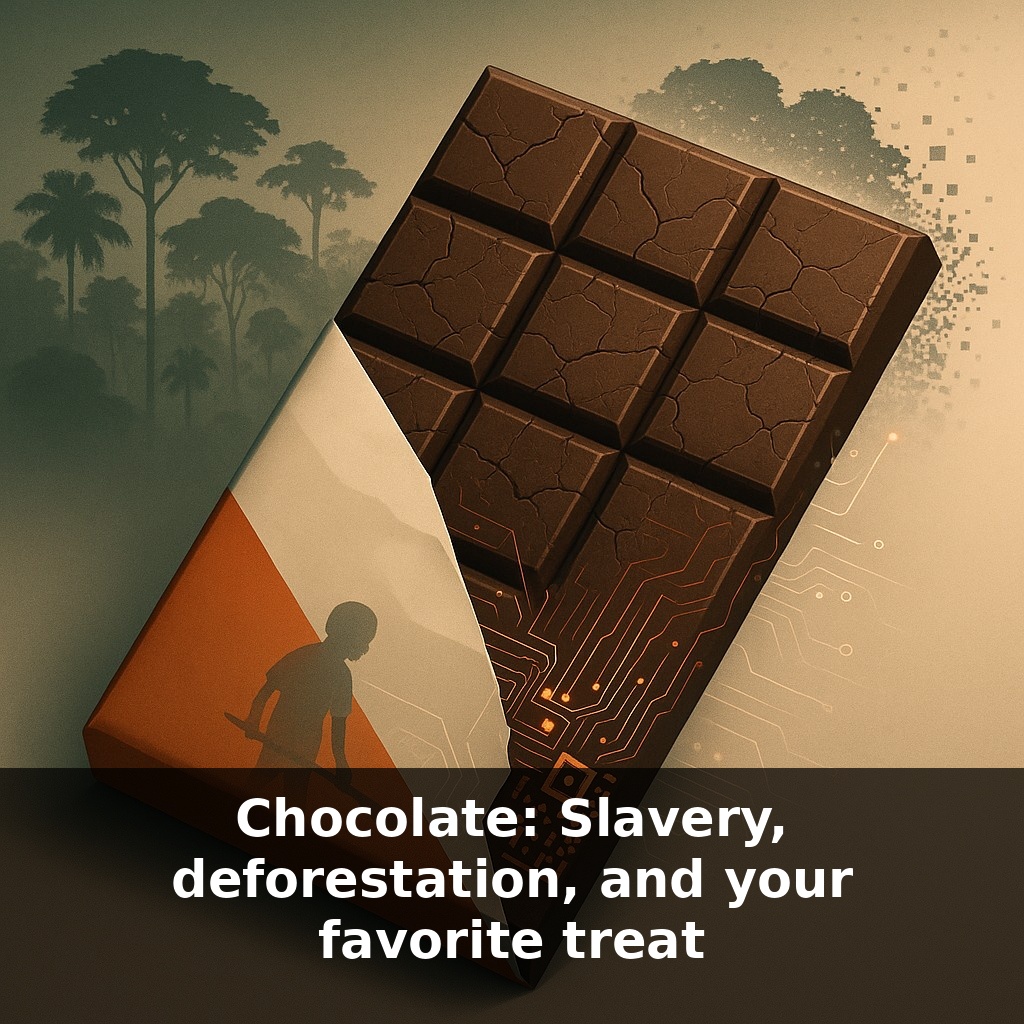
Right now, a child in West Africa is swinging a machete for your next bite of chocolate. In the same hour, a football field of tropical forest quietly disappears. We’re told chocolate is joy and comfort—so how did our sweetest habit get tied to some of the darkest realities?
A supermarket shelf makes all chocolate look the same: glossy wrappers, familiar logos, reassuring labels. But beneath that neat row of bars is a mess of contracts, middlemen, and invisible risks that would never fit on the back of the package. Most of us “vote with our wallet” based on price, flavor, or maybe a green seal that promises something better, trusting that someone else has checked the hard parts for us. Yet the closer you look, the more those guarantees start to blur. A bar labeled “sustainably sourced” might still come from a farm where the owner can’t afford basic food. A “child-labor free” claim may cover only part of a company’s supply. In this episode, we’ll follow the trail from your favorite treat back to the farm gate, and ask how much control any of us really have over what’s hiding in a simple square of chocolate.
Step behind the packaging and the buzzwords and the view gets stranger. The same bar that wins an ethical-award logo in Europe might trace back to a farmer who has never tasted branded chocolate, can’t set the price for their beans, and is one bad harvest away from abandoning cocoa entirely. Supply chains stretch across borders like long-distance train lines: beans move from tiny plots to village depots, to export warehouses, to factories humming thousands of miles away. At each stop, value is added, but power concentrates upward, while the people at the starting point stay stuck on the economic platform.
Walk further down that line from farm to factory and the numbers start to feel less abstract. Two countries—Côte d’Ivoire and Ghana—supply most of the world’s cocoa, but millions of people there are living on less than a dollar a day from it. A typical smallholder works a few hectares, often with aging trees, unstable rains, and soil that’s been pushed hard for years. With prices set far away and costs for fertilizer, tools, and school fees rising, many families are left with one brutally simple equation: either cut corners, or get out.
Cutting corners can mean pulling children out of school during peak harvest, putting them on long days with machetes or pesticide sprayers. Surveys in both countries classify this as hazardous work, not just “helping out at home.” It can also mean edging into protected areas to plant new cocoa when old plots stop producing. When forest guards are few and penalties low, the lure of fertile land is strong.
On the other side of the world, brands talk about “zero deforestation” and “ethical cocoa,” and they aren’t entirely bluffing. Many now use satellite maps to flag fresh forest loss, phone apps to register farms, and barcodes that trace beans from certain co-ops into specific product lines. But those systems rarely cover every grower feeding into a company’s volume. A single cooperative may mix beans from members with mapped farms and neighbors whose plots are invisible on any corporate dashboard.
Certification labels step into this gap, setting standards on child labor, land use, and minimum premiums. They matter: a guaranteed extra few hundred dollars per ton can mean replacing a broken roof instead of patching it with plastic. Yet audits sample only a slice of farms, and inspectors may visit once a year, if that. Someone using banned chemicals or hiring children the week after an audit won’t appear in the scorecard.
Layered on top are new laws in Europe and the U.S. demanding proof that cocoa wasn’t grown on recently cleared forest and wasn’t produced with forced labor. Companies now scramble to collect farm GPS points, digitize paperwork, and drop risky suppliers. The risk is that those with the least capacity to comply—small farmers without documents, land titles, or smartphone access—are pushed out first, even if they’ve never cut a tree or hired a child.
A cocoa farmer’s year can look less like a business plan and more like a medical chart. One bad infection—say, swollen shoot disease hitting a plot—can wipe out trees just as surely as a fever can knock you flat before a marathon. The “treatment” options are limited: replant and wait years for income, borrow at harsh rates, or switch to a more immediately profitable crop. Meanwhile, at the other end, a luxury brand in Europe might launch a single-origin bar sourced from a handful of GPS-mapped farms, much like a boutique clinic offering personalized care to a select group of patients. Next door on the shelf, a budget bar blends beans from hundreds of anonymous farms, closer to a crowded public hospital where staff do their best but can’t trace every case history. Both products draw from the same regions, but the level of monitoring, investment, and attention per farm differs so sharply that they might as well exist in separate health systems.
By 2035, your impulse buy at the checkout could function more like a boarding pass than a wrapper—scan a code and see the farms, rainfall patterns, even carbon footprint behind that bar. As investors watch land conflict, heat stress, and lawsuits rise, “cheap” cocoa may look less like a bargain and more like a liability. The open question: will tools that make farmers visible also give them leverage, or just tighten the grip of those already holding the pen on global contracts?
So the next time you unwrap a bar, treat it less like a guilty pleasure and more like a playlist you can curate: whose voices are you amplifying, whose are on mute? Tools, labels, and new laws won’t fix everything, but they crack the door. The open question is whether we walk through as passive snackers or as listeners willing to change the tune.
Before next week, ask yourself: 1) “If I opened my kitchen cabinet right now, which chocolate brands might be linked to West African child labor or illegal cocoa-driven deforestation, and am I willing to swap at least one of them for a certified brand (e.g., Fairtrade, Rainforest Alliance, or direct-trade) on my very next grocery trip?” 2) “The next time I’m about to buy a chocolate bar, will I pause for 30 seconds to look up that company’s latest transparency or ESG report on cocoa sourcing, and if I don’t find anything, am I prepared to choose a different brand?” 3) “Whose ear could I reach this week—a friend, coworker, or local café owner—to share one specific fact from the episode (like how cocoa expansion drives deforestation in Côte d’Ivoire and Ghana) and suggest a concrete switch to more ethical chocolate together?”