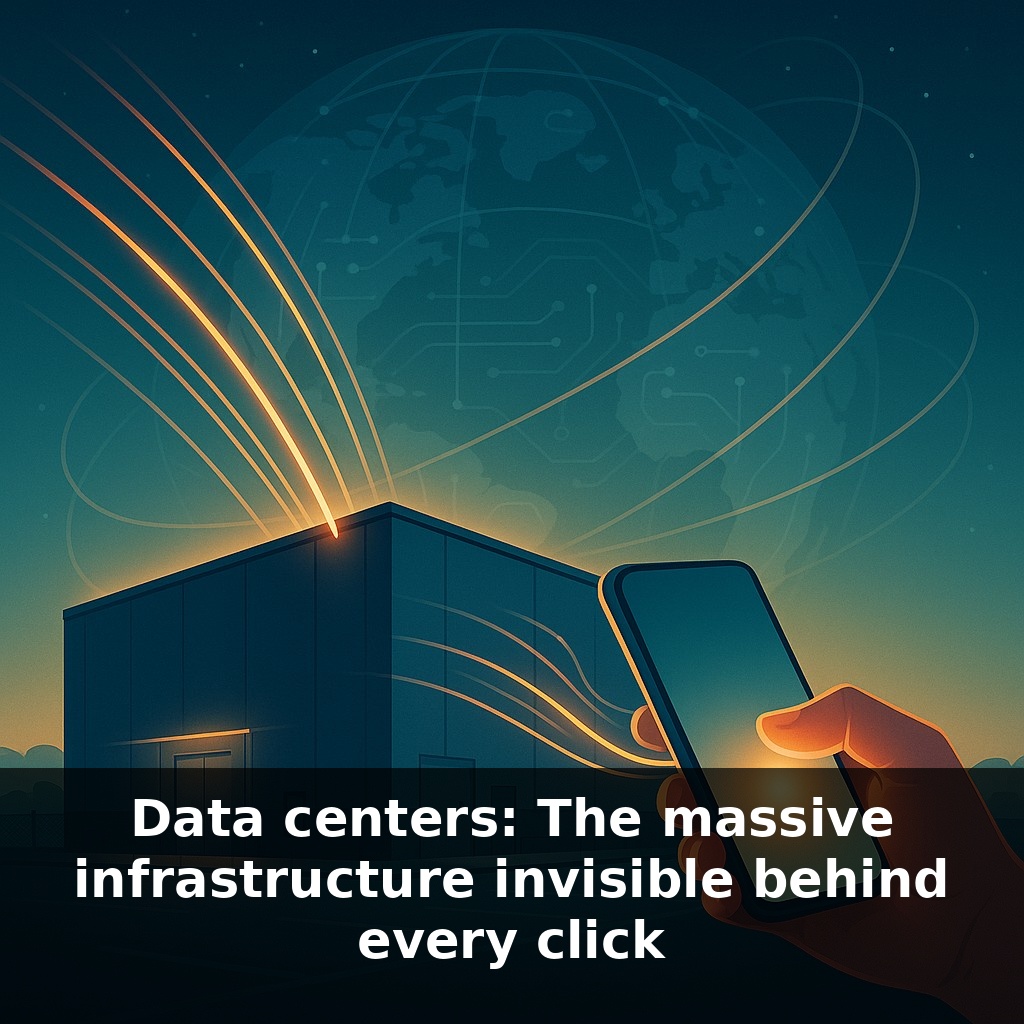
Right now, a windowless warehouse on the edge of some town is working harder for your phone than the battery in your hand. With a single tap to send a photo or play a song, you quietly recruit thousands of hidden machines you’ll never see—but your life stops if they do.
Those anonymous buildings don’t just store your selfies; they quietly choreograph much of the world’s economy. A new movie drops? Millions stream it through the same few facilities. A retailer launches a flash sale? Their “website traffic spike” is really a surge of electricity, heat, and data inside distant racks of hardware.
Because the stakes are so high, locations are chosen with almost surgical precision: close to cheap, stable power, fiber routes, cool climates, and sometimes even under tax‑friendly regulations. The companies behind them—Amazon, Microsoft, Google, Alibaba—treat capacity planning like airlines treat seat yield, constantly forecasting how many clicks, searches, and streams tomorrow will bring.
And now AI is reshaping the blueprint again. Training a single large model can use more energy than a hundred typical online services combined, forcing data centers to evolve from “just” reliable to aggressively intelligent about every watt.
Some of the most prized neighbors for these facilities aren’t people at all, but things like glaciers, rivers, and steady ocean breezes. Cool climates slice the cost of keeping hardware at safe temperatures; in places like Finland and Sweden, the “waste” heat is piped into district heating systems, warming homes instead of the sky. Elsewhere, operators chase proximity to wind or solar farms, or negotiate to run on hydropower. Under all of this is a constant tradeoff: low latency, cheap energy, political stability, and room to grow rarely exist in the same spot.
Stand inside one of these facilities and the first surprise is the sound: not a sci‑fi hum, but a dense, constant rush of air and faint whine of spinning fans. Rows of server racks form narrow corridors called “hot” and “cold” aisles, carefully arranged so that chilled air is pushed where it’s needed and exhaust heat is captured instead of spilling everywhere. That choreography matters; cooling alone can swallow a huge slice of the power budget, so layout isn’t just interior design—it’s an engineering decision measured in megawatts and dollars.
Behind the scenes, software obsessively watches every component. Tiny temperature sensors, power meters, and airflow gauges stream data into control systems that adjust in real time: nudging a fan speed here, shifting a workload there. In some cutting‑edge sites, AI doesn’t just suggest tweaks; it’s allowed to steer the environment directly, shaving percentage points off the energy bill that add up to millions per year.
All of this sits atop a layered safety net. Power doesn’t arrive from the grid and go straight to servers; it flows through transformers, switchgear, battery banks, and diesel generators designed to pick up the slack in seconds. Networking is built the same way: multiple fiber paths, redundant switches, and automatic failover so that a cut cable or failed router doesn’t ripple out as a global outage.
The physical diversity is widening. Hyperscale campuses outside major cities handle bulk processing and storage, while smaller “edge” sites move closer to users so latency‑sensitive tasks—like real‑time gaming or autonomous vehicles—don’t wait on distant responses. Some operators slot entire mini‑facilities into standardized modules, letting them add capacity more like stacking shipping containers than constructing office towers.
If a hospital is organized around keeping people alive despite equipment failures, these places are organized around keeping bits flowing despite everything from storms to surges in viral video traffic. The goal isn’t perfection; it’s resilience so strong that you never notice when something breaks.
In the same way a touring orchestra needs different venues for rehearsals, small gigs, and stadium shows, your online life is routed through a mix of specialized facilities. A single food‑delivery order might ping a nearby edge site to calculate the fastest route, tap a payment provider’s cluster in another city to confirm your card, and finally land in a retailer’s massive storage farm to update inventory logs. Each step hits a different physical building, often owned by different companies.
Operators now treat carbon the way airlines treat fuel: a line item that can make or break the business. Some schedule the most flexible tasks—like backing up archives or training new recommendation models—for hours when wind or solar output is high. Others sell “green tiers” of cloud service where your storage is guaranteed to run on matched renewable energy.
Even the byproducts are becoming assets. Heat is piped into nearby greenhouses, and server‑warmed water feeds aquaculture tanks, turning digital exhaust into tomatoes and fish instead of wasted degrees.
As demand keeps climbing, the real shift may be *who* gets a say in how these facilities evolve. City planners are starting to treat them like power plants, zoning where they can sit and when they may draw hardest on the grid. Local residents push for benefits in return: jobs, shared backup power, or cheaper heat. Think of it as neighborhoods negotiating a “band rider” with their digital headliners—if you’re hosting the show, what do you get besides the noise and the lights?
As clicks multiply, the question shifts from “how big can these hubs get?” to “who helps steer them?” Unions for technicians, watchdogs for water use, even artists mapping their invisible footprints may all matter. Your quiet choices—which platforms you favor, what you stream, when you back up—are tiny votes in how this hidden infrastructure will grow.
Before next week, ask yourself: Where in my daily digital habits (streaming, cloud backups, endless tabs, AI tools) am I creating “hidden” demand on data centers, and what could I realistically reduce or batch starting today? If I had to explain to a friend how much water, electricity, and land it takes to power just my own online life, what would I say—and what in that explanation makes me uncomfortable enough to change something now? Looking at the companies whose services I use the most, which ones are actually transparent about their data center energy mix and cooling methods, and how might that information influence which platforms I choose or recommend this week?