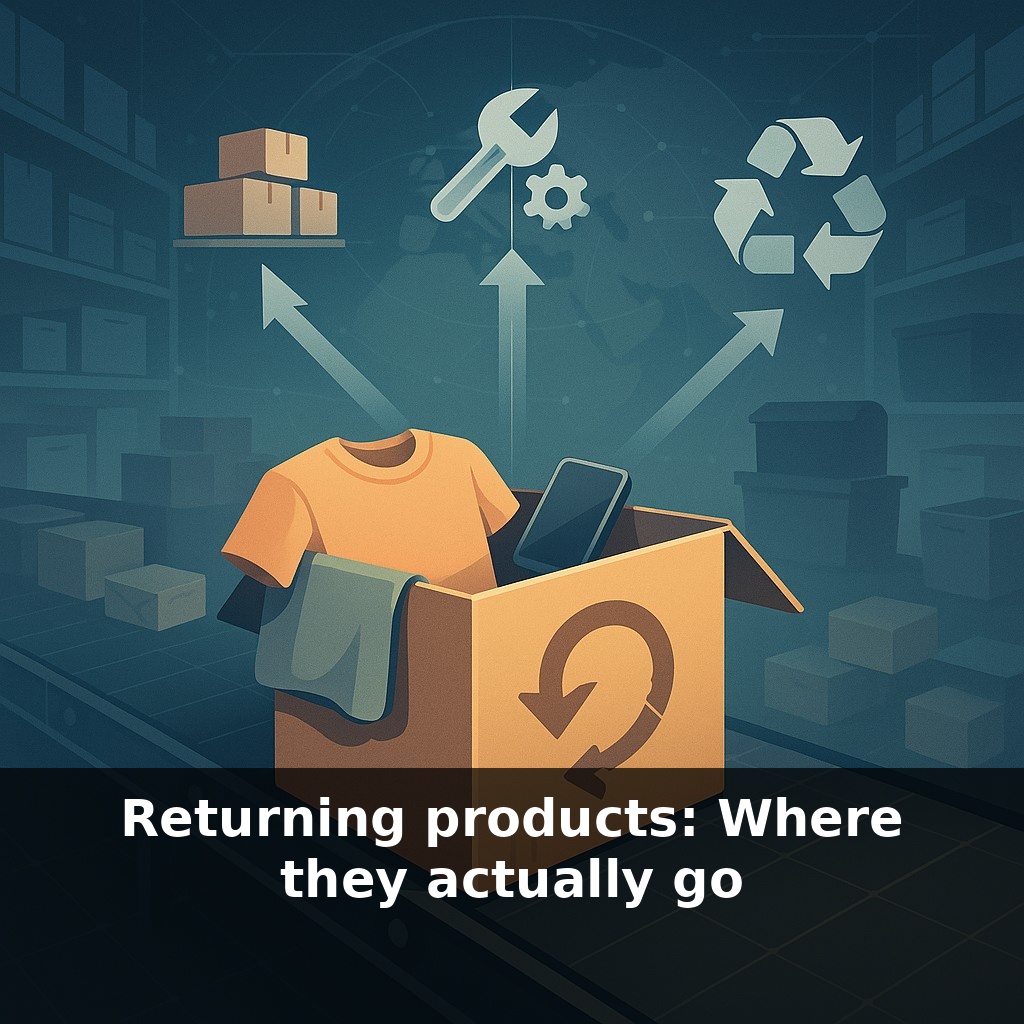
Roughly a third of the clothes bought online are sent back—yet almost none return to the rack you picture. A dress lands in a silent warehouse. A gadget arrives in a plastic bin. From there, a hidden system decides: resell, repair, recycle…or quietly destroy.
Most of what we “send back” doesn’t simply rewind its journey; it enters a parallel economy with its own winners and losers. A T‑shirt that didn’t fit you might be bundled with hundreds of others and auctioned off to a reseller in another state—or another continent—who has never heard of the original brand. A “like new” tablet may be stripped for parts to keep dozens of other devices alive a bit longer. Some items are downgraded step by step: first to outlet stock, then to bulk liquidations, and finally to materials sold by the pound. Along the way, value evaporates at each stop, like a leaking pipe no one quite designed but everyone uses. And with every hop—truck, warehouse, sorting center—the environmental tab grows, quietly folded into the price of “free” and “easy” returns.
Behind those quick return labels sits a messy clash of incentives. Retailers push “free, no‑questions‑asked” policies because they boost sales. Shoppers over‑order sizes, colors and styles, treating their bedrooms like fitting rooms. Logistics companies are paid for volume moved, not waste avoided. And manufacturers have little reason to design products that survive this harsh back‑and‑forth journey. The result isn’t one villain, but a tangle of tiny decisions that, together, quietly turn our return habits into a costly, carbon‑heavy habit we barely notice.
A returned item’s fate is mostly decided in the first few minutes after it reaches a processing center. Workers or scanners log its ID, condition, and reason code—“too big,” “defective,” “changed mind,” and dozens more. That tiny data trail matters: a brand‑new, unopened item might be routed one way; a scuffed, opened, or out‑of‑season product goes down a very different path.
From there, specialized software assigns each item to the “least bad” option financially: send to an outlet store, divert to an online marketplace under a different seller name, group into bulk pallets, or offload to a liquidator that buys thousands of mixed items for pennies on the dollar. Each decision weighs storage costs, labor, expected resale price, and time left before the item becomes obsolete. In fast fashion or consumer electronics, that window can be just weeks.
This is where data—or the lack of it—really bites. Many retailers still treat returns as an accounting headache, not an information goldmine. So patterns go unnoticed: a zipper model that fails 10 times more often in humid climates, or a shoe style that runs chronically small and boomerangs back from first‑time buyers. The companies that do mine this information can quietly redesign problem products, tweak size charts, or even block serial returners from certain offers.
A growing group of “returns specialists” sits in the middle. Firms like Optoro, Happy Returns, Loop, and ZigZag plug into retailers’ systems to triage items in real time, directing each one to the most efficient next stop. Some experiment with drop‑off kiosks or consolidated collection points so trucks carry full loads instead of zigzagging to individual homes.
Meanwhile, circular‑economy models try to rewrite the script altogether: clothing rental subscriptions, “trade‑in” programs for phones and laptops, repair memberships for appliances, and take‑back schemes that promise to turn last year’s purchase into raw material for the next. When products are built with standardized parts and easier disassembly, that promise becomes more than marketing—each return is less a dead end and more a planned loop.
Walk through two different warehouses and you can feel how design choices echo down the line. In one, fast‑fashion pieces arrive in tangled plastic, with generic barcodes and missing fabric details. Every misprint or mystery fiber means slower sorting, more items shuffled to the “we’ll deal with this later” pile. In another, a sportswear brand adds QR codes that reveal exact materials, factory batch, even wash‑test results. That data lets software decide on the fly whether something can be resold in-region, repaired locally, or routed to a specialist recycler that handles that exact blend of fibers.
Electronics tell a similar story. A modular laptop with standardized screws, battery, and screen can be opened, tested, and revived quickly; a glued‑shut tablet with proprietary parts is far likelier to end up as scrap. Some retailers now run “second chance” events—short online drops where verified‑good returns are sold in limited windows—turning what used to be a quiet loss into a mini marketing moment.
Returns could quietly reshape how products are made and sold. As brands feel pressure to count every gram of wasted fabric and every extra delivery mile, design teams may start treating “what happens after you’re done” as seriously as the initial unboxing. Think loyalty programs that reward keeping items longer, “pre‑owned first” filters by default, or dynamic pricing that nudges you toward lower‑impact options, like a refurbished gadget that shows its “mileage” the way cars show odometer readings.
As brands map this “afterlife” more honestly, we may see labels list not just size and fabric, but likely futures: resale score, refurbishability, compostability. Returns data could start steering design the way playlists shape radio—quietly, statistically, yet decisively—so each “no thanks” you send back nudges the next generation a bit closer to staying in play.
Before next week, ask yourself: “If I could only return 50% of what I usually send back, which items would I *keep* once I picture them getting liquidated, shredded, or shipped overseas instead of reshelved—and why?” “The next time I’m about to buy two sizes or ‘try it and return it,’ what would I do differently if I had to imagine the exact path of that return—sorting center, reseller, landfill, or export—and would that change which size, brand, or store I choose?” “Looking at my last three returns, which ones were caused by things I can control (like not checking measurements, material, or reviews), and what specific habit could I adopt today—like always checking garment measurements or avoiding final-sale ‘just in case’ buys—to cut that wasteful pattern in half?”