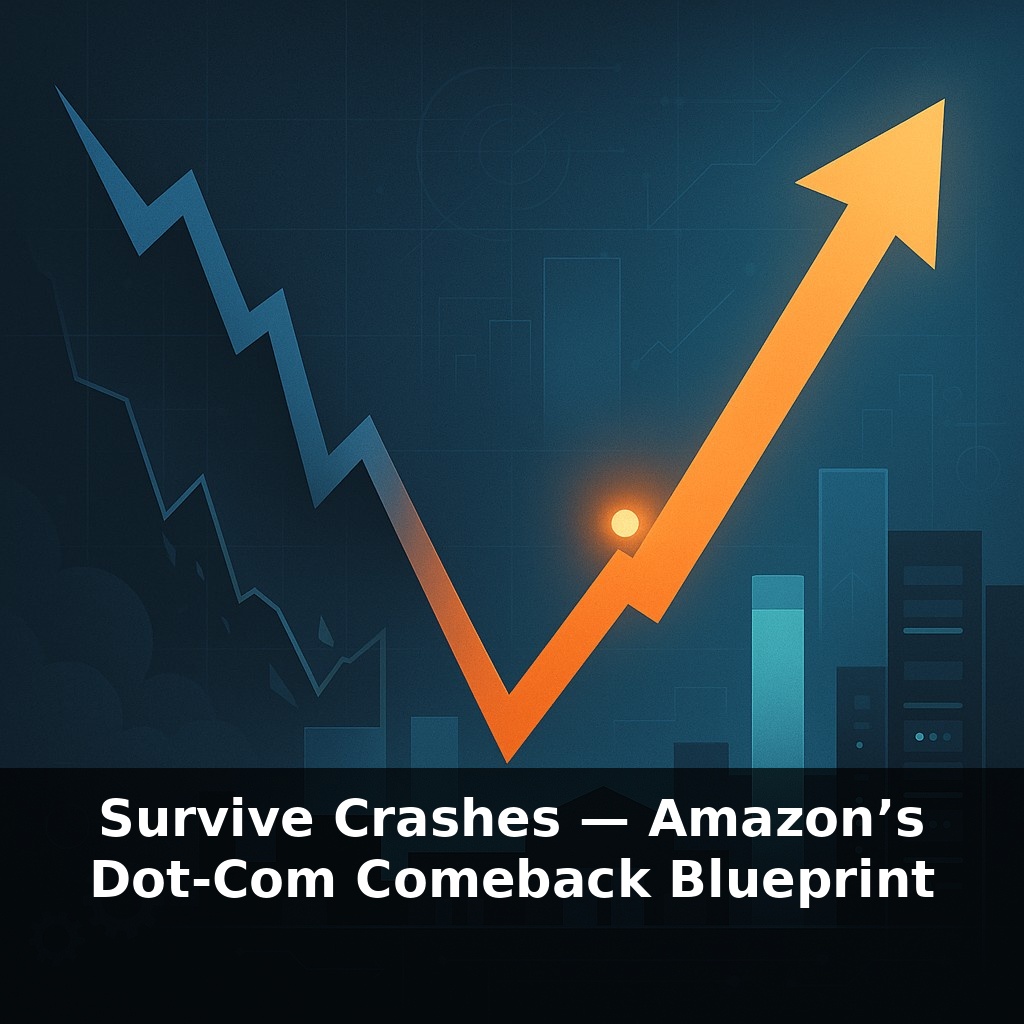
Amazon’s stock once crashed more than ninety percent—yet the company didn’t just survive, it quietly built the engines that now power much of online retail and cloud computing. In this episode, we’ll step into that crash and trace how they turned near‑disaster into a blueprint.
$5 million in profit on $1.12 billion in sales. That was Amazon’s first-ever profitable quarter in 2001—barely a rounding error on revenue, yet a turning point that told investors something had fundamentally changed inside the company. It wasn’t a victory lap; it was proof that a business once dismissed as a “glorified bookstore” could rewire itself under extreme stress.
In this episode, we zoom into that rewiring: how Amazon treated cheap capital like a perishable asset, reshuffled its most ambitious projects, and quietly shifted from owning everything to orchestrating other people’s inventory. Think of it less as a heroic comeback story, more as a playbook in controlled retreat: where to cut, what to preserve, and how to plant the next profit engine while the old one is still sputtering.
Bezos called this phase Amazon’s “get our house in order” era, and it went far beyond a few cost cuts. Managers were suddenly graded not on how fast they grew, but on how much cash their part of the business consumed or produced. Internal dashboards shifted from vanity metrics—page views, new categories launched—to unglamorous ones like inventory turns and fixed-cost coverage. If the earlier years felt like opening new restaurants on every corner, this period was more like rewriting the menu, renegotiating the rent, and standardizing the kitchen so each meal actually earned a margin.
The real inflection point inside Amazon wasn’t a single quarter; it was a mindset flip from “how big can this be?” to “how long can we survive?” Once the crash hit, cash stopped being background noise and became the central constraint every decision orbited around.
They started by dissecting the business into cash engines and cash drains. Each unit had to surface something very specific: when do we pay suppliers, when do customers pay us, and how much working capital sits trapped in between? That’s how the famous focus on the cash conversion cycle hardened into a discipline. Categories or initiatives that swallowed cash without a clear path to improvement were slowed, shrunk, or shut down—not because the ideas were bad, but because they were too expensive to carry through uncertainty.
At the same time, they re‑sequenced growth. Instead of pouring dollars evenly across every bold idea, Amazon triaged. Projects that could improve margins or lighten the balance sheet moved up in priority. That’s how third‑party selling vaulted from side experiment to core pillar so quickly: it generated fees without requiring Amazon to own more stock or build new stores. More speculative ventures were pushed out on the timeline. The question wasn’t “do we believe in this?” but “can this justify its oxygen bill right now?”
Crucially, they embedded frugality into process, not just slogans. Capital requests were forced through tighter gates: what’s the payback period, what happens in a downside scenario, how does this affect our fixed cost base? Internal teams were nudged toward asset‑light tactics: partner instead of build, lease instead of buy, turn a cost center into a service that others might eventually pay for.
If you’ve listened to earlier episodes, notice the contrast: SoftBank’s upside came from amplifying risk; this chapter of Amazon’s story is about selectively muting it. For investors and operators today, the lesson is subtle but powerful: resilience isn’t only about cutting fast when a shock hits. It’s about having pre‑chosen which bets you’ll protect, which can be paused without killing long‑term value, and which can morph into platforms that earn more per unit of capital than the business you started with.
Think of what came next less as “Amazon got disciplined” and more as “Amazon learned to make every dollar report for duty.” Marketplace didn’t just add fees; it taught the company how to standardize seller onboarding, dispute handling, and catalog quality so each new participant required less incremental effort. That muscle later made launching entirely new categories feel closer to tweaking a recipe than inventing a cuisine.
Internally, AWS began as a way to stop rebuilding the same infrastructure for every team. The surprise was that once storage and compute were packaged for internal customers, selling them externally looked obvious. What started as a cost problem turned into a pricing and product question.
For your own venture or investment thesis, the useful question isn’t “where can we cut?” but “which recurring headache, if turned into a product or service, would create its own line of revenue?” That shift—from tolerating pain to weaponizing it—is where the most resilient post‑crash platforms often begin.
Crashes expose whether a company is a sprinter or a distance runner. To tilt long‑term, treat fixed costs like a hot stove: only touch what you can quickly pull back from. Watch where cash quietly pools—unused software seats, half‑empty offices, overbuilt data tools—and ask how to rent or resell that slack capacity. Your future edge may resemble a sublet: monetizing space, code, or attention you once viewed as overhead, not inventory.
Survival, then, isn’t about heroics; it’s about staying curious when everyone else panics. As you face the next downturn, treat your operations like a kitchen between rushes: clear the counters, bottle your best sauces, and note which orders never stop coming. The firms that outlast shocks keep experimenting with the menu, even when they’re short on fuel.
Start with this tiny habit: When you sit down at your desk each morning, spend 30 seconds asking, “What’s my flywheel today?” and write one concrete step that strengthens your core loop (for example, “email 1 past customer to ask what almost stopped them from buying”). When you feel tempted to chase a shiny new idea, pause and say out loud, “Relentless focus,” then move one inch closer on that flywheel step (like improving a single sentence on your product page). When you check your analytics, instead of scanning everything, look only at one survival metric (like repeat purchase rate or trial-to-paid conversion) and jot a single question about how Amazon might have improved that number during the dot-com crash.