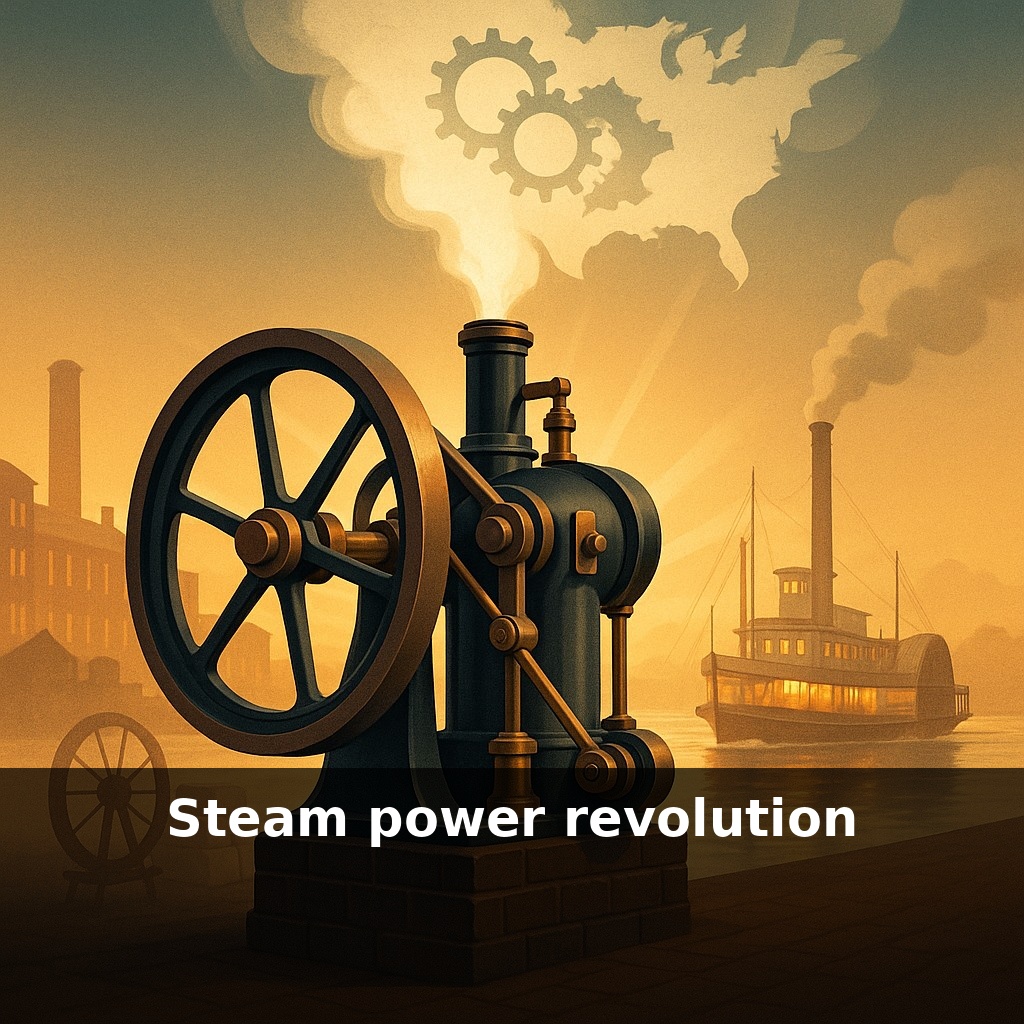
A single steam engine in Lowell once did the work of roughly two thousand people spinning cotton by hand. Now jump to a crowded river dock: smoke, noise, and a wooden boat leaving New York, promising to outrun the wind itself. How did boiling water start reshaping a continent?
By the early 1800s, steam in America was no longer a scientific curiosity; it was becoming a gamble people were willing to stake fortunes—and lives—on. Investors poured money into mills, shipyards, and workshops that often looked more like experiments than businesses. Towns that once dozed beside slow rivers began to hum at all hours, their rhythms set not by sunrise and seasons but by whistles and rotating shifts, like a town switching from acoustic instruments to a relentless, ticking metronome. Steam engines crept into places that had never seen large-scale power before: inland crossroads, shallow Western rivers, muddy construction sites. They powered sawmills that devoured forests, presses that flooded cities with cheap newspapers, and pumps that made deeper mines possible. Each new installation quietly rewrote what a “normal” day’s work could look like—and who controlled it.
Yet in the United States, this transformation took on a distinctly local flavor. British factories had grown up near coal mines and old ports; American steam spread along rivers that froze in winter and across prairies with barely a road scratched into them. Entrepreneurs learned to treat boilers and engines like modular power outlets, dropping them into places where waterwheels were useless or labor was scarce. A frontier town might get its first real surge of mechanical power not from a grand factory complex, but from a noisy engine bolted to a single workshop or dockside warehouse.
At first, American builders copied British machinery, but they quickly hit a wall: Britain’s famous Watt-style engines were fuel-hungry, heavy, and best suited to coal-rich regions and big urban complexes. In a country with long distances, thinly settled interiors, and wildly different landscapes, that model was a bad fit. The United States needed power that could travel.
That’s where high-pressure designs came in. Instead of relying on gentle atmospheric pressure, these engines pushed steam to far higher pressures—often 5 to 10 times greater than the earliest machines. They were smaller, lighter, and strong enough to move themselves. Suddenly, power didn’t have to stay rooted to a riverbank or deep shaft. It could ride on wheels and hulls.
Once steam climbed onto boats and rails, geography started to lose some of its veto power. Fulton’s Clermont, churning up the Hudson in 1807, didn’t just shave time off the New York–Albany route. It hinted that rivers could run both ways economically. Farmers upstream could ship flour, timber, and pork against the current without waiting on wind or muscle. River towns that once felt like dead ends turned into junctions.
Railroads went further, literally. A few dozen experimental miles of track in 1830 became a dense web by mid-century, linking Atlantic ports to interior farms, coal fields, and new cities. Freight that had taken weeks by wagon moved in days. That speed didn’t just convenience travelers; it rewired business logic. Merchants could carry smaller inventories because replacement goods were a timetable away, not a season away. Factories could specialize, trusting that parts and customers lay within reliable reach.
Inside urban centers, concentrated mechanical power encouraged clustering. Textile complexes in places like Lowell leaned into sheer scale: thousands of spindles, regimented shifts, and rows of brick boardinghouses to keep workers close. Production that had once been scattered across household workshops folded into supervised floors. Control of timing, output, and discipline shifted toward owners and overseers, tightening the link between energy, capital, and authority.
And in the background, a quieter change unfolded: steam culture. Boiler explosions, patent fights, and headline-grabbing races pushed engineers, insurers, and lawmakers into the same conversation. Standards for pressure, materials, and inspection emerged unevenly, but they marked the beginning of treating power as something that needed regulation as well as celebration.
In practice, this new power showed up in wildly different ways depending on where you stood. On Western rivers, steamboat captains treated time like a rival to beat. Schedules tightened, fares shifted by season, and once-isolated farmers started timing harvests to meet distant markets—closer to planning a concert tour than a one-off gig. In factory towns, whistles didn’t just mark shifts; they synchronized hundreds of people the way a conductor pulls an orchestra into tempo. Shops opened earlier, boardinghouse meals fell into strict slots, even church services slid around train arrivals. Out on construction sites, portable engines let contractors bid on jobs that once seemed impossible: draining swamps for rail beds, powering pile drivers for urban piers, feeding stone crushers for macadam roads. That flexibility nudged Americans to treat mechanical power less as a rare privilege and more as a tool you could rent, redirect, or relocate whenever opportunity appeared.
Steam’s legacy sits inside today’s energy debates like a half-forgotten blueprint. Once Americans trusted remote, invisible power, they learned to tolerate risk, delay, and dependence on distant fuel—much like plugging into a regional grid now. Data centers, container ports, even cloud computing echo that earlier leap: specialized hubs doing intense work so the rest of us can act with a light touch, the way a single concert hall can project a city’s music far beyond its walls.
Steam didn’t just launch factories and vehicles; it rewired expectations. Americans grew used to timetables, tickets, and coordinated flows of goods the way listeners learn to trust a broadcast schedule. That mindset—confidence that distant systems will hum on cue—became the quiet ancestor of how we now accept power grids, broadband, and global logistics as everyday background.
Before next week, ask yourself: “Where in my current work or routines am I still relying on ‘manual labor’—repetitive tasks or processes—that could be my equivalent of pre-steam hand-cranking, and what specific tool or automation could be my ‘steam engine’ here?” “If I treated data and information the way early industrialists treated coal—something to be gathered, stored, and fed into engines—what data in my life or business could I start collecting today to power better decisions?” “Just as steam power reshaped entire cities and trade routes, what’s one part of my environment (schedule, workspace, tech stack, team structure) I could redesign this week so that my ‘engines’ run with less friction and more output?”