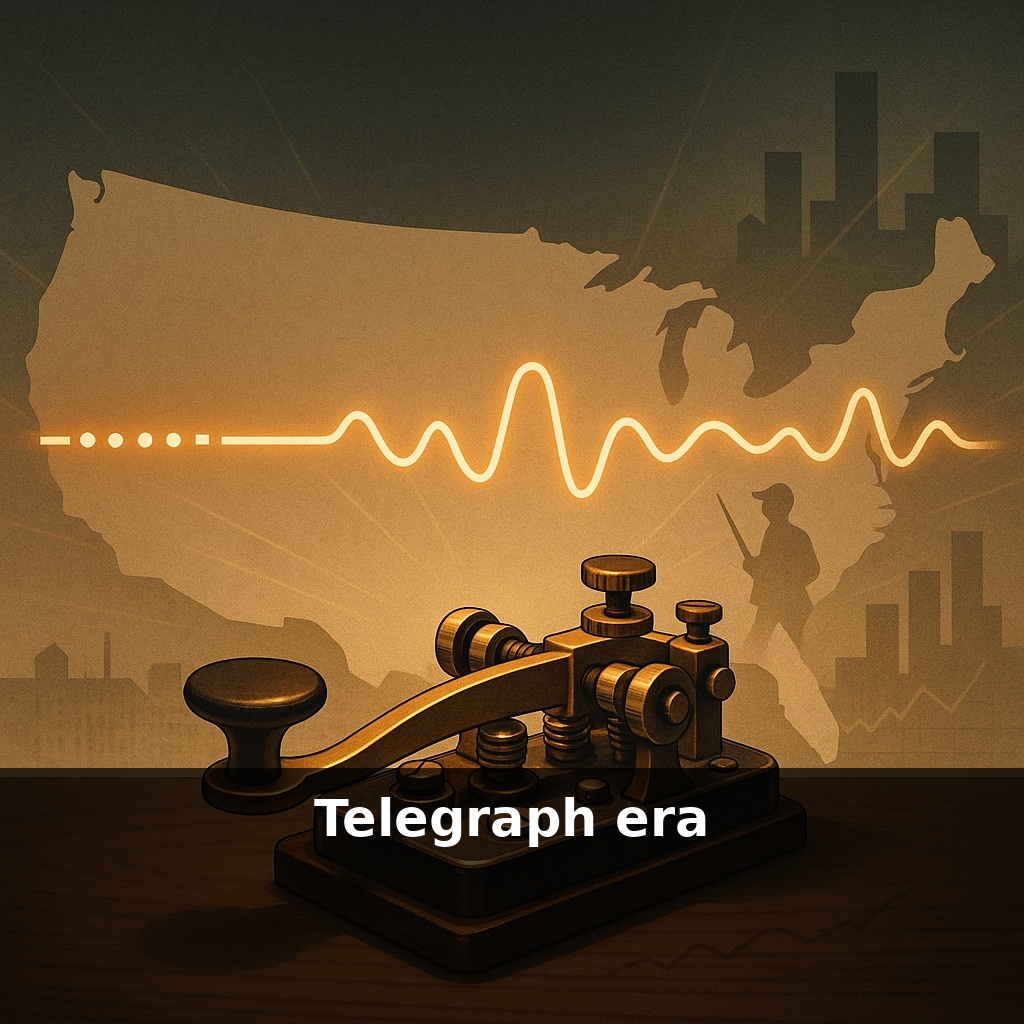
A single sentence once took weeks to cross America. Then, almost overnight, it took minutes. In this episode, we drop into a New York newsroom, a Civil War battlefield, and a Wall Street office to follow the crackling clicks that quietly rewired the entire country.
By the 1850s, those faint clicks on telegraph sounders were doing far more than racing news across distances. They were redrawing where power sat, who could profit, and how everyday life felt. A rancher in Texas could check cattle prices in Chicago before selling. A small-town banker could confirm a client’s credit in New York before approving a loan. Even the timing of when factories paid workers or when ships left harbor began to sync to invisible signals running over distant poles.
The wires also created new jobs and strange new skills. Teenage operators in dusty depots learned to “hear” Morse code as if it were spoken language, sorting urgent orders from idle chatter. Corporations quietly discovered they could manage far-flung branches from a single office, like a conductor leading musicians scattered across the continent. What began as a gadget for messages became the backbone of a new kind of national coordination.
Those wires also reshaped how time and distance felt. Before, each town lived by its own clock tower and gossip; after, train schedules, stock prices, and war dispatches pushed Americans to think in shared, standardized beats. A message from hundreds of miles away could change today’s decisions, not next month’s. As more poles marched along rail lines and roads—50,000 miles by 1861, four times that by 1900—people and businesses began to plan on a larger canvas. Local risks could be hedged with distant news, much as a careful climber checks weather far up the mountain before taking the next step.
Western Union sat at the center of this new web. It began as just one of many small firms stringing wire along railroad rights-of-way, but through aggressive buyouts and rate wars it fused dozens of regional lines into a single, continent-spanning monopoly. By the 1870s, if you sent a telegram in most of the United States, you were effectively handing that message to Western Union. That control wasn’t abstract: the company could decide which towns got connections first, which newspapers received fast financial quotes, and how much urgency would cost.
That pricing mattered. Early messages were luxuries, stripped of adjectives and pleasantries to save money; businesses spoke in tight, cryptic phrases that read more like ledgers than letters. As competition and scale pushed rates downward, new uses appeared. Merchants began wiring routine orders instead of waiting for the mail. Families started sending news of births, deaths, and arrivals at the train station. Telegraph offices, often tucked into railroad depots or general stores, became small stages where public and private lives briefly overlapped: a wall of official forms and tariffs beside whispered condolences or hurried stock tips.
The same wires quietly reconfigured government. Washington could request reports from territorial governors and military posts in hours instead of seasons, making it far harder for distant officials to drift into semi-independence. During crises—financial panics, epidemics, natural disasters—state and federal leaders could coordinate relief and policy in something like real time. That created a new expectation: citizens began to demand that authorities respond quickly because, for the first time, rapid response felt technically possible.
Journalism, commerce, and governance all had to learn a new skill: filtering. When battlefield updates, price changes, and political rumors could flood in all day, editors and clerks became early information managers, deciding what to print, trade on, or ignore. Their choices shaped what counted as “news” and which voices reached a national audience. And behind them stood armies of mostly anonymous operators—women increasingly among them by the 1870s—whose proficiency determined whether those distant voices arrived clearly or not at all.
Operators turned those abstract clicks into something intensely human. In small towns, the local telegrapher might be the only person who knew that wheat prices dipped at noon or that a distant cousin arrived safely out West. One operator compared the wire traffic to listening to a crowded train station: not a blur of noise, but distinct “voices” you learned to recognize by rhythm alone. On Wall Street, brokers treated incoming quotes like musicians reading a constantly changing score; a few seconds’ lead on a price could mean the difference between profit and ruin. During crises—fires, floods, bank runs—mayors and railroad superintendents leaned on favored operators the way a ship’s captain trusts a navigator, asking, “What are they seeing upriver? What’s happening three towns ahead?” Telegraph lines also became early testing grounds for corporate secrecy: companies developed private codebooks so that a sentence about cotton or copper, if intercepted, would read like nonsense to anyone outside the firm.
Policymakers now face questions that would feel familiar to telegraph-era reformers: Who owns the lines, and who gets left off the map? Today’s undersea cables and low‑orbit satellites echo fights over rural access and fair rates. Think of regulators as jazz arrangers, deciding which instruments get heard and when. Study how Western Union was challenged, and you see templates for antitrust, net neutrality, and public options for basic connectivity.
The telegraph age didn’t just fade; it left fossils in our language and habits—“wire stories,” “off the record,” even the urge to check for updates. Your challenge this week: notice every moment when a tiny alert changes your plan, mood, or money. Each ping is a faint echo of those first clicks that taught Americans to live by the line.