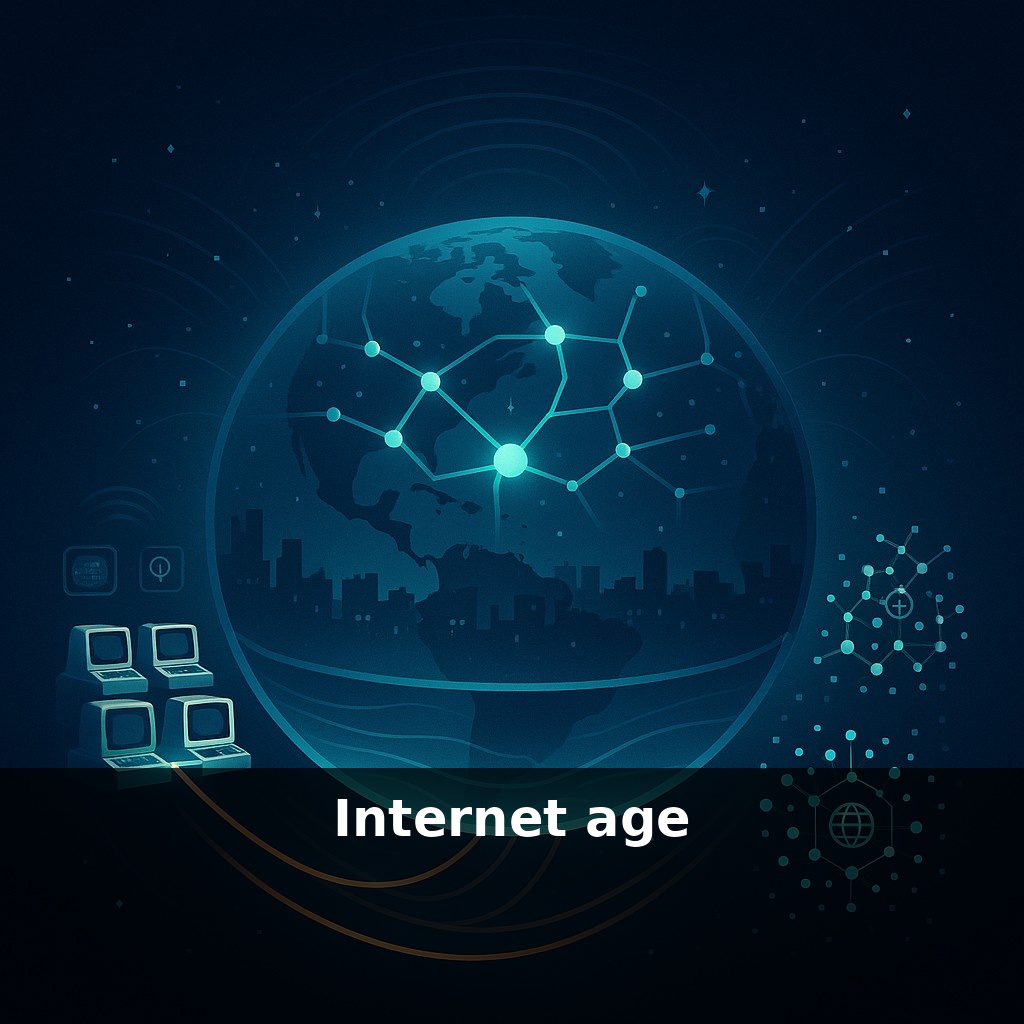
Right now, as you listen, billions of invisible messages are racing beneath oceans and over rooftops. Yet this vast system began as a tiny U.S. defense experiment linking just four bulky machines. How did a military test quietly turn into the nervous system of modern life?
By the mid‑1980s, the once‑quiet research network had started to leak into ordinary life. Universities traded code like bands swapping bootleg tapes, and early hobbyists dialed in over screeching modems, watching text creep across the screen line by line. What had been a closed academic corridor was turning into a crowded public street. Then, in 1991, Tim Berners‑Lee released the World Wide Web protocols, and the network suddenly gained something like a shared language and storefront windows. Graphical browsers followed, and clicking a blue link felt almost magical—like opening a trapdoor to another room. Within a few years, garage startups, online forums, and early digital marketplaces were jostling for space, setting the stage for the dot‑com boom—and the first signs that this new frontier would be shaped as much by money and power as by curiosity.
Suddenly, being “online” wasn’t just for researchers and hobbyists; it was creeping into offices, classrooms, and living rooms. In the mid‑1990s, millions of new users logged on through commercial providers, choosing quirky email addresses the way people once chose vanity license plates. News sites began updating faster than the morning paper, early message boards hosted sprawling debates among strangers, and niche fan pages sprang up for everything from local bands to rare comic books. The culture felt experimental and a bit lawless, as if an enormous new city were being built faster than anyone could draft the zoning laws.
By the late 1990s, the experience of going online was changing as fast as the underlying machinery. Those screeching dial‑up connections that tied up the family phone line delivered at most 56 kilobits per second; a single song could take an hour to download, and watching full‑motion video felt like science fiction. Yet engineers were quietly rolling out faster pipes—cable and DSL first, then fiber—so that, within a generation, the average fixed‑broadband user would see speeds more than two thousand times higher, around 113 megabits per second. That leap didn’t just make old tasks quicker; it made entirely new behaviors possible.
Search engines, once clunky directories, evolved into something closer to a global reference desk. When Google launched, its clean white page stood out against the banner‑filled portals of the day. Underneath that simplicity, the scale was staggering: today it fields on the order of 100 billion queries every month, turning human curiosity into a continuous, measurable stream. What you type into that box helps determine which businesses thrive, which medical information surfaces, even which rumors spread.
Faster connections also transformed how people consumed culture. Instead of driving to a video store or waiting for a TV rerun, users increasingly clicked “play” and expected instant gratification. By the early 2020s, streaming had swollen to about 65 percent of all global Internet traffic, as movies, music, live sports, and video calls all flowed through the same infrastructure. The Internet stopped feeling like a library you visited occasionally and started to resemble a utility—closer to electricity or running water.
Money followed attention. Early banner ads gave way to targeted campaigns tuned by real‑time data. In 2017, digital advertising revenue overtook television’s, and analysts now project online ads to reach roughly US$740 billion by 2025. That shift didn’t just hurt old media; it rewired incentives. Platforms designed their feeds and notifications to keep eyes on screens, feeding the ad machine.
Yet this new abundance arrived unevenly. While billions came online, billions more remained on the margins or disconnected entirely. Debates over “digital divides” and “net neutrality” signaled a deeper question: who should control a technology that had moved from quirky experiment to essential infrastructure for work, education, entertainment, and political life?
When a storm knocks out connectivity in a neighborhood, the reaction now resembles a small‑scale blackout: work pauses, homework stalls, video calls freeze mid‑sentence. That dependence reshapes physical spaces. Cafés advertise “fast Wi‑Fi” more prominently than their coffee beans; libraries lend hotspots alongside books; city buses become rolling offices as commuters answer emails in transit. Schools assign online-only homework, assuming access at home, while small retailers juggle card readers, delivery apps, and social feeds just to stay visible. Even civic life routes through screens: town halls livestream meetings, organizers coordinate protests in group chats, and disaster alerts buzz on pockets before sirens sound. Underneath it all, decisions about who gets fiber, who pays which rates, and whose data can be tracked quietly redraw old lines of privilege. In some towns, church parking lots and fast‑food chains double as de facto digital shelters, where people sit in parked cars after hours, chasing a free signal to apply for jobs or file government forms.
As more of life shifts online, policies and code start to feel like zoning laws for a new kind of city. Rules on algorithmic transparency, platform liability, and data ownership will shape who gets heard or hidden. Work follows this shift: résumés, portfolios, even office chatter move to clouds run by a few firms. Like musicians adapting to streaming, entire professions may be forced to chase volatile metrics, while basic digital literacy becomes a gatekeeper for opportunity and voice.
The next phase of this story may hinge less on speed than on choice: who sets the rules for speech, trade, and identity when a few platforms feel as familiar as neighborhood streets? Your search history can tilt elections, your “like” can boost a stranger’s business. As laws scramble to catch up, each click quietly helps draft the constitution of the Internet age.
Before next week, ask yourself: Where in my daily online routine (news feeds, social media, email, or YouTube) do I feel the most hijacked—like the app is steering my attention more than I am—and what’s one concrete boundary (time limit, blocked site, or removed app) I’m actually willing to try for three days? When was the last time I felt genuinely absorbed and satisfied doing something offline (a walk, a book, a hobby, a conversation), and how can I deliberately swap 30 minutes of “scroll time” for that exact activity at least twice this week? If my phone and laptop were only allowed to do three things that truly matter to me (learning a skill, staying in touch with specific people, building a project, etc.), what would those three be—and how could I rearrange my home screen or bookmarks tonight so they’re front and center, while everything else gets buried or removed?