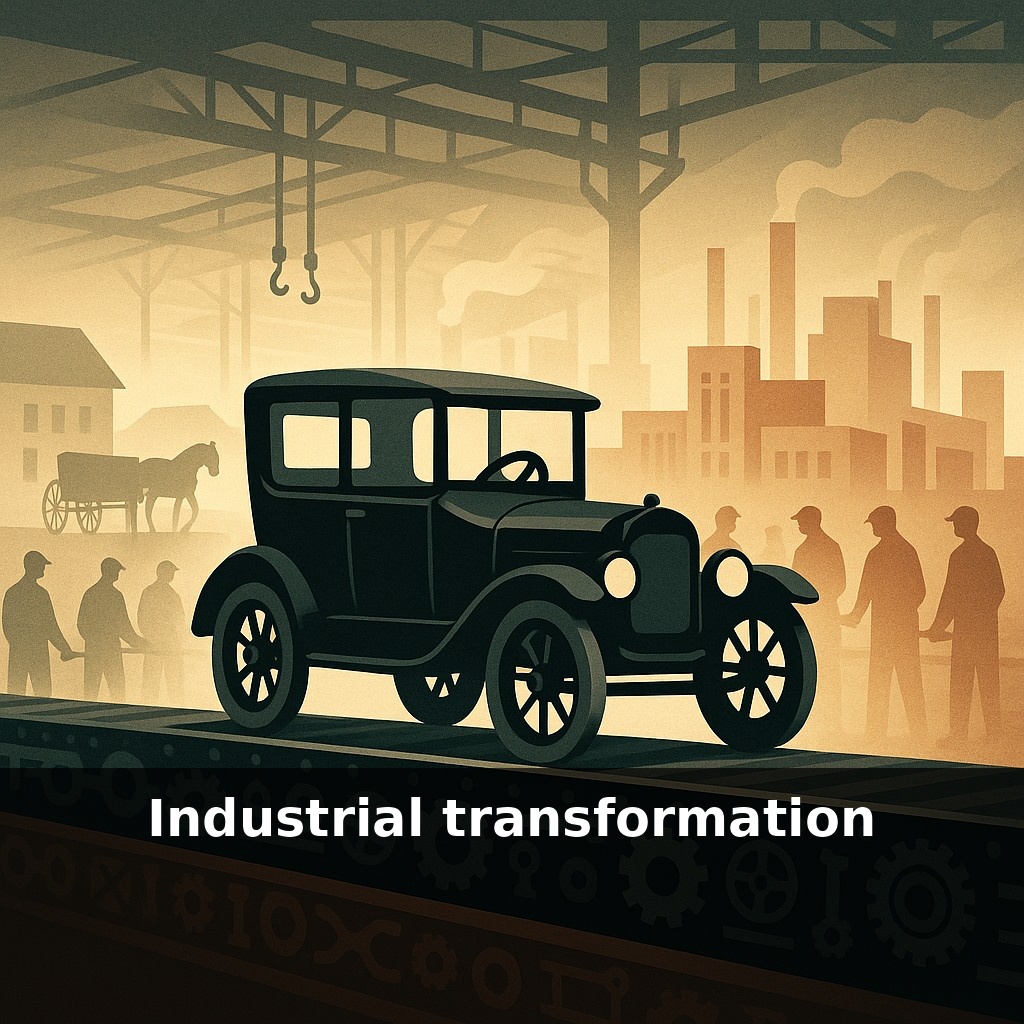
By the late 1920s, about half of American families owned a car—yet most workers still tightened the same few bolts all day long. In this episode, we’re stepping onto Ford’s factory floor to ask: how did mass production make life both richer and more mechanical at the same time?
On a Detroit street in the 1910s, a Model T might rattle past a horse-drawn wagon, while a delivery truck advertised a soap brand that someone in Texas could buy in exactly the same box. That odd mix—old transport, new machines, identical products—signals a deeper shift: production was no longer just local skill, it was becoming a national system.
In this episode, we’ll follow that system as it thickens and stretches. Electric motors snake into factories, breaking tasks into smaller, faster motions. Engineers with stopwatches stand beside machinists and argue over seconds. Credit plans quietly turn a year’s wages into a living room full of metal and glass.
We’ll ask how a country of tinkerers and shopkeepers turned into a landscape of plants, showrooms, and billboards—and what was gained and lost along the way.
Factories, once centered on a few master craftsmen, now filled with specialists whose jobs were so narrow that training could take hours instead of years. That shift didn’t just speed things up; it changed who could participate. Recent immigrants, women, and rural migrants stepped into roles designed to be quickly learned and tightly measured. At the same time, managers began treating workplaces like laboratories, tweaking workflows and pay schemes, then watching the results. Meanwhile, rail networks and telegraphs stitched distant plants and offices into a single, humming industrial organism.
Walk into Highland Park in 1913 and the first thing that hits you isn’t the machinery—it’s the rhythm. Bodies, parts, and carts move in a timed sequence so tight that Ford’s engineers start slicing work into motions, not minutes. A man who once fit a whole carriage now tightens two specific bolts on every chassis that passes his station, hundreds of times per day. The payoff is visible in sheer volume: Model T output soars from the tens of thousands into the millions within a decade, and the car shifts from luxury item to everyday tool.
To make this work at scale, parts have to fit together with eerie reliability. That pushes firms to perfect interchangeable components in industries beyond guns and sewing machines. Gauges, jigs, and specialized machine tools proliferate. A carburetor built in one plant must meet tolerances that let it slip into an engine block cast in another state without hand-filing or shimming. The craft skill doesn’t vanish; it gets pushed upstream into the design of machines, dies, and fixtures, then locked into repeatable routines.
Scientific management spreads alongside these techniques. Consultants fan out from Philadelphia and New York, stopwatches in hand, timing shovel loads in a steel yard one month and bricklaying the next. Their reports recommend narrower tasks, new incentive pay schemes, redesigned tools. Unions and skilled workers often resist, seeing not just job loss but an attack on judgment and autonomy. Yet by the 1920s, some version of time-and-motion thinking has seeped into most large factories.
As output explodes, so does the challenge of finding buyers. Firms begin to shape demand as actively as they shape steel. National advertising campaigns stitch distant consumers into a shared mental map of products: the same car emblem in Kansas and New York, the same soap slogan on streetcars and in magazines. Installment plans link this new marketing to household budgets, turning “someday” purchases into monthly payment streams.
Your challenge this week: pick one everyday object—your fridge, your shoes, your car—and trace its likely path backwards. How many different firms, regions, and standardized parts probably touch it before it reaches you?
A Ford worker in 1915 might leave the plant with oily hands, step onto a streetcar plastered with ads, and pay his fare with coins earned from the very system those ads depended on. His wage bought ready-made clothes, canned food, a cheap wristwatch—each arriving through similarly sliced-up production. Standard sizing quietly rewired daily life: shoes came in numbered lengths instead of custom fits; kitchens were sold as coordinated “sets,” encouraging people to replace whole rooms, not single tools. Chain stores multiplied, undercutting local shops with centrally negotiated prices and identical window displays from Ohio to Oklahoma. Even time itself felt more standardized: factory whistles, synchronized clocks on office walls, train timetables tightening expectations about punctuality. The new abundance didn’t just fill homes with objects; it channeled attention, habits, and even small-talk toward brands, models, and upgrades, tying personal identity a bit more tightly to things made far away.
Factory logic quietly slipped beyond workshop walls. Once firms mastered repeatable output, they began standardizing schedules, training, even leisure—think of ballparks lit for night games or movies timed to fit an evening. Homes followed suit: recipes assumed packaged ingredients; schooldays mirrored office hours. That earlier wave hints at today’s shift: as algorithms and robots take on more routine tasks, the open question is who will redesign the “upstream” work of judgment and creativity.
The story doesn’t end in the factory. As goods poured outward, ideas about “normal” life hardened too—like street grids laid over older footpaths. Neighborhoods sprouted garages, roads bent toward shopping streets, evenings tilted toward radio shows selling new desires. When production habits changed, the nation’s calendar and map quietly redrew themselves.
Start with this tiny habit: When you finish opening your daily production report (or dashboard), say out loud one process step where you see waste (like “packaging line changeover” or “coil loading time”) and whisper one possible digital fix (like “simple sensor here” or “tablet checklist there”). Then, before you close your laptop at the end of the day, spend exactly 2 minutes searching your existing systems (MES, CMMS, or ERP) for *one* data point that touches that step—nothing more. Tomorrow, repeat with a different process step, but still just 2 minutes and one data clue.