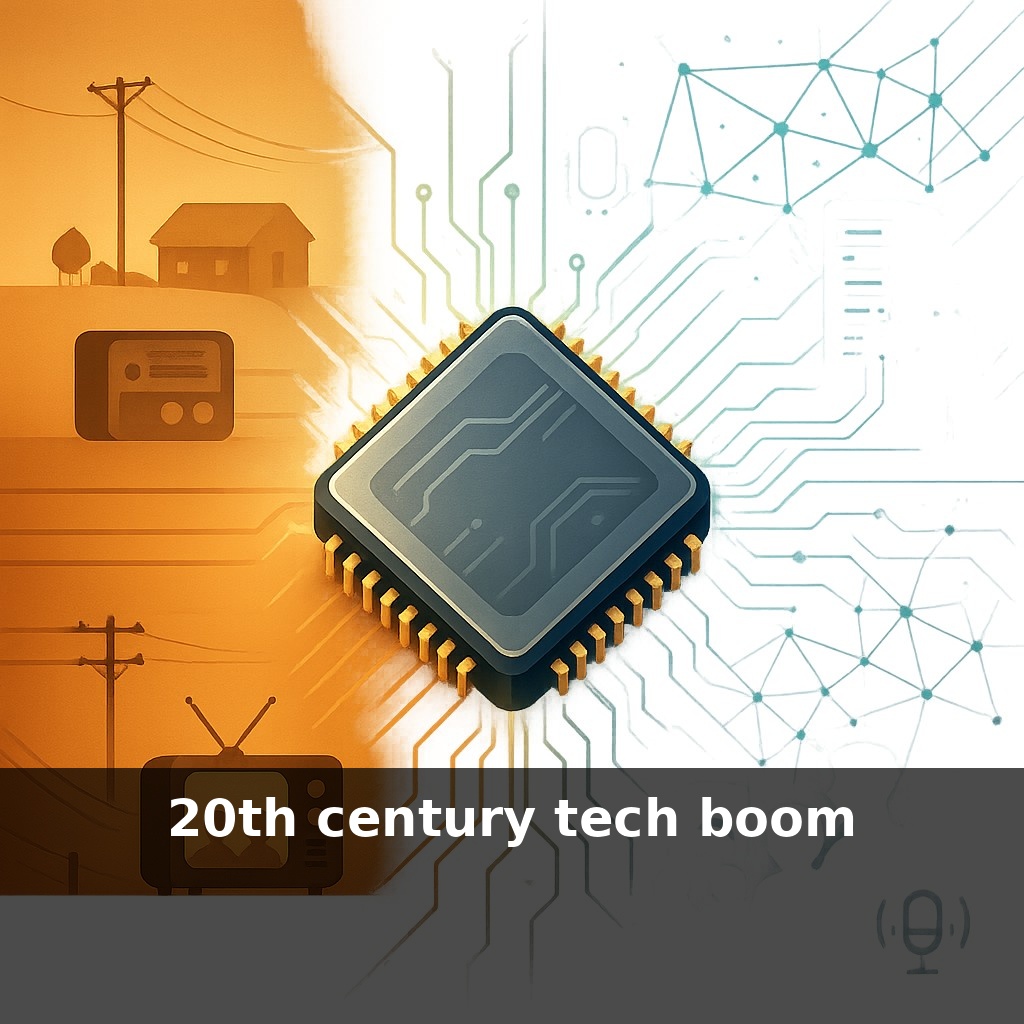
By the end of the 1900s, a single computer chip held more transistors than there were people on Earth. A farm kid with a crackly radio, a family around a black‑and‑white TV, an engineer wiring the first internet node—all part of one accelerating technological story.
In 1900, most Americans still lit their homes with gas and sent messages at the speed of a horse or a wire; by 2000, a teenager could fire off an email that crossed a continent in less than a blink. The century between wasn’t just busy—it was compressed, like history on fast‑forward. Telegraph wires gave way to telephone lines, then radio waves, then satellite links quietly stitching together oceans and time zones. A family gathering around the living‑room set for the first live Olympic broadcast from Tokyo was experiencing something as new—and disorienting—as early railroad passengers who suddenly found distant cities pulled within a day’s travel. As venture capital chased bolder ideas into Silicon Valley garages, the gap between “science fiction” and “normal Tuesday” kept shrinking, until connectivity felt less like a marvel and more like the air everyone breathed.
By mid‑century, the United States had quietly turned laboratories and defense contracts into engines of civilian life. Wartime codebreakers evolved into early computer scientists; Cold War rocket races financed the launch pads for global communication. The transistor’s tiny switch unlocked portable radios that slipped into pockets, while integrated circuits shrank room‑sized machines into office companions that hummed beside filing cabinets. Venture capital sniffed out opportunity in Bay Area garages, treating bold prototypes like unsigned bands—high‑risk acts that, with enough backing, might suddenly headline the world.
The real surprise of the 20th‑century tech boom is how ordinary it felt while it was happening. People weren’t walking around saying, “History is compressing”; they were just buying new gadgets, upgrading office equipment, and trying to keep up with the latest “must‑have” device.
Early in the century, communications advances mostly meant new kinds of infrastructure: switchboards, microwave relay towers, coaxial cables under streets and oceans. These were big, physical projects that required crews, cranes, and government regulators. Yet behind the scenes, another revolution was quietly shifting from steel and copper to sand—specifically, purified silicon. When researchers learned how to etch microscopic patterns into that silicon, they turned a raw material as common as beach sand into the most valuable real estate on Earth.
As engineers crammed more components into smaller spaces, something subtle but important happened: technology moved closer to the user. What began as giant machines in corporate basements crept onto desktops, then into backpacks, and eventually into pockets. Each step inward changed who had power. Telegraphs and early telephones were tools of businesses and governments; portable calculators, game consoles, and home computers gave individual people computational leverage that would have looked like science fiction to a 1930s engineer.
This shift also changed how new ideas spread. Mid‑century innovations often depended on top‑down decisions—Bell Labs researchers making a breakthrough, or a federal agency approving a new broadcast standard. By the late 20th century, a small startup could write software in a rented office, ship it on floppy disks or over early network connections, and suddenly alter how millions worked or played. Silicon Valley venture capitalists poured billions into these long‑shot bets, accepting that nine out of ten might fail if the tenth rewrote the rules.
Think of the century’s progress the way a physician watches a patient’s chart: the vital signs don’t just rise steadily—they hit inflection points, where a small change in treatment suddenly improves everything else. Better microelectronics didn’t just make cheaper radios; they made possible global positioning, digital imaging, encryption, and the control systems that guide aircraft and spacecraft. By 2000, the United States had built not just faster tools, but an entire ecosystem where connectivity, computation, and capital constantly amplified one another—and where “normal life” depended on technologies that barely existed a generation before.
By the late 1900s, an office worker could start the morning sorting faxes, spend lunch trading instant messages, and go home to a living room where the latest game console quietly relied on the same kinds of chips once reserved for military projects. A doctor in Boston might review digital scans from a rural clinic hundreds of miles away, using satellite links and fiber lines that made distance feel more like a routing choice than a barrier. A small mail‑order catalog in Wisconsin could morph into an early e‑commerce site, taking orders at midnight from customers they would never meet. Music fans went from saving for a single record to burning custom CDs, then downloading tracks from strangers’ hard drives, long before streaming felt routine. Even classroom filmstrips evolved into educational TV, then interactive software, and finally web‑based lessons. Each domain—medicine, retail, entertainment, education—quietly rewrote its own rules as new tools slipped from labs into everyday hands.
Policies now lag inventions the way a cautious driver trails an ambulance—following the route, never setting the pace. As quantum labs, brain‑inspired chips, and swarms of low‑orbit satellites move from prototype to product, American choices about education, privacy, and monopoly power will harden into new infrastructure. The risk isn’t just unequal access, but unequal influence over the algorithms quietly grading, hiring, lending, and voting alongside us.
The 20th‑century boom didn’t end; it changed tempo. Today’s code, sensors, and low‑cost launches extend that arc, like a jazz band riffing on a familiar standard instead of starting a new song. Your challenge this week: notice every time you “wait” for tech—a loading bar, a dead zone, a lag—and ask: if this delay vanished, what new behavior would quietly appear?